
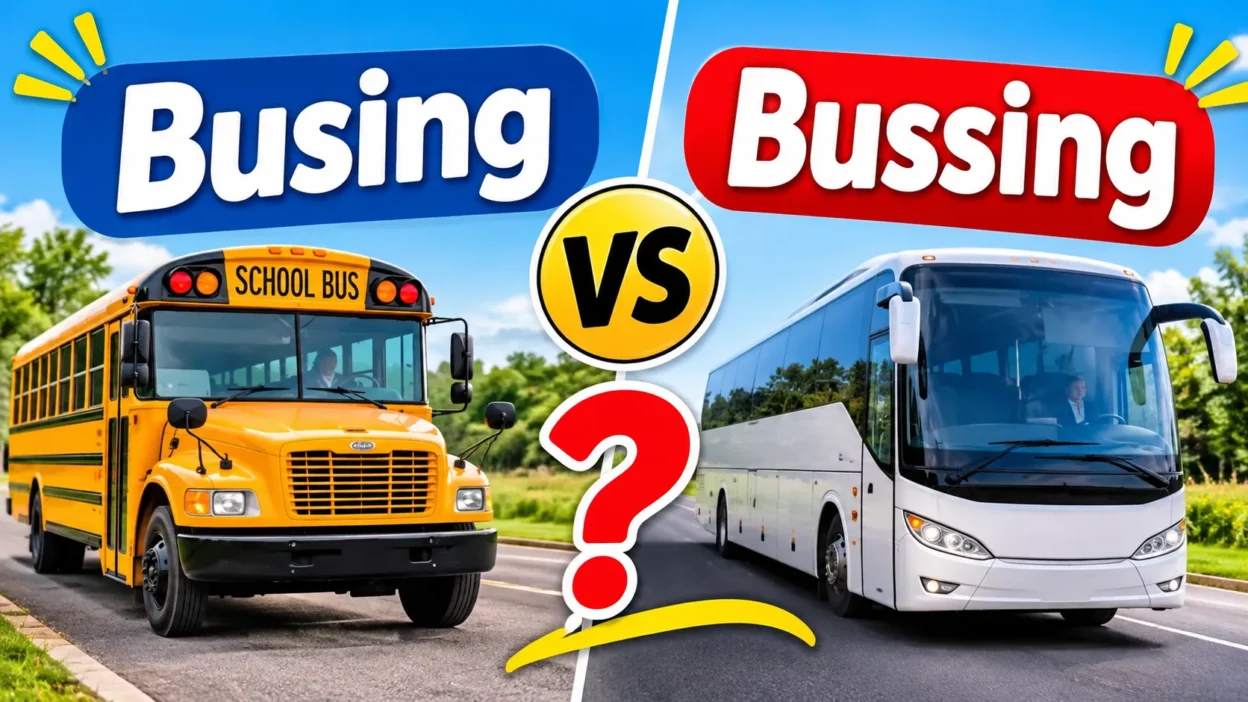
Is it busing or bussing? Both spellings are correct, but busing is the more common spelling for the act of transporting people by bus, especially in American English. Bussing is a recognized alternative spelling of the same word. However, in restaurant work, bussing tables means clearing used dishes, wiping tables, and preparing them for new customers.
The confusion comes from the way English forms words by adding endings. Some words double their final consonant before adding -ing, while others do not. The word bus has two accepted spellings in this context, which is why you may find both busing and bussing in dictionaries and everyday writing. This guide explains their meanings, spelling rules, differences, and uses, with practical examples to help you choose the right form.
Quick Answer: Busing or Bussing?
Both busing and bussing are correct spellings. Busing is the standard and more common spelling for transporting people by bus, including school transportation. Bussing is a less common variant for this meaning and is also widely used for clearing tables in restaurants. Choose the spelling that fits your meaning and audience.
Why Do People Confuse Busing and Bussing?
People often confuse busing vs. bussing because both spellings are associated with the verb bus. They look almost identical, but one has a single final s, while the other has a double s.
The confusion becomes easier to understand when you look at their uses:
- Busing: Commonly means transporting people by bus.
- Bussing: An accepted, less common spelling for transporting people by bus.
- Bussing tables: Means clearing used plates, glasses, and other items from restaurant tables.
Another reason for the confusion is that English spelling rules do not always work in the same way for every word. Some verbs double their final consonant before adding -ing, while others keep their original spelling.
Importantly, bussing is not always a spelling mistake. It is a recognized variant of busing and has an established use in the restaurant industry.
What Does Busing Mean?
Busing is the act of transporting people from one place to another by bus. It is the present participle or gerund form of the verb bus.
The word can describe ordinary transportation, such as taking passengers to an airport, or organized transportation, such as providing school buses for students.
Busing in School Transportation
One common use of busing is in education. Schools and school districts arrange transportation to take students between their homes, schools, and other locations.
For example:
- The school district provides busing for students who live far away.
- The school is busing children to the science museum.
- Parents complained about several problems with school busing.
- The district arranged busing for students attending a different school.
Busing and School Desegregation
Busing also has a specific historical meaning in American education. It can refer to transporting students to schools outside their residential neighborhoods as part of efforts to achieve racial balance and reduce school segregation.
In this context, school busing or desegregation busing describes a transportation policy rather than simply a regular school bus service.
For example:
- The court ordered busing to help desegregate public schools.
- The community debated the proposed school busing plan.
- The history of desegregation busing remains an important subject in American education.
Therefore, the word busing can refer to everyday bus transportation as well as a particular policy in the history of American schools.
What Does Bussing Mean?
Bussing has two main uses. It can mean transporting people by bus, as a variant spelling of busing. It also refers to clearing tables in restaurants.
The restaurant meaning is especially common in everyday American English. A restaurant worker who performs this task is called a busser.
Bussing Tables in Restaurants
Bussing tables means removing used plates, glasses, silverware, and other items after customers finish eating. It may also include wiping tables and preparing them for the next customers.
A person who does this work helps keep the dining area clean and organized.
Examples:
- She is bussing tables at a busy restaurant.
- He got his first job bussing tables after school.
- The restaurant hired two employees for bussing duties.
- The staff finished bussing tables before closing.
Bussing as Transportation
Bussing can also appear as a variant spelling of busing when describing transportation by bus.
For example:
- The school is bussing students to a nearby sports center.
- The organization arranged bussing for visitors.
- The district discussed bussing students between schools.
Although this spelling is accepted, busing is generally the more familiar choice for transportation in American English.
Busing vs. Bussing: What’s the Difference?
The main difference is spelling preference and context. Both can describe transportation by bus, but bussing has an additional common meaning in restaurant work.
| Feature | Busing | Bussing |
| Spelling | One final s | Double s |
| Meaning | Transporting people by bus | Transporting people by bus; clearing restaurant tables |
| School transportation | Common | Accepted variant |
| Public transportation | Common | Accepted variant |
| Restaurant table clearing | Not the usual spelling | Common |
| American English | Preferred for transportation | Common for restaurant work |
| Example | Busing students to school | Bussing tables at a restaurant |
The easiest way to understand the difference is to remember that busing is the usual spelling for bus transportation, while bussing tables refers to restaurant cleaning duties.
When Should You Use Busing or Bussing?
The right spelling depends on what you are trying to describe.
When to Use Busing
Use busing when referring to the transportation of people by bus. It is especially suitable for American English writing.
Common situations include:
- School busing: Transporting students to and from school.
- Public busing: Providing transportation for passengers.
- Student busing: Taking students to another school or location.
- Desegregation busing: Transporting students as part of a school integration policy.
- Employee busing: Taking workers to a workplace or event.
Examples:
- The school district provides busing for children in rural areas.
- The city introduced free busing for event visitors.
- The company is busing employees to the new office.
- Parents requested better school busing services.
- The court discussed a plan for busing students between neighborhoods.
When to Use Bussing
Use bussing when referring to clearing tables in a restaurant. You may also encounter it as an alternative spelling for transporting people by bus.
Common restaurant situations include:
- Bussing tables: Removing used dishes and cleaning tables.
- Restaurant bussing: Keeping dining areas clean.
- Bussing duties: Tasks performed by restaurant bussers.
- Bussing staff: Employees responsible for clearing tables.
Examples:
- She works evenings bussing tables.
- The restaurant needs another employee for bussing duties.
- He started bussing tables during the summer.
- The staff are bussing the dining area after lunch.
- The manager thanked everyone for helping with bussing.
15 Examples of Busing and Bussing in Sentences
These examples show how both spellings work in everyday English.
Examples of Busing
- The school is busing students to the history museum.
- Public busing is available for residents in the area.
- The district provides free busing for eligible students.
- The company arranged busing for its employees.
- The city is busing passengers during the road closure.
- The parents raised concerns about school busing.
- The court ordered busing as part of a school desegregation plan.
- The organizers are busing visitors to the event.
Examples of Bussing
- She is bussing tables at a local restaurant.
- He found a part-time job bussing after school.
- The restaurant hired a new worker for bussing duties.
- The staff finished bussing tables before the next customers arrived.
- Everyone helped with bussing during the busy dinner shift.
- The restaurant manager explained the rules for bussing tables.
- The school is bussing students to a nearby sports center.
Notice that the final example uses bussing as a variant for transportation. The spelling does not automatically make the meaning different; the surrounding sentence tells you how the word is being used.
Common Mistakes When Using Busing and Bussing
Even though both forms are accepted, writers can make mistakes when they ignore the meaning or use an unfamiliar spelling.
1. Thinking Bussing Is Always Incorrect
Bussing is a recognized English spelling. It is an accepted variant of busing and is commonly used for clearing restaurant tables.
Incorrect assumption: Bussing is always a spelling error.
Correct understanding: Both spellings are accepted, but their common uses can differ.
2. Using Busing When You Mean Restaurant Table Clearing
When describing restaurant work, bussing tables is the familiar spelling.
Example:
- Correct: She is bussing tables after dinner.
- Less usual: She is busing tables after dinner.
3. Assuming Busing Only Refers to School Transportation
Busing is not limited to schools. It can describe transporting passengers, employees, visitors, and other groups of people by bus.
Example: The company arranged busing for conference guests.
4. Confusing Busing with Desegregation Busing
Although the word can describe a school transportation service, it also has a specific historical meaning connected to school integration in the United States.
Desegregation busing refers to transporting students to schools outside their neighborhoods to help achieve racial balance.
5. Treating Both Spellings as Completely Different Words
The spellings overlap in meaning when they refer to transportation. The distinction is not simply that one word means transportation and the other always means restaurant work.
Memory Trick: How to Remember Busing vs. Bussing
Use these simple reminders:
- Busing = Bus transportation. Think about a bus carrying students, passengers, or workers.
- Bussing = Bussing tables. Think about a restaurant worker collecting plates and cleaning tables.
Remember the phrase “bussing tables” to connect the double s with restaurant work.
If you are writing about school transportation or public transportation in American English, choose busing. If you are describing restaurant duties, choose bussing.
Is Busing or Bussing Used in American and British English?
Both spellings are recognized in English, but their popularity and common uses can vary.
American English
In American English:
- Busing is the more common spelling for transporting people by bus.
- Bussing is a recognized alternative spelling for transportation.
- Bussing tables is the usual expression for clearing tables in restaurants.
For example: The school district provides busing for students, while the restaurant staff are bussing tables.
British English
In British English, busing and bussing can both be encountered as spellings for transportation by bus. Usage may vary by publication and context.
For formal writing, follow the spelling convention used by your school, publisher, or chosen style guide. The restaurant expression bussing tables is also understandable in English, although restaurant terminology can vary between regions.
Related Words: Bus, Busing, Bussing, Bused, and Bussed
Learning related words can help you understand how these spellings are formed.
| Word | Meaning | Example |
| Bus | A vehicle or the verb meaning to transport by bus | They bus students to school. |
| Busing | The act of transporting people by bus | The school provides busing. |
| Bussing | An alternative spelling of busing; also clearing tables | She is bussing tables. |
| Bused | Transported by bus | The students were bused to the museum. |
| Bussed | An alternative spelling of bused; also used for restaurant table clearing | He bussed the tables. |
| Busser | A restaurant worker who clears tables | The busser collected the plates. |
Busing vs. Bused
Busing is the -ing form of bus, while bused is a past-tense or past-participle form.
- The school is busing students to the event.
- The school bused students to the event.
Bussing vs. Bussed
Bussing is the -ing form, while bussed is a past-tense or past-participle spelling used in contexts such as restaurant table clearing.
- She is bussing tables.
- She bussed the tables after dinner.
Final Verdict: Which Spelling Should You Choose?
Both busing and bussing are correct English spellings. The best choice depends on the meaning and the audience.
- Choose busing for transporting people by bus, especially in American English.
- Choose bussing for clearing tables in restaurants.
- Remember that bussing is also an accepted, less common variant for transportation.
If you are writing about school busing, public transportation, or desegregation busing, the spelling busing is generally the safest choice in American English. If you are describing a restaurant employee collecting dishes and cleaning tables, use bussing.
Frequently Asked Questions
1. Is it busing or bussing?
Both busing and bussing are correct. Busing is the more common spelling for transporting people by bus, while bussing is a recognized alternative and is also commonly used for clearing restaurant tables.
2. Is bussing a real word?
Yes, bussing is a real English word. It can be used as a variant of busing and also describes the restaurant task of clearing used dishes and cleaning tables.
3. Is busing one S or two?
Busing has one final s before the -ing ending. It is the more common spelling for transporting people by bus in American English. The alternative spelling bussing has two final s letters.
4. What does busing mean?
Busing means transporting people from one place to another by bus. It can refer to school transportation, public transportation, or organized transportation for employees and visitors. It can also refer to transporting students to schools outside their neighborhoods to help achieve racial balance.
5. What does bussing mean in a restaurant?
In a restaurant, bussing means clearing used plates, glasses, and silverware from tables, wiping the surfaces, and preparing the tables for new customers. A person who performs this work is called a busser.
6. Is bussing tables or busing tables correct?
Bussing tables is the familiar and standard expression in American English for clearing restaurant tables. It describes collecting used dishes and cleaning tables after customers finish eating.
7. Is busing the same as school desegregation?
Not always. Busing generally means transporting people by bus. However, desegregation busing specifically refers to transporting students to schools outside their neighborhoods as part of efforts to reduce racial segregation and achieve racial balance in schools.
8. Is bussing an accepted variant of busing?
Yes. Bussing is recognized as a less common spelling variant of busing when the word means transporting people by bus. Both spellings are accepted, although busing is generally more common for this meaning in American English.
Remember This
- Busing means transporting people by bus.
- Bussing is an accepted variant spelling of busing.
- Bussing tables means clearing used dishes and cleaning restaurant tables.
- School busing can refer to ordinary student transportation.
- Desegregation busing refers to transporting students to help achieve racial balance in schools.
- The best spelling depends on the meaning and your audience.
Conclusion
The difference between busing and bussing is mainly a matter of spelling preference and context. Both forms are correct, and both can refer to transporting people by bus. However, busing is the more common spelling in American English for school transportation, public transportation, and other bus services. It is also used in the historical expression desegregation busing, which refers to transporting students as part of efforts to reduce school segregation.
On the other hand, bussing is especially familiar in the restaurant industry, where bussing tables means collecting used dishes and preparing tables for new customers. It is also an accepted alternative spelling for transportation by bus. Remember these common uses, consider your audience, and choose the spelling that makes your meaning clear.