
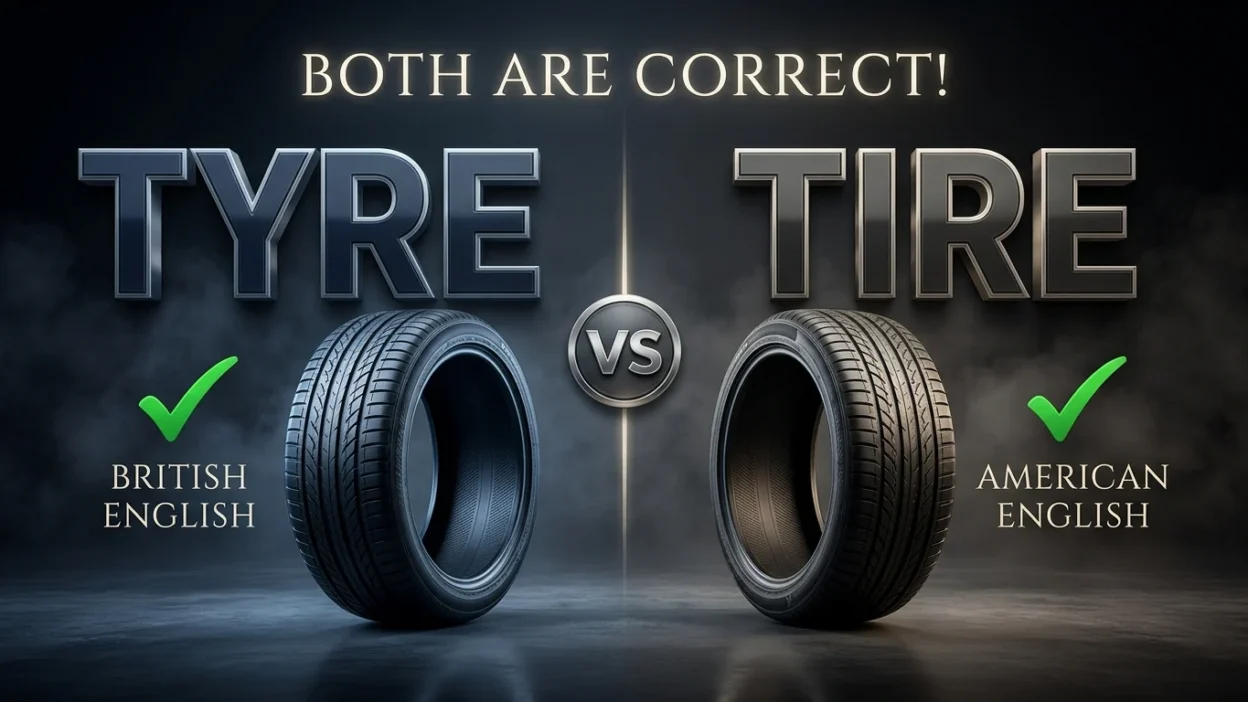
Have you ever wondered whether the correct spelling is tyre or tire? Both spellings are correct, but the right choice depends on the type of English you are using.
Tyre is the standard British English spelling for the rubber covering around a vehicle’s wheel, while tire is the preferred American English spelling. Although they look different, both words have the same meaning and pronunciation when referring to a vehicle.
The difference between tyres and tires is more than a simple spelling preference. It reflects the regional differences between British and American English. People in the United Kingdom, Australia, New Zealand, and Ireland generally write tyre, while Americans and Canadians commonly use tire.
The word tire also has another meaning: to become tired or exhausted. Understanding these differences will help you choose the correct spelling, write naturally for your audience, and avoid confusion when discussing car tyres, tire pressure, flat tyres, or vehicle wheels.
Quick Answer: Tyre or Tire?
Tyre is the correct British English spelling, while tire is the standard American English spelling for the rubber covering around a vehicle’s wheel. Both words have the same meaning and pronunciation. Use tyre for British-style writing and tire for American-style writing. The plural forms are tyres and tires, respectively.
Why Do People Confuse Tyre and Tire?
People often confuse tyre and tire because both spellings describe the same vehicle component. There is no difference in their meaning when they refer to the rubber covering fitted around a wheel. The difference comes from regional English spelling conventions.
British and American English developed different spelling preferences over time. Some words retained their traditional British forms, while American English adopted alternative spellings.
For example:
- Colour vs Color: British English uses colour, while American English uses color.
- Centre vs Center: British English uses centre, while American English uses center.
- Favourite vs Favorite: British English uses favourite, while American English uses favorite.
- Tyre vs Tire: British English uses tyre, while American English uses tire.
Another reason for the confusion is that tire has two meanings in English. It can refer to a vehicle’s rubber covering or describe the action of becoming tired or exhausted. The context helps readers understand which meaning is intended.
What Does Tyre Mean?
Tyre is a noun used in British English to describe the rubber covering fitted around the outer edge of a vehicle’s wheel. It is an important part of a vehicle because it provides grip on the road, supports the vehicle’s weight, and helps absorb shocks from uneven surfaces.
A tyre is used on different types of vehicles, including cars, motorcycles, bicycles, buses, and trucks.
Common expressions include:
- Car tyre: A tyre fitted to a car.
- Flat tyre: A tyre that has lost air or cannot maintain its proper pressure.
- Spare tyre: An additional tyre carried for emergencies.
- Tyre pressure: The amount of air pressure inside a tyre.
- Tyre tread: The patterned surface that touches the road.
- Tyre replacement: Changing an old or damaged tyre for a new one.
Examples of Tyre in Sentences
- My car needs a new tyre before the long journey.
- The mechanic repaired the damaged tyre.
- Always check your tyre pressure before driving.
- One of the rear tyres has a small puncture.
- She bought four new car tyres last week.
- The bicycle tyre needs more air.
- His spare tyre was stored in the boot.
- The garage offers affordable tyre replacement services.
In all these examples, tyre follows British English spelling conventions.
What Does Tire Mean?
Tire is the standard American English spelling for the same rubber covering fitted around a vehicle’s wheel. It performs the same function as a British tyre by providing road traction, supporting the vehicle, and helping maintain stability while driving.
In the United States, drivers, mechanics, vehicle manufacturers, and automotive businesses generally use tire instead of tyre.
Common expressions include:
- Car tire: A rubber covering fitted around a car wheel.
- Flat tire: A tire that has lost air or become punctured.
- Spare tire: An extra tire kept for emergencies.
- Tire pressure: The air pressure inside a tire.
- Tire tread: The patterned outer surface of a tire.
- Tire rotation: Moving tires between different wheel positions to help promote even wear.
- Tire repair: Fixing a damaged or punctured tire.
Examples of Tire in Sentences
- My car needs a new tire before the road trip.
- The mechanic replaced the damaged tire.
- Check your tire pressure regularly.
- One of my front tires has lost air.
- I purchased four new car tires yesterday.
- The bicycle tire has a small hole.
- He keeps a spare tire in the trunk.
- The shop offers affordable tire replacement services.
These examples show how tire is used in American English.
Tyre vs Tire: What Is the Difference?
The main difference between tyre and tire is regional spelling. Both words describe the same vehicle component, have the same pronunciation, and function as nouns when referring to a wheel covering.
| Feature | Tyre | Tire |
| Spelling | Tyre | Tire |
| English variety | British English | American English |
| Meaning | Rubber wheel covering | Rubber wheel covering |
| Pronunciation | /taɪər/ | /taɪər/ |
| Part of speech | Noun | Noun |
| Plural form | Tyres | Tires |
| Common usage | UK, Australia, New Zealand | USA, Canada |
| Example | Flat tyre | Flat tire |
| Correct spelling | Yes | Yes |
Neither spelling is universally better or more correct. Your choice depends on your intended audience and the English spelling style you follow.
When Should You Use Tyre or Tire?
Choosing the correct spelling becomes easy when you know where your readers are from.
When to Use Tyre
Use tyre when writing in British English or following a spelling convention that uses the British form.
It is commonly preferred in:
- United Kingdom
- Ireland
- Australia
- New Zealand
Examples:
- The car needs a replacement tyre.
- Check your tyre pressure before travelling.
- The garage sells high-quality tyres.
- My bicycle has a flat tyre.
- The mechanic inspected all four tyres.
When to Use Tire
Use tire when writing in American English or following North American spelling conventions.
It is commonly preferred in:
- United States
- Canada
Examples:
- I need a new tire for my car.
- The mechanic checked all four tires.
- My front tire has lost pressure.
- The shop sells different types of tires.
- He replaced the damaged tire yesterday.
Writing tip: Choose one regional spelling and use it consistently throughout your article, assignment, or professional document. Avoid switching between tyre and tire without a reason.
Is Tyres or Tires the Correct Plural?
Both tyres and tires are correct plural forms. The spelling depends on whether you are using British or American English.
- Tyre → Tyres: British English.
- Tire → Tires: American English.
For example:
British English: My car needs four new tyres.
American English: My car needs four new tires.
You should not write tyres when following standard American spelling or tires when following standard British spelling for the vehicle component.
The same rule applies to related expressions:
| British English | American English |
| Car tyres | Car tires |
| Flat tyres | Flat tires |
| Spare tyres | Spare tires |
| Winter tyres | Winter tires |
| Tyre pressure | Tire pressure |
| Tyre tread | Tire tread |
| Tyre repair | Tire repair |
| Tyre replacement | Tire replacement |
Does Tire Have More Than One Meaning?
Yes. The word tire has more than one meaning in English. It can refer to a vehicle’s rubber wheel covering, but it can also be used as a verb meaning to become tired, weary, or exhausted.
This second meaning is used in both British and American English.
Tire as a Noun
As a noun in American English, tire means the rubber covering around a vehicle’s wheel.
Example: The front tire needs to be replaced.
In British English, this vehicle component is normally called a tyre.
Tire as a Verb
As a verb, tire means to make someone tired or to become weary.
Examples:
- Long walks tire me.
- Children sometimes tire after playing outside.
- I never tire of listening to good music.
- The long journey began to tire everyone.
Notice that British English also uses tire for this verb. It does not change to tyre.
This distinction is important because the spelling depends on the meaning as well as the regional convention.
Why Does Tire Also Mean to Become Tired?
The verb tire has an older history than the modern automotive meaning. It comes from Old English tēorian, associated with becoming weary, failing, or becoming exhausted.
Over time, the verb developed into the modern English word tire.
The vehicle-related word has a separate spelling history. Although both words are spelled tire in American English, they are not the same word historically.
This explains why British English uses two different spellings:
- Tyre: The rubber covering around a vehicle’s wheel.
- Tire: To become tired or exhausted.
Understanding the context makes it easier to recognize which meaning is being used.
Where Does the Word Tyre Come From?
The history of tyre is interesting because its exact origin is not completely certain.
One traditional explanation connects the word with attire, suggesting that a wheel was dressed or covered with an outer layer. However, this is a proposed explanation rather than a universally established origin.
Historically, wheels were fitted with different outer coverings to protect them and improve their performance. As rubber technology developed, rubber became the material commonly associated with modern vehicle tyres.
The spelling tyre became established in British English, while tire became the standard American spelling.
How Old Are the Words Tyre and Tire?
The spelling history of these words developed over several centuries.
The word tyre appeared in English in earlier forms, while the spelling tire also became established over time. The precise historical development is more complicated than simply saying that one spelling replaced the other.
The modern distinction became especially important as British and American English developed separate spelling conventions.
The invention and growth of rubber tyres for vehicles helped make both spellings widely recognizable. Today, the difference remains primarily regional rather than a difference in meaning.
Is There a Difference Between a Tyre and a Wheel?
Yes. A tyre and a wheel are related vehicle components, but they are not the same thing.
A tyre is the rubber covering fitted around the outer edge of a wheel. The wheel is the structural component that connects to the vehicle and supports the tyre.
Here is a simple explanation:
- Tyre: The rubber component that makes contact with the road.
- Wheel: The assembly that supports the tyre and connects to the vehicle.
- Rim: The outer part of the wheel on which the tyre is mounted.
For example, when someone says they have a flat tyre, it usually means the rubber covering has lost air or been punctured, not that the entire wheel is damaged.
Understanding the difference between a tyre, wheel, and rim is useful when discussing vehicle maintenance and repairs.
What Are the Main Parts of a Tyre or Tire?
Modern vehicle tyres contain several components that work together to support the vehicle and provide safe contact with the road.
Some important parts include:
- Tread: The patterned outer surface that touches the road and provides grip.
- Sidewall: The outer side of the tyre between the tread and bead.
- Bead: The reinforced edge that helps secure the tyre to the wheel rim.
- Carcass: The main structural body of the tyre.
- Inner liner: The airtight inner layer used in many tubeless tyres.
These parts help a tyre maintain its shape, carry weight, and perform under different driving conditions.
Tyre vs Tire in Different English-Speaking Countries
Although the difference is often described as British versus American English, other countries also have their own spelling preferences.
| Country | Common spelling |
| United Kingdom | Tyre |
| Ireland | Tyre |
| Australia | Tyre |
| New Zealand | Tyre |
| United States | Tire |
| Canada | Tire |
Australian, New Zealand, and Irish English generally follow British spelling for this word. Canadian English commonly uses tire, following North American usage.
If you are writing for an international audience, either spelling can be understood. However, matching the spelling used by your intended readers makes your writing more natural.
Common Mistakes When Using Tyre and Tire
Even though both spellings are correct, writers sometimes make mistakes when choosing between them.
Here are some common errors to avoid.
1. Thinking tyre is incorrect
Tyre is not a misspelling. It is the standard British English spelling for the vehicle component.
2. Thinking tire is always American
Tire is also used in British English as a verb meaning to become exhausted.
3. Mixing British and American spellings
Incorrect in consistent British English: My car has four new tires.
Correct: My car has four new tyres.
Incorrect in consistent American English: My car has four new tyres.
Correct: My car has four new tires.
4. Using the wrong plural form
British English: One tyre, two tyres.
American English: One tire, two tires.
5. Confusing a tyre with a wheel
A tyre is the outer rubber covering, while a wheel is the supporting component fitted to the vehicle.
6. Assuming the words have different pronunciations
Tyre and tire are pronounced the same way when referring to the vehicle component.
Memory Trick: How to Remember Tyre vs Tire
A simple memory trick can help you remember which spelling to use.
- Tyre = British English: Remember the Y in tyre as the spelling used in the UK.
- Tire = American English: Remember the I in tire as the spelling used in the USA.
You can also remember this sentence:
British cars have tyres, while American cars have tires.
For the verb meaning to become exhausted, always use tire, regardless of whether you are writing British or American English.
Similar British and American Spelling Differences
Tyre and tire are not the only words with different British and American spellings. Many everyday English words have regional variations.
| American English | British English |
| Tire | Tyre |
| Color | Colour |
| Favorite | Favourite |
| Center | Centre |
| Theater | Theatre |
| Analyze | Analyse |
| Defense | Defence |
| Traveling | Travelling |
| Gray | Grey |
| Organize | Organise |
| License (noun and verb) | Licence (noun), license (verb) |
| Check | Cheque (banking sense) |
Learning these British vs American spelling differences can help you improve your vocabulary and write more confidently for different English-speaking audiences.
Frequently Asked Questions
1. Is it spelled tyre or tire?
Both spellings are correct. Tyre is the standard British English spelling, while tire is the standard American English spelling for the rubber covering around a vehicle’s wheel.
2. Is tyre British or American?
Tyre is British English spelling. It is also commonly used in Australia, New Zealand, and Ireland. American English uses tire.
3. Why do British people spell tire as tyre?
British English retained the spelling tyre for the vehicle component, while American English standardized tire. These differences developed as regional English spelling conventions evolved.
4. Is tires or tyres the correct plural?
Both are correct, depending on the regional spelling. Tyres is the British English plural, while tires is the American English plural.
5. Is tire incorrect in British English?
No. Tire is a correct British English verb meaning to become tired or exhausted. However, when referring to the rubber covering around a vehicle’s wheel, British English uses tyre.
6. Do tyre and tire have the same pronunciation?
Yes. Both words have the same pronunciation, generally represented as /taɪər/. The difference is in spelling, not pronunciation.
7. Is tyre used in Australia and Canada?
Australia generally uses tyre, following British English spelling. Canada commonly uses tire, following North American spelling conventions.
8. What is the difference between a tyre and a wheel?
A tyre is the rubber covering fitted around a wheel. The wheel is the structural component that connects to the vehicle and supports the tyre. They work together but are not the same part.
Remember This
- Tyre is the standard British English spelling.
- Tire is the standard American English spelling.
- Tyres is the British plural form.
- Tires is the American plural form.
- Both words have the same meaning and pronunciation when referring to a vehicle’s rubber covering.
- Tire can also mean to become tired or exhausted in both British and American English.
- A tyre is different from a wheel or rim.
- Use one regional spelling consistently throughout your writing.
Conclusion
The difference between tyre and tire is mainly a matter of British and American English spelling. Tyre is the preferred spelling in the United Kingdom, Australia, New Zealand, and Ireland, while tire is commonly used in the United States and Canada. Both words describe the same rubber covering fitted around a vehicle’s wheel, and neither spelling is wrong when used in the appropriate regional context.
Remember that tire has an additional meaning as a verb, describing the act of becoming tired or exhausted. This spelling remains the same in both British and American English. Whether you are writing about car tyres, flat tires, tyre pressure, tire tread, or vehicle maintenance, choosing the spelling that matches your audience will make your English clearer and more consistent.