
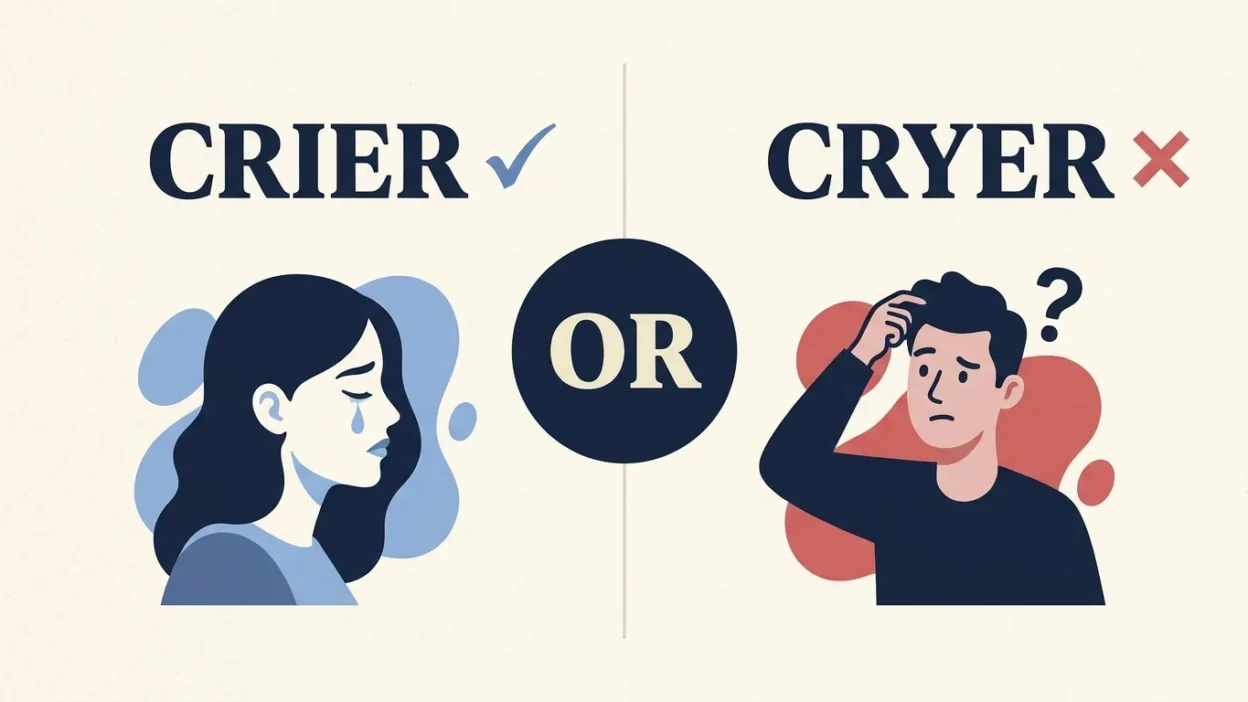
Have you ever wondered whether crier or cryer is the correct spelling? Both forms look natural and sound very similar, but they are not equally common in modern English.
If you are writing about someone who cries easily or a person who announces news in public, crier is the standard spelling. The word appears in everyday expressions such as a frequent crier and a town crier.
The spelling cryer also exists, but it is much less common as an ordinary noun. It may appear in older texts as a historical spelling variant, in discussions about English spelling, or as a person’s surname.
Understanding this difference helps you avoid spelling mistakes while recognizing that not every occurrence of cryer is incorrect.
If you are learning English, checking your writing, or looking for the meaning of crier vs. cryer, this guide explains the definitions, spelling rules, history, pronunciation, examples, and correct usage of both forms.
Quick Answer:
Crier is the preferred modern spelling for a person who cries or someone who announces news publicly. Cryer is a much less common historical or variant spelling and also occurs as a surname. For ordinary modern writing, choose crier. Keep Cryer when it is someone’s established name or when reproducing a historical spelling.
Example: She is not usually a crier, but the movie made her emotional.
Why Do People Confuse Crier and Cryer?
The confusion between crier and cryer comes from their similar pronunciation and the way English forms nouns from verbs. Both spellings are generally pronounced like “CRY-er,” so hearing the word does not tell you which spelling to use.
The spelling cryer may seem logical because it looks like the verb cry with the ending -er. However, English spelling conventions often change the final y to i when certain endings are added. This pattern helps explain why crier is the established spelling.
Historical spelling variation is another reason readers encounter cryer. English spelling was less standardized in earlier periods, and older documents sometimes preserve forms that are now uncommon.
The key distinction is straightforward: crier is the standard modern common noun, while cryer is a rare variant or a surname, depending on the context.
Crier: Meaning, Definition, and Examples
Crier is a noun with two main meanings. It describes someone who cries or weeps, especially someone who cries easily, and it can refer to a person who announces information publicly.
What Does Crier Mean?
According to standard dictionary usage, a crier can mean:
- A person who cries: Someone who sheds tears, particularly someone who cries frequently or easily.
- A public announcer: A person who calls out news, notices, or official information to people in a public place.
The second meaning is especially familiar in the expression town crier. Traditionally, a town crier announced important news, public notices, and official messages by calling them out in streets or marketplaces. Before modern mass communication, this role helped communities receive information.
The first meaning appears in everyday conversation. For example, someone might describe themselves as a big crier if they often cry during emotional films, weddings, or touching moments.
Examples of Crier in Sentences
- I am not usually a crier, but that movie made me tear up.
- My little brother has always been a frequent crier.
- The town crier announced the arrival of the royal visitors.
- She is a big crier whenever she watches a sad film.
- The historical festival featured a traditional town crier.
- Everyone stopped talking when the crier began announcing the news.
- The child was a sensitive crier when he was younger.
- The crier called out the latest public announcement in the marketplace.
In these examples, crier is used as a common noun rather than as a person’s name.
Cryer: Meaning, Definition, and Examples
Cryer is a less common spelling associated with the word crier. It may appear in historical material as a spelling variant, but it is not the preferred form for the ordinary noun in modern English. It is also used as a surname, where the spelling should remain unchanged.
What Does Cryer Mean?
The meaning of cryer depends on its context.
- Historical or variant spelling: Some older texts and records use cryer where modern English generally uses crier.
- Family name: Cryer appears as a surname. In this case, it is a proper noun and must follow the person’s established spelling.
- Discussion of spelling: Writers may use cryer when explaining the difference between crier and cryer.
It would be too broad to say that cryer never exists. The more accurate explanation is that it is much less common than crier as an ordinary English noun.
Examples of Cryer in Sentences
- The historical document preserved the older spelling cryer.
- The family name was recorded as Cryer.
- Jon Cryer is an example of a person whose surname uses this spelling.
- The researcher retained cryer when quoting the original document.
- The Cryer family attended the ceremony.
- The spelling guide explains why cryer is less common in modern usage.
Notice that the examples involving historical spelling refer to a particular source or context. In ordinary contemporary writing, use crier when you mean someone who cries or announces news.
Crier vs. Cryer: Key Differences
| Feature | Crier | Cryer |
| Standard modern spelling | Yes | No, not for the usual common noun |
| Main usage | A person who cries or announces news | Rare variant or surname |
| Part of speech | Common noun | Proper noun when used as a surname |
| Historical usage | Established form | May appear in older texts |
| Town announcer | Town crier | Rare historical variant |
| Pronunciation | Usually “CRY-er” | Usually “CRY-er” |
| Everyday writing | Preferred | Use only when context supports it |
| Example | She is a frequent crier. | The author’s surname is Cryer. |
The most important difference is standard modern usage. Although both spellings exist, crier is the usual choice for the common noun.
Origin and History of Crier and Cryer
The history of crier helps explain why the spelling may seem unusual to modern English learners.
The word developed from the verb cry, which can mean to weep, shout, or call out loudly. The noun crier is associated with the idea of someone who cries out or makes an announcement. Its history is linked to Middle English and Old French, where the French verb crier meant to shout or call out.
Historically, a town crier was an important public figure. Town criers announced royal proclamations, local regulations, public notices, and community news. They often used a loud voice or a bell to attract attention before delivering their message.
English spelling has changed over time. Before spelling became more standardized, writers sometimes used different forms of the same word. This historical variation helps explain why cryer may appear in older records.
How Does the Spelling Rule Work?
English has several words in which a final y changes to i when an ending is added:
- Cry → crier
- Try → trier
- Dry → drier
- Carry → carrier
- Apply → applier
These examples show a familiar spelling pattern, although English spelling rules have exceptions. In the case of crier, the established modern spelling uses i.
When Should You Use Crier?
Use crier in ordinary modern English when referring to a person who cries or a person who announces information publicly.
Use Crier When:
- You describe someone who cries easily.
- You refer to someone who cries frequently.
- You talk about a person who becomes emotional during films or other events.
- You describe a traditional public announcer.
- You use the expression town crier.
- You write about historical public announcements.
Examples of Correct Usage
Talking about yourself:
“I am not normally a crier, but that film made me emotional.”
Talking about a baby:
“The baby was a frequent crier during the night.”
Talking about movies:
“She is a big crier during sad films.”
Talking about history:
“The town crier announced the king’s message.”
Talking about public information:
“The crier called out the new rules in the town square.”
In each example, crier is the standard noun. It works in general, educational, professional, and formal writing whenever the meaning fits.
When Should You Use Cryer?
Use Cryer when it is the established spelling of a person’s surname. You may also need to preserve cryer when quoting an older document or discussing a historical spelling variant.
Use Cryer When:
- It is someone’s actual family name.
- You are referring to a person whose surname is spelled Cryer.
- You reproduce a historical record exactly.
- You discuss the spelling variant itself.
- You quote a source that deliberately uses this form.
Examples of Correct Usage
- Mr. Cryer will attend the meeting.
- The Cryer family moved to another town.
- Jon Cryer is known by that surname.
- The researcher preserved the original spelling cryer in the transcription.
- The article discusses the historical use of cryer.
Important: Do not change someone’s surname from Cryer to Crier. Proper names can preserve spellings that differ from the standard spelling of an ordinary word.
Crier or Cryer? 12 Everyday Examples
These sentences demonstrate how the two spellings work in different contexts.
- I am not usually a crier, but emotional stories make me tear up.
- The baby became a frequent crier during the night.
- The town crier announced the festival in the main square.
- She is a big crier whenever she watches a sad movie.
- The historical play featured a crier delivering an official message.
- Everyone listened carefully as the crier called out the announcement.
- The document listed the family name as Cryer.
- Mr. Cryer was invited to speak at the event.
- The Cryer family arrived early for the ceremony.
- The historian reproduced the spelling cryer from the original record.
- The teacher explained why crier is the preferred modern spelling.
- The spelling guide compared crier vs. cryer to help readers avoid mistakes.
The first six examples use crier as a common noun. The remaining examples show Cryer as a surname or cryer as a spelling discussed in a historical context.
Common Mistakes When Using Crier and Cryer
Knowing the correct spelling is easier when you understand the mistakes to avoid.
Mistake 1: Writing Cryer for Someone Who Cries
Less preferred in standard modern English:
“She is a frequent cryer.”
Preferred:
“She is a frequent crier.”
Use crier for someone who cries often.
Mistake 2: Writing Town Cryer Instead of Town Crier
Less preferred:
“The town cryer announced the news.”
Standard form:
“The town crier announced the news.”
The established expression is town crier.
Mistake 3: Assuming Cryer Is Never a Real Spelling
Overly broad statement:
“Cryer is not a real word.”
More accurate statement:
“Cryer is a rare variant or historical spelling and is also used as a surname.”
Context matters when evaluating uncommon spellings.
Mistake 4: Changing a Person’s Surname
Incorrect if the person’s actual surname is Cryer:
“Mr. Crier attended the meeting.”
Correct:
“Mr. Cryer attended the meeting.”
Always verify the spelling of a person’s name rather than applying a general spelling rule to it.
Mistake 5: Assuming Pronunciation Determines Spelling
Both forms are generally pronounced alike. That does not mean they are equally preferred in modern writing.
When you are unsure, consider the meaning and context instead of relying only on pronunciation.
Mistake 6: Confusing Crier With Crying
These words have different grammatical functions:
- Crier: A noun describing a person.
- Crying: The -ing form of the verb cry.
Examples:
- The baby is crying.
- The baby is a frequent crier.
Both sentences are correct, but they do not mean exactly the same thing.
Easy Memory Trick: How to Remember Crier vs. Cryer
A simple way to remember the standard spelling is:
Cry → Crier
Think of the final y changing to i before the ending -er. Similar patterns appear in try → trier and dry → drier.
You can also remember this short sentence:
“A crier cries; a Cryer may be someone’s name.”
Use crier when describing someone who cries or announces news. Use Cryer when that is the person’s established surname.
This memory trick is especially useful for students, English learners, and anyone who frequently confuses the two spellings.
American vs. British English: Crier or Cryer?
There is no general American-versus-British spelling difference between these words. Crier is the standard spelling in both varieties of English.
| Feature | American English | British English |
| Standard common noun | Crier | Crier |
| Traditional announcer | Town crier | Town crier |
| Person who cries | Crier | Crier |
| Surname | Cryer, if that is the name | Cryer, if that is the name |
| General spelling difference | None | None |
Pronunciation can vary slightly between accents. American English often uses an r-colored ending, while British pronunciation depends on the accent and may not pronounce the final r in the same way. The spelling remains the same.
Whether you are writing for readers in the United States, United Kingdom, Australia, India, or Pakistan, crier is the appropriate standard spelling for the common noun.
Similar Words and Related Terms
Understanding related vocabulary can help you use crier more precisely.
- Cry: To shed tears or call out loudly.
- Crying: The act of shedding tears or calling out.
- Weeper: A person who weeps or cries.
- Sobbing: Crying with repeated, often unsteady breaths.
- Town crier: A person who traditionally announces news and public notices.
- Announcer: Someone who presents information to an audience.
- Caller: Someone who calls out or makes a call.
- Crier vs. Cryer: A spelling comparison involving the standard noun and a less common variant.
- Crier meaning: The definition of a person who cries or makes public announcements.
- Cryer meaning: The meaning or usage of the rare spelling, including its use as a surname.
These terms are related but are not always interchangeable. For example, an announcer may present information on television, while a town crier traditionally calls out public information in a town. A weeper, by contrast, is someone who cries.
Final Verdict:
Crier is the preferred spelling in modern English when you mean someone who cries or someone who makes public announcements. It is the standard form used in expressions such as a frequent crier and town crier.
Cryer has a more limited role. It may appear as a historical or variant spelling, and it is also an established surname. Therefore, it is not accurate to say that the spelling never exists; it is simply not the usual modern spelling for the common noun.
For everyday writing, school assignments, professional communication, and general articles, choose crier. When referring to a person whose surname is Cryer, preserve that exact spelling.
Frequently Asked Questions
1. Is crier or cryer the correct spelling?
Crier is the standard modern spelling for someone who cries or makes public announcements. Cryer is much less common as an ordinary noun and is also used as a surname.
2. What is the difference between crier and cryer?
Crier is the established modern common noun. Cryer is a rare historical or variant spelling and a family name. The correct choice depends on the context in which the word appears.
3. Is cryer a real word?
Yes. Cryer occurs as a surname and may appear as a historical or variant spelling. However, crier is the preferred form for the ordinary modern noun.
4. What does crier mean?
A crier is a person who cries, often frequently or easily. The word also describes a person who publicly announces information, as in the expression town crier.
5. How do you spell town crier?
The standard spelling is town crier, with an i. A town crier traditionally announces news, official proclamations, or public notices to a community.
6. Are crier and cryer pronounced the same?
They are generally pronounced the same way, approximately “CRY-er.” Their difference is primarily spelling and usage rather than pronunciation.
7. Is crier used in American and British English?
Yes. Crier is the standard spelling in both American and British English. There is no general regional spelling distinction between the two forms.
8. Why is crier spelled with an i instead of a y?
English spelling often changes a final y to i when certain endings are added. The pattern appears in words such as try → trier and dry → drier. Crier is the established modern spelling, although English spelling patterns have exceptions.
Remember This
- Crier: The standard noun for someone who cries or announces news.
- Cryer: A rare variant or historical spelling, and a surname.
- Town crier: The established expression for a traditional public announcer.
- American and British English: Both use crier as the standard common noun.
- Memory trick: Cry → crier.
- Proper names: Keep Cryer when it is someone’s actual surname.
Conclusion
The difference between crier or cryer comes down to modern spelling, historical usage, and context. Crier is the preferred spelling for a person who cries or someone who makes public announcements. It is the standard form used in everyday writing and in the traditional expression town crier.
Cryer is much less common as an ordinary noun, but it can appear in historical records and as a family name. Recognizing these uses helps you avoid spelling mistakes without incorrectly dismissing every occurrence of the less common form.
For most modern writing, remember the simple rule: cry becomes crier. Use crier for the common noun, and preserve Cryer when it is someone’s established name.