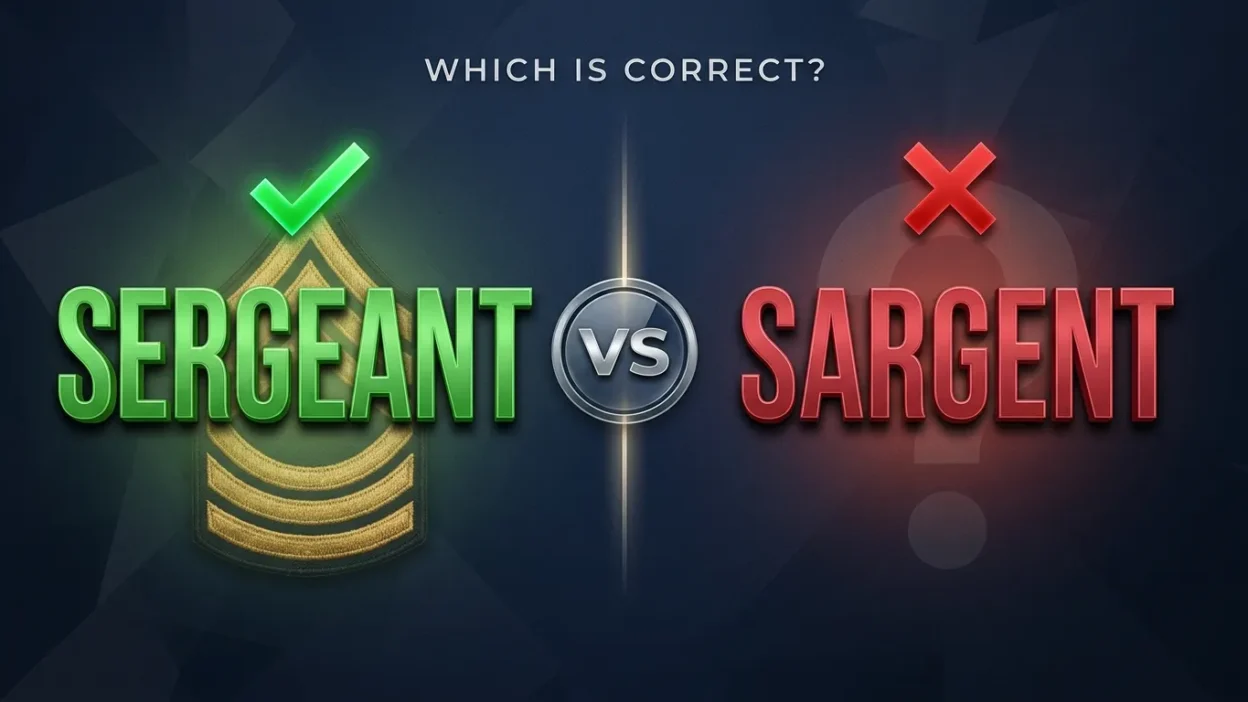
Is it sergeant or sargent? The correct spelling is sergeant. Both sargent and sargeant are common misspellings of this word. A sergeant is a military or police officer who holds a particular rank and often has responsibilities such as supervising personnel, giving instructions, and maintaining discipline. Although the word is pronounced approximately “SAR-jent,” its spelling does not follow the way it sounds.
The spelling can be confusing for students, English learners, and even experienced writers because the first syllable sounds like “sar,” making sargent seem reasonable. However, standard English uses sergeant, with an e after the first s and ea in the second part of the word.
If you are writing about an army sergeant, police sergeant, staff sergeant, or drill sergeant, the spelling stays the same. This guide explains the word’s meaning, pronunciation, usage, related terms, and common spelling mistakes.
Quick Answer: Sergeant or Sargent?
Sergeant is the only correct standard spelling for the military or police rank. Sargent and sargeant are misspellings. A sergeant is generally a noncommissioned military officer or a supervisory police officer. The word is pronounced approximately “SAR-jent,” which explains why its spelling often causes confusion.
Why Do People Confuse Sergeant, Sargent, and Sargeant?
People confuse sergeant, sargent, and sargeant because the pronunciation of the correct word is unusual.
Although sergeant begins with the letters ser, its first syllable sounds like “sar.” This makes people think the word should be spelled sargent. Others write sargeant because they remember the sound but place the letters incorrectly.
Here are the three spellings and their status:
- Sergeant: The correct standard English spelling.
- Sargent: An incorrect spelling when referring to a military or police rank.
- Sargeant: Another common misspelling of sergeant.
The confusion happens because English spelling does not always match pronunciation. The word sergeant has a historical spelling that has remained in modern English even though its pronunciation has changed.
What Does Sergeant Mean?
Sergeant is a noun that refers to a rank or position in the military or police. A person holding this rank often has leadership and supervisory responsibilities.
A sergeant may give instructions, supervise other personnel, maintain discipline, organize duties, and help ensure that rules are followed. The exact responsibilities depend on the country, military branch, or police department.
How Do You Spell Sergeant in the Army?
In many military organizations, a sergeant is a noncommissioned officer (NCO). Noncommissioned officers are enlisted personnel who have gained leadership responsibilities through promotion and experience.
A military sergeant may train soldiers, supervise daily activities, inspect equipment, and make sure instructions are followed.
Examples:
- The sergeant led the soldiers through their morning drills.
- The army sergeant checked the equipment before training.
- A sergeant explained the safety rules to the new recruits.
- She was promoted to sergeant after years of service.
Military rank systems differ between countries and branches, so the exact position of a sergeant is not identical everywhere.
How Do You Spell Police Sergeant?
The correct spelling for a police rank is also sergeant.
A police sergeant generally supervises police officers and helps manage daily operations. Their responsibilities may include assigning duties, reviewing reports, coordinating shifts, and supporting investigations.
Examples:
- The police sergeant arrived at the scene.
- The sergeant assigned duties to the officers.
- She spoke with the police sergeant about the incident.
- The sergeant reviewed the officers’ reports.
Police rank structures vary by jurisdiction. In some police forces, a sergeant ranks below an inspector or lieutenant, depending on the system.
What Is a Staff Sergeant?
A staff sergeant is a specific military rank used in several armed forces. Its position and responsibilities vary depending on the country and military branch.
Example: The staff sergeant organized the training schedule for the unit.
What Is a Drill Sergeant?
A drill sergeant is a military instructor responsible for training new recruits in military discipline, procedures, physical fitness, and basic skills.
Example: The drill sergeant taught the recruits how to follow commands.
What Is a Sergeant Major?
A sergeant major is a senior military rank or appointment in several military organizations. The exact duties and position depend on the service and country.
Example: The sergeant major addressed the soldiers during the ceremony.
What Does Sargent Mean?
Sargent is not the correct standard spelling of the military or police rank sergeant.
People often write sargent because the correct word sounds like “SAR-jent.” However, the spelling uses e, not a, after the first letter.
- Incorrect: The sargent gave instructions to the soldiers.
- Correct: The sergeant gave instructions to the soldiers.
There is one important distinction: Sargent can appear as a person’s surname or proper name. In that situation, it is a name, not a misspelling of the military rank.
For example:
- Mr. Sargent attended the meeting.
- The sergeant supervised the soldiers.
Always use sergeant when referring to the military or police rank.
What Does Sargeant Mean?
Sargeant is another common misspelling of sergeant. It is not the accepted standard spelling of the military or police rank.
The mistake usually happens because people try to write the word according to its pronunciation.
Incorrect: The sargeant trained the new recruits.
Correct: The sergeant trained the new recruits.
For standard English writing, use sergeant, not sargeant.
Sergeant vs. Sargent vs. Sargeant: Comparison Table
| Feature | Sergeant | Sargent | Sargeant |
| Spelling status | Correct | Incorrect for the rank | Incorrect for the rank |
| Part of speech | Noun | Misspelling or proper surname | Misspelling |
| Military rank | Yes | No | No |
| Police rank | Yes | No | No |
| Pronunciation intended | SAR-jent | Usually intended as SAR-jent | Usually intended as SAR-jent |
| Standard English usage | Accepted | Not accepted for the rank | Not accepted for the rank |
The correct spelling is always sergeant when you mean the military or police rank. Remember that Sargent may still be correct as a person’s actual surname.
When Should You Use Sergeant, Sargent, or Sargeant?
Choosing the correct spelling depends on what you want to say.
When to Use Sergeant
Use sergeant when referring to a military or police rank.
Examples:
- The sergeant led the training session.
- My brother wants to become an army sergeant.
- The police sergeant questioned the witness.
- The staff sergeant inspected the equipment.
- The drill sergeant trained the new recruits.
When to Use Sargent
Use Sargent only when it is someone’s actual surname or part of a proper name.
Example:
- Mr. Sargent will speak at the event.
Do not use sargent as a spelling alternative for the military rank.
When to Use Sargeant
Avoid sargeant when referring to a military or police officer. It is a misspelling in standard English.
Incorrect: She became a police sargeant.
Correct: She became a police sergeant.
15 Examples of Sergeant in Sentences
Here are practical examples showing how to use sergeant correctly in everyday writing.
- The sergeant gave clear instructions to the soldiers.
- A police sergeant arrived at the accident scene.
- The army sergeant checked the training equipment.
- She worked hard to become a sergeant.
- The sergeant supervised the evening shift.
- The drill sergeant prepared the recruits for training.
- He asked the sergeant for permission to leave.
- The staff sergeant organized the team’s activities.
- The police sergeant reviewed the officers’ reports.
- The sergeant explained the rules to the new members.
- Everyone listened carefully when the sergeant spoke.
- The experienced sergeant helped train younger soldiers.
- The first sergeant attended the morning meeting.
- The sergeant major inspected the military unit.
- The detective sergeant discussed the investigation with the team.
These examples show how sergeant appears in military, police, and formal rank titles.
Common Mistakes with Sergeant, Sargent, and Sargeant
Even experienced writers can misspell sergeant because its pronunciation is unusual. Here are common mistakes to avoid.
1. Writing Sargent Instead of Sergeant
The first syllable sounds like “sar,” so people sometimes write sargent.
- Incorrect: Sargent
- Correct: Sergeant
2. Writing Sargeant Instead of Sergeant
Some writers add an extra a after the g, creating another incorrect spelling.
- Incorrect: Sargeant
- Correct: Sergeant
3. Confusing a Surname with a Military Rank
Sargent may be a person’s surname, but it is not the standard spelling of the rank.
- Mr. Sargent is a proper name.
- The sergeant is a military rank.
4. Assuming the Pronunciation Determines the Spelling
The word sounds approximately like “SAR-jent,” but it is spelled sergeant. Do not rely only on how a word sounds when writing it.
5. Misspelling Longer Rank Titles
The spelling sergeant remains the same in longer titles.
- Staff sergeant
- First sergeant
- Drill sergeant
- Sergeant major
- Police sergeant
- Detective sergeant
Memory Trick: How to Remember Sergeant
A simple memory trick can help you remember the correct spelling.
Break the word into its letters:
S-E-R-G-E-A-N-T
Remember these points:
- Start with SER, not SAR.
- Keep GEANT at the end.
- Always use sergeant for the military or police rank.
You can also remember this sentence:
“Every sergeant starts with SER.”
This simple reminder can help you avoid writing sargent or sargeant by mistake.
American vs. British English: Sergeant or Sargent
There is no spelling difference between American and British English for this word.
| English Variety | Correct Spelling | Incorrect Rank Spelling |
| American English | Sergeant | Sargent, Sargeant |
| British English | Sergeant | Sargent, Sargeant |
| Canadian English | Sergeant | Sargent, Sargeant |
| Australian English | Sergeant | Sargent, Sargeant |
Whether you are writing for an American, British, Canadian, or Australian audience, sergeant is the correct spelling for the rank.
The pronunciation may vary slightly between speakers, but the standard spelling remains unchanged.
How Do You Abbreviate Sergeant? Understanding Sgt.
The standard abbreviation for sergeant is Sgt.
It is commonly used in military and police titles, especially before a person’s name.
Examples:
- Sgt. James led the training session.
- Sgt. Brown spoke to the officers.
- Sgt. Ahmed inspected the equipment.
In formal writing, spell out sergeant when the full word is more appropriate. Use Sgt. when an abbreviation fits the context or an official title.
The plural of sergeant is sergeants, not sergeant’s.
Similar Words and Related Military Ranks
Learning related terms can help you understand how sergeant is used.
| Word or Phrase | Meaning |
| Sergeant | A military noncommissioned officer or police supervisory rank |
| Staff sergeant | A specific noncommissioned military rank |
| First sergeant | A senior enlisted leadership position in some military organizations |
| Drill sergeant | A military instructor who trains recruits |
| Sergeant major | A senior military rank or appointment |
| Police sergeant | A police officer who generally supervises other officers |
| Detective sergeant | A police sergeant working in an investigative role |
| Noncommissioned officer (NCO) | An enlisted military member holding a leadership rank |
| Sgt. | The standard abbreviation for sergeant |
These ranks and titles are related, but their responsibilities and positions differ between military services and police departments.
Final Verdict: Which Spelling Is Correct?
Sergeant is the correct standard spelling for a military or police rank. Sargent and sargeant are common misspellings and should not be used for this meaning.
Remember these simple rules:
- Use sergeant for a military or police rank.
- Use Sargent only when it is someone’s actual surname or proper name.
- Avoid sargeant in standard English writing.
- Use Sgt. as the common abbreviation for sergeant.
- The correct spelling is the same in American and British English.
If you are writing a school assignment, professional document, news article, or military-related text, always choose sergeant.
FAQs
1. Is it sergeant or sargent?
Sergeant is the correct spelling for a military or police rank. Sargent is a common misspelling, although it can be a correct surname or proper name.
2. Is it sergeant or sargeant?
Sergeant is correct. Sargeant is an incorrect spelling in standard English. Always use sergeant when referring to a military or police officer’s rank.
3. Why is sergeant spelled differently from how it sounds?
The word sergeant has an unusual spelling because of its historical development. Its modern pronunciation is approximately “SAR-jent,” which is why people sometimes write sargent instead.
4. Is sargent ever correct?
Yes, Sargent can be correct as a person’s surname or part of a proper name. However, it is not the standard spelling of the military or police rank. That spelling is sergeant.
5. How do you spell sergeant correctly?
The correct spelling is S-E-R-G-E-A-N-T. Remember that the word begins with SER, not SAR.
6. Is sergeant spelled the same in American and British English?
Yes. Sergeant is the correct spelling in both American and British English. Neither variety uses sargent or sargeant as the standard spelling of the rank.
7. What is the abbreviation for sergeant?
The common abbreviation for sergeant is Sgt. It is often used before a person’s name or in official military and police titles.
8. What is the plural of sergeant?
The plural of sergeant is sergeants. You simply add -s to the singular form.
Example: The sergeants attended the training meeting.
Remember This
- Sergeant = Correct spelling for a military or police rank.
- Sargent = Incorrect for the rank, but it can be a surname.
- Sargeant = Incorrect spelling.
- Sgt. = Common abbreviation for sergeant.
- Sergeants = Correct plural form.
- Sergeant is spelled the same in American and British English.
Conclusion
The difference between sergeant, sargent, and sargeant is straightforward once you learn the correct spelling. Sergeant is the accepted English word for a military or police rank. The other two forms are common spelling mistakes when used to describe that rank. Although the word is pronounced approximately “SAR-jent,” its spelling begins with SER, which is the detail that often confuses writers.
To remember the correct form, learn the letter sequence S-E-R-G-E-A-N-T and use it whenever you write about an army sergeant, police sergeant, staff sergeant, or drill sergeant. Remember that Sargent can still be a person’s surname, and Sgt. is the common abbreviation for the rank. With these simple rules, you can spell and use the word confidently.