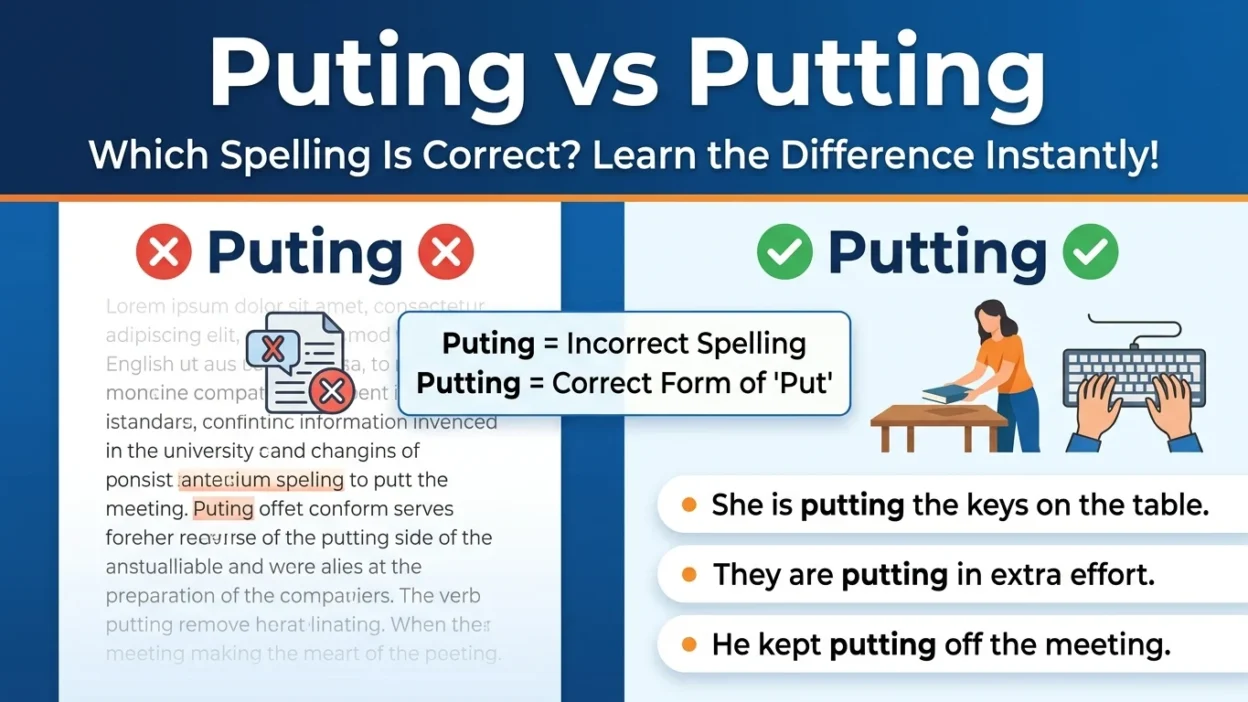
Puting vs putting often confuses learners, but the correct spelling is putting, while puting is an incorrect spelling in English writing and grammar.
The verb put follows a special English spelling rule. It is a short word, so simply adding -ing is not enough because the final t doubles, meaning put becomes putting.
This spelling pattern works differently from many other verbs. A simple example is putting my phone on the table, where the phone and table clearly show the -ing form in everyday use.
From my experience reviewing grammar lessons, people often make this mistake.
The word putting also has a golf meaning. In golf, it comes from putt, where a player hits the ball gently across the green.
The pronunciation has a different pronunciation from the everyday verb, but the spelling stays the same. Its meaning depends on the sentence, not the letters.
Quick Answer
Putting is the correct spelling.
Puting is incorrect in standard English and should not be used in formal or informal writing unless it is a proper noun or part of a specific name.
- ✅ Correct: She is putting the books on the shelf.
- ❌ Incorrect: She is puting the books on the shelf.
What Does “Putting” Mean?
Putting is the present participle and gerund form of the verb put.
The verb put means to place, position, move, or set something somewhere. When describing an action that is happening now or referring to the act itself, English uses putting.
Examples include:
- I am putting my phone in my bag.
- They are putting together a new project.
- Putting your health first is always a good idea.
- She enjoys putting puzzles together.
The extra “t” follows an important English spelling rule.
Why Is “Putting” Spelled with Two Ts?
Many English learners wonder why put becomes putting instead of puting.
The answer lies in a common spelling rule.
When a one-syllable verb ends with one vowel followed by one consonant, the final consonant is usually doubled before adding -ing.
Examples:
| Base Verb | Correct -ing Form |
| put | putting |
| sit | sitting |
| run | running |
| swim | swimming |
| stop | stopping |
Since put ends with one vowel (u) followed by one consonant (t), the final t doubles before adding -ing.
Puting vs Putting Comparison
| Feature | Puting | Putting |
| Correct English spelling | ❌ No | ✅ Yes |
| Found in dictionaries | ❌ No | ✅ Yes |
| Accepted in academic writing | ❌ No | ✅ Yes |
| Used in professional communication | ❌ No | ✅ Yes |
| Standard grammar | ❌ Incorrect | ✅ Correct |
The comparison clearly shows that putting is always the correct choice in modern English.
Examples of “Putting” in Sentences
Seeing words in context makes them easier to remember.
Here are some everyday examples:
- She is putting the groceries away.
- We are putting our ideas into action.
- He kept putting off his homework.
- They are putting new furniture in the office.
- Putting kindness first makes a difference.
- The teacher is putting the papers on the desk.
- I am putting my trust in you.
- They spent the afternoon putting together a bicycle.
Each sentence demonstrates the correct spelling.
Common Mistakes People Make
Many writers accidentally type puting because they forget to double the final consonant.
Common mistakes include:
- Writing puting instead of putting
- Assuming all verbs simply add -ing
- Relying too heavily on autocorrect
- Typing too quickly without proofreading
Fortunately, once you understand the spelling rule, the mistake becomes much easier to avoid.
Easy Trick to Remember the Correct Spelling
A simple memory trick is:
“Put needs another T before adding -ing.”
Think of it this way:
Put + T + ing = Putting
You can also compare it with similar words:
- Run → Running
- Sit → Sitting
- Stop → Stopping
Whenever you remember these words, you’ll naturally remember putting too.
American vs British English
Unlike some English words that have different spellings in American and British English, putting is spelled exactly the same in both.
| American English | British English |
| putting | putting |
There is no spelling difference between the two varieties of English.
Whether you’re writing for readers in the United States, the United Kingdom, Canada, Australia, or elsewhere, putting remains the correct spelling.
Related Words and Phrases
Understanding related vocabulary can strengthen your English skills.
Some commonly used phrases with putting include:
- putting together
- putting away
- putting off
- putting on
- putting down
- putting forward
- putting into practice
- putting pressure on
- putting effort into
- putting your best foot forward
These expressions appear frequently in both spoken and written English.
Why Correct Spelling Matters
Correct spelling does more than help you avoid mistakes.
Using accurate spelling:
- Builds credibility
- Improves readability
- Creates a professional impression
- Helps readers understand your message
- Supports better SEO when publishing online
- Prevents confusion in academic and workplace writing
Even a small spelling error like puting can distract readers and reduce trust in your writing.
Tips to Avoid Spelling Errors
If you often confuse similar spellings, these habits can help:
- Read your writing aloud.
- Use grammar and spell-check tools.
- Learn common English spelling patterns.
- Practice frequently used verbs.
- Proofread before sending emails or publishing content.
- Read quality English books and articles regularly.
Consistent practice makes correct spelling become automatic.
FAQs
Is puting ever correct?
Generally, no. Puting is considered a spelling mistake in standard English. It may occasionally appear as a surname, place name, or brand, but it is not the correct verb form.
Why does putting have two Ts?
English spelling rules require doubling the final consonant when a one-syllable verb ends with a single vowel followed by a single consonant before adding -ing.
Is putting a real English word?
Yes. Putting is the present participle and gerund of the verb put.
Is putting correct in American English?
Yes. American English uses putting, just like British English.
Is putting correct in British English?
Yes. British English also spells the word putting.
What is the past tense of put?
The past tense is put.
Examples:
- Today I put the book away.
- Yesterday I put the book away.
The verb does not change in the past tense.
What is the present participle of put?
The present participle is putting.
Example:
She is putting flowers into the vase.
How can I remember the correct spelling?
Remember this simple rule:
One vowel + one consonant = double the consonant before adding -ing.
This works for words like putting, running, sitting, and stopping.
Summary
The debate over puting vs putting has a straightforward answer. Putting is the only correct spelling in standard English, while puting is a common misspelling caused by forgetting to double the final consonant before adding -ing.
This spelling follows a well-established English grammar rule that also applies to words like running, sitting, and stopping.
Whenever you write emails, assignments, blog posts, or professional documents, choose putting with confidence.
Taking a few extra seconds to proofread and remember the consonant-doubling rule will help you write more accurately, communicate more effectively, and leave a stronger impression on your readers.