The first time I saw DEI, it was in a social media post about a company changing its hiring policies. At first, I assumed it was another texting abbreviation or piece of social media slang, like “LOL” or “TBH.” Then I started seeing it everywhere in news headlines, LinkedIn posts, online forums, and workplace discussions.
That made me curious enough to search what does DEI stand for. If you’ve done the same, you’re not alone. Today, DEI is one of the most talked-about terms in business, education, and public conversations. This guide explains the DEI meaning, where it’s used, why it’s trending, and what it actually means in simple language.
Quick Answer:
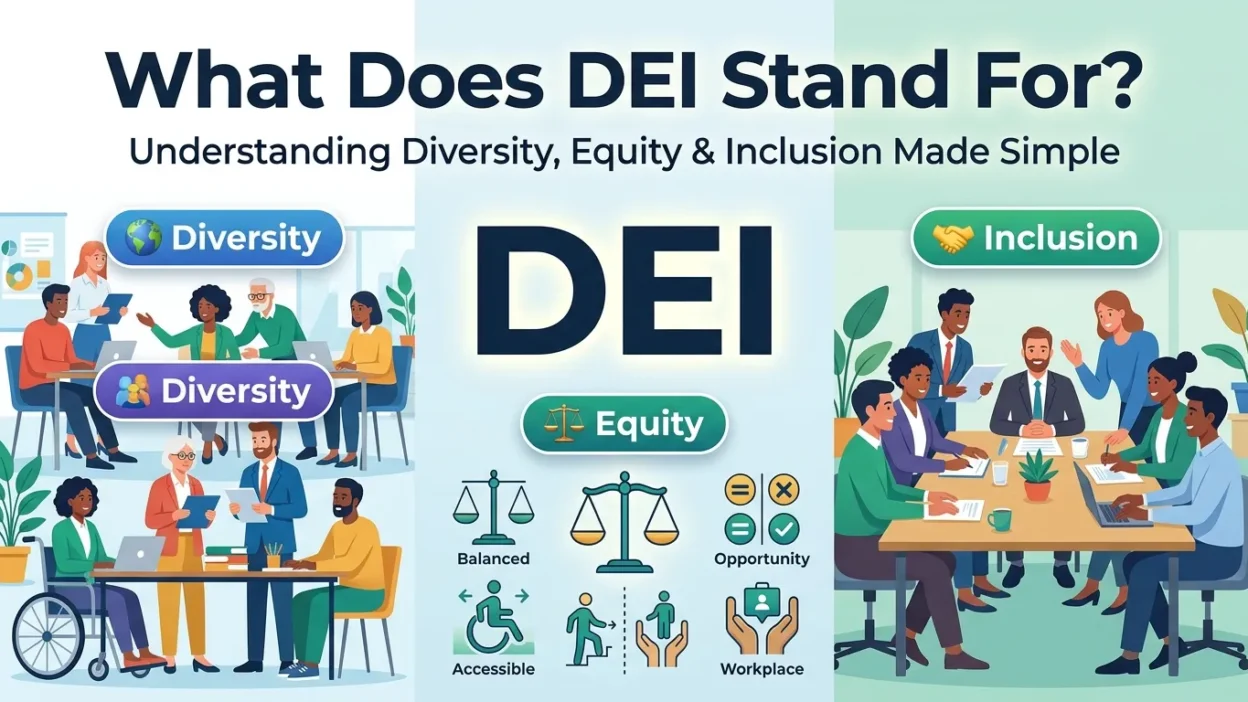
DEI stands for Diversity, Equity, and Inclusion. It refers to efforts, policies, and practices that help create fair, welcoming, and respectful environments where people from different backgrounds have equal opportunities to succeed.
What Does DEI Stand For?
The answer to what does DEI stand for is Diversity, Equity, and Inclusion.
Many people search for what is DEI, DEI full form, or DEI acronym meaning after seeing the abbreviation in workplace emails, company announcements, or social media discussions. Although it often appears online, DEI is not traditional social media slang or casual chat shorthand. Instead, it is a widely used professional abbreviation.
Here’s what each part means.
Diversity
Diversity means having people from different backgrounds, experiences, cultures, races, ethnicities, genders, religions, ages, abilities, and perspectives. Diverse groups bring different ideas and experiences that can improve learning, teamwork, and problem-solving.
Equity
Equity means providing fair opportunities by recognizing that people may start from different situations. Rather than treating everyone exactly the same, equity focuses on giving people the support they need to succeed.
Inclusion
Inclusion means creating an environment where everyone feels respected, valued, heard, and able to participate. Inclusion helps people feel that they belong and that their contributions matter.
Together, these ideas form the Diversity, Equity, and Inclusion meaning used by businesses, schools, nonprofits, healthcare organizations, and many other groups.
Example sentence:
“Our company introduced new DEI training to help build a more inclusive workplace.”
Bold Summary: DEI stands for Diversity, Equity, and Inclusion—a framework that encourages fairness, opportunity, respect, and belonging for people from all backgrounds.
DEI at a Glance
| Letter | Stands For | Simple Meaning |
| D | Diversity | People with different backgrounds and experiences. |
| E | Equity | Giving people fair opportunities and support. |
| I | Inclusion | Making everyone feel welcomed, respected, and included. |
If you ever forget the DEI abbreviation, this simple table makes it easy to remember.
What Is DEI in Simple English?
If you’re still wondering what does DEI mean, imagine a classroom where every student is different.
Some students may speak different languages. Others may have different learning styles or come from different cultures.
- Diversity means those differences exist.
- Equity means every student receives the support they need to succeed.
- Inclusion means every student feels welcomed, respected, and encouraged to participate.
That’s the easiest way to understand the DEI definition.
In simple terms, DEI is about creating places where everyone has the chance to contribute, succeed, and feel like they belong.
Where Did DEI Come From?
Many people think DEI is a brand-new idea, but its roots go back several decades.
The concept grew from efforts to promote equal opportunity and reduce unfair treatment in workplaces and educational institutions. Over time, organizations realized that simply bringing together people from different backgrounds was not enough. They also needed to create environments where everyone could participate, grow, and feel respected.
As a result, many organizations expanded their focus to include diversity, equity, and inclusion together. Today, these ideas are often part of Human Resources (HR) strategies, employee development, leadership training, and organizational culture.
While different organizations may define or implement DEI in different ways depending on their goals, industry, or local laws, the core idea remains the same: helping people feel respected and giving them fair opportunities to succeed.
Why Is Everyone Talking About DEI?
One of the biggest reasons people search what does DEI stand for is because they keep seeing the term in news headlines and online conversations.
Over the past few years, many businesses, schools, universities, government agencies, and nonprofit organizations have introduced, expanded, changed, or debated DEI programs. As a result, DEI has become a frequent topic in news stories, podcasts, social media discussions, and workplace conversations.
Some discussions focus on:
- Workplace diversity
- Hiring practices
- Employee belonging
- Inclusive leadership
- Accessibility
- Representation
- Company culture
- Educational opportunities
- Public policy
- Community initiatives
Because DEI is often connected to current events, many people search for its meaning after seeing it mentioned in articles, videos, or online debates.
It’s important to remember that people have different opinions about DEI and how organizations should approach it. This guide focuses on explaining what DEI means and how the term is commonly used, rather than taking a position on those discussions.
Why Do Organizations Use DEI?
Organizations use DEI because they want to build environments where employees, students, customers, or community members feel respected and included.
A strong focus on organizational culture often includes:
- Building an inclusive workplace
- Improving communication
- Supporting employee belonging
- Encouraging respectful teamwork
- Expanding accessibility
- Promoting equal opportunity
- Increasing representation
- Creating welcoming environments
Different organizations may have different DEI goals depending on their mission and the communities they serve.
What Is a DEI Program?
A DEI program is a set of activities, policies, or initiatives designed to support diversity, equity, and inclusion within an organization.
Examples include:
- Employee mentoring programs
- Inclusive hiring practices
- Leadership development
- Accessibility improvements
- Employee Resource Groups (ERGs)
- Diversity awareness events
- Community outreach
- Educational workshops
Every organization designs its DEI programs differently based on its needs and objectives.
What Is DEI Training?
DEI training helps employees, managers, teachers, or students better understand topics related to diversity, equity, inclusion, communication, and respectful behavior.
Training may cover subjects such as:
- Inclusive communication
- Respect in the workplace
- Team collaboration
- Accessibility awareness
- Cultural understanding
- Professional conduct
- Reducing bias during hiring
The exact topics vary from one organization to another.
What Is a DEI Policy?
A DEI policy explains how an organization plans to support diversity, fairness, inclusion, and respectful treatment.
Depending on the organization, a policy may include:
- Hiring guidelines
- Equal opportunity statements
- Accessibility commitments
- Employee conduct expectations
- Reporting procedures
- Workplace inclusion initiatives
Policies help employees understand organizational expectations and goals.
What Does a DEI Officer Do?
Some organizations have a DEI Officer or similar leadership role.
This person’s responsibilities may include:
- Supporting inclusion initiatives
- Working with HR teams
- Helping improve workplace culture
- Reviewing organizational practices
- Coordinating employee education
- Encouraging accessibility and belonging
- Measuring progress on DEI goals
Not every organization has this position, and responsibilities vary depending on the organization.
Where Is DEI Commonly Used?
If you’ve recently searched DEI meaning in text, DEI meaning online, or DEI meaning in social media, you’ve probably noticed the abbreviation appearing almost everywhere.
You’ll commonly see DEI in:
- Workplace emails
- HR documents
- Company announcements
- Job postings
- LinkedIn articles
- News websites
- Reddit discussions
- Facebook posts
- X (formerly Twitter) conversations
- TikTok videos
- YouTube comments
- Online forums
- University websites
- Government publications
Although DEI appears in many online conversations, it is not typical text slang. Unlike abbreviations such as “LOL,” “BRB,” or “IMO,” DEI almost always refers to Diversity, Equity, and Inclusion.
Is DEI Formal or Informal?
The tone depends on the setting.
Formal
- Business reports
- HR documents
- Company policies
- Government publications
- Educational materials
Neutral
- News articles
- Podcasts
- Informational websites
- Interviews
Informal
- Social media discussions
- Reddit threads
- Facebook comments
- Group chats discussing current events
Even in informal chat, DEI usually keeps the same meaning. It is a professional abbreviation that has become part of everyday online communication, which is why so many people continue searching for what does DEI stand for, DEI explained, and DEI meaning today.
Real-World Examples of DEI
Understanding what does DEI stand for is easier when you see it in everyday situations. Here are a few simple examples of how Diversity, Equity, and Inclusion can look in real life.
Workplace Example
A company updates its hiring process so that every qualified applicant is evaluated using the same clear criteria. It also offers accessibility tools for employees who need them and encourages respectful teamwork.
School Example
A school provides learning support for students with different educational needs and creates clubs where students from different backgrounds feel welcome to participate.
Community Example
A local community center hosts events that celebrate different cultures and ensures its building is accessible to people with disabilities.
Healthcare Example
A hospital offers translated materials for patients who speak different languages, making it easier for everyone to understand important health information.
These examples show that DEI is about creating fair opportunities and welcoming environments in many different settings.
Realistic Conversation Examples
Here are natural examples showing how people use DEI in online communication, social media, and workplace conversations.
- “did you see the company’s new dei policy today?”
- “our manager scheduled dei training for next week.”
- “i finally know what dei stands for now.”
- “everyone on linkedin is talking about dei again.”
- “our school introduced new dei programs this semester.”
- “the article explained dei in a really simple way.”
- “i thought dei was just another texting abbreviation.”
- “they’re hiring a new dei officer this month.”
- “there’s a podcast discussing dei and workplace culture.”
These conversations show that DEI meaning in text, DEI meaning in chat, and DEI meaning online almost always refer to Diversity, Equity, and Inclusion rather than casual social media slang.
When to Use DEI
Now that you know what is DEI, it’s also helpful to know when the abbreviation is appropriate.
✅ Do Use DEI When
- Talking about workplace diversity.
- Discussing inclusive workplace initiatives.
- Explaining DEI programs or DEI training.
- Writing business reports or HR documents.
- Talking about schools, nonprofits, healthcare, or community organizations.
- Joining thoughtful online conversations about workplace culture or inclusion.
❌ Don’t Use DEI When
- You mean casual text slang meaning like “LOL” or “BRB.”
- Your audience may not understand the abbreviation without explanation.
- You’re joking about serious workplace or educational topics.
- You’re replacing a detailed explanation with only the abbreviation.
- The discussion has nothing to do with diversity, equity, or inclusion.
Quick Comparison Table
| Context | Example Phrase | Why It Works |
| Workplace meeting | “our dei committee meets tomorrow.” | Appropriate professional use. |
| Company email | “please complete the annual dei training.” | Common HR communication. |
| LinkedIn post | “our organization expanded its dei initiatives.” | Fits business discussions. |
| University website | “new dei resources are available.” | Appropriate educational use. |
| Gaming chat | “gg that’s so dei.” | Doesn’t work because DEI isn’t gaming slang or chat shorthand. |
Similar Terms and Related Words
When researching DEI meaning, you’ll probably come across these related terms.
| Term | Meaning | When to Use It |
| EDI | Equity, Diversity, and Inclusion | Common in Canada, the UK, and some organizations. |
| Equal Opportunity | Fair treatment in hiring and education | Employment and legal discussions. |
| Accessibility | Making spaces usable for everyone | Technology, education, and workplaces. |
| Representation | Including different groups in leadership and media | Diversity discussions. |
| Belonging | Helping people feel accepted and valued | Employee engagement and team culture. |
| Inclusive Workplace | A workplace where everyone feels respected | HR and organizational culture. |
| Employee Resource Groups (ERGs) | Employee-led groups that support shared interests or backgrounds | Large organizations and companies. |
Although these terms are related, they are not exact replacements for DEI. Each focuses on a different part of creating welcoming and fair environments.
Common Myths About DEI
Because DEI is discussed so often online, there are many misunderstandings about what it actually means.
Myth 1: DEI Is Just Internet Slang
Fact: DEI is a professional abbreviation, not casual social media slang or chat shorthand.
Myth 2: DEI Only Applies to Big Companies
Fact: Schools, universities, nonprofits, healthcare organizations, government agencies, and community groups also use DEI principles.
Myth 3: DEI Is Only About Hiring
Fact: Hiring is only one part of DEI. It can also include accessibility, employee development, leadership opportunities, workplace culture, communication, and inclusion.
Myth 4: Every Organization Uses DEI the Same Way
Fact: Organizations may design different DEI programs depending on their goals, industry, location, and legal requirements.
Key Takeaways
- DEI stands for Diversity, Equity, and Inclusion.
- It focuses on fairness, opportunity, respect, and belonging.
- DEI is commonly used in workplaces, schools, nonprofits, healthcare, and government organizations.
- It is not typical texting culture slang, even though it appears frequently in online communication.
- The exact way organizations apply DEI may differ depending on their goals and needs.
- Understanding the DEI abbreviation helps you better follow news stories, workplace discussions, and social media conversations.
FAQs
What does DEI stand for?
DEI stands for Diversity, Equity, and Inclusion. It describes efforts to create fair, respectful, and welcoming environments where people from different backgrounds have opportunities to succeed.
What is DEI?
If you’re asking what is DEI, it refers to policies, programs, and practices that support diversity, fairness, accessibility, inclusion, and equal opportunity within organizations and communities.
What does DEI mean at work?
In the workplace, DEI often refers to initiatives that support respectful communication, fair hiring practices, accessibility, employee belonging, leadership development, and inclusive organizational culture.
What is a DEI program?
A DEI program is a collection of initiatives designed to promote diversity, equity, and inclusion through activities such as employee training, mentoring, accessibility improvements, or Employee Resource Groups (ERGs).
Why do companies have DEI training?
Organizations may offer DEI training to improve communication, encourage respectful workplaces, increase awareness of inclusion practices, and support positive teamwork.
Is DEI required by law?
Requirements vary depending on the country, region, industry, and organization. Some equal opportunity and anti-discrimination laws apply broadly, while specific DEI programs and policies are generally developed by individual organizations.
Can DEI mean something else?
Yes. Although Diversity, Equity, and Inclusion is by far the most common meaning today, DEI can occasionally represent different phrases in specialized industries or organizations. The intended meaning depends on the context.
Why is DEI discussed so much in the news?
DEI often appears in news coverage because businesses, schools, universities, and governments regularly discuss or update policies related to workplace culture, education, accessibility, hiring, and organizational practices.
Final Thought
If you’ve been searching what does DEI stand for, the answer is Diversity, Equity, and Inclusion. More than just an abbreviation, DEI represents a set of ideas focused on creating fair opportunities, respectful workplaces, and welcoming communities.
Although it’s often mentioned in online communication, news stories, and social media discussions, it isn’t casual text slang. Understanding the DEI meaning, DEI full form, and how the term is used can help you better follow workplace conversations, current events, and discussions about organizational culture in today’s digital world.