Have you ever wondered whether the correct spelling is tying or tieing? These two spellings look similar, so it is easy to understand why people confuse them. However, only one is accepted in standard modern English.
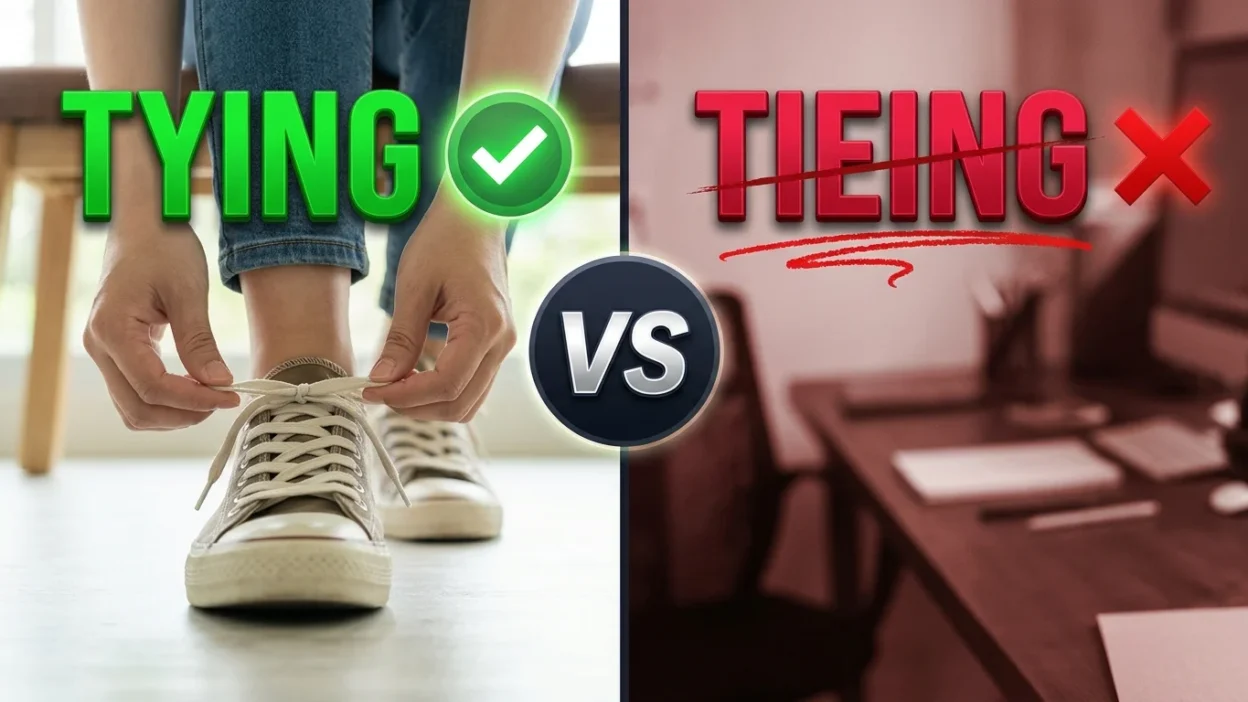
Tying is the correct spelling, while tieing is generally considered a misspelling. The word tying is the present participle and gerund form of the verb tie, which means to fasten, secure, attach, or connect something using a rope, string, ribbon, or similar material.
The confusion happens because English has different spelling rules for adding -ing to verbs. When a verb ends in -ie, the final letters change to y before adding -ing. This is why tie becomes tying, just as die becomes dying and lie becomes lying.
Understanding this simple rule will help you avoid spelling mistakes in school assignments, emails, professional documents, and everyday writing. Let’s explore the difference between tying and tieing, their meanings, grammar rules, and correct usage with easy examples.
Quick Answer:
Tying is the correct spelling, and tieing is generally incorrect in standard English. Tying is the -ing form of the verb tie, meaning to fasten, secure, or connect something. When adding -ing to a verb ending in -ie, change ie to y. Therefore, the correct spelling is tying, not tieing.
Why Do People Confuse Tying and Tieing?
People confuse tying and tieing because both spellings seem logical when adding the suffix -ing to the word tie.
In English, many verbs simply take -ing without changing their spelling:
- Walk → Walking
- Jump → Jumping
- Play → Playing
- Read → Reading
- Talk → Talking
However, some verbs require a spelling change before adding -ing. In particular, verbs ending in -ie change those two letters to y.
For example:
- Tie → Tying
- Die → Dying
- Lie → Lying
- Vie → Vying
Some writers mistakenly keep the original letters and produce tieing. Although this spelling may look reasonable, it does not follow the standard spelling rule.
The important thing to remember is that tying is the accepted spelling in standard English, whether you are writing casually, academically, or professionally.
First Word: Tying (Correct Spelling)
Tying is the correct and standard spelling. It is the present participle and gerund form of the verb tie.
The word means fastening, securing, joining, attaching, or connecting something with a knot, rope, string, ribbon, or another material.
Meaning and Definition of Tying
According to its everyday usage, tying can describe several actions:
- Fastening something: Securing an object with a knot or string.
- Connecting objects: Joining two or more things together.
- Securing something: Keeping an object in place with a rope or cord.
- Making something equal: Bringing two competitors or teams to the same score.
- Connecting ideas: Linking information, events, or arguments.
- Getting married: Used in the expression tying the knot.
Examples of Tying
- She is tying her shoelaces before leaving home.
- He is tying a ribbon around the gift box.
- The farmer is tying the plants to wooden supports.
- My father is tying the boat to the dock.
- The final goal is tying the game.
In each sentence, tying describes an action involving fastening, connecting, or making something equal.
Second Word: Tieing (Incorrect Spelling)
Tieing is generally considered a misspelling of tying when referring to the present participle or gerund of tie.
People sometimes write tieing because they believe the original spelling of the base verb should remain unchanged before adding -ing. However, verbs ending in -ie follow a different spelling pattern.
Why Is Tieing Incorrect?
The standard spelling rule changes the final -ie into y before adding -ing.
The correct formation is:
Tie + ing → Tying
Not:
Tie + ing → Tieing
Here are some common incorrect and correct sentences:
| Incorrect Spelling | Correct Spelling |
| She is tieing her shoes. | She is tying her shoes. |
| He is tieing the rope. | He is tying the rope. |
| They are tieing the packages. | They are tying the packages. |
| I am tieing my hair. | I am tying my hair. |
| We are tieing the final knot. | We are tying the final knot. |
For standard modern English writing, always choose tying instead of tieing.
Tying vs. Tieing: Comparison Table
The following table explains the main differences between these two spellings.
| Feature | Tying | Tieing |
| Correct spelling | Yes | No |
| Base word | Tie | Tie |
| Meaning | Fastening or connecting | Intended meaning of tying |
| Grammar | Present participle / gerund | Nonstandard spelling |
| Standard English | Accepted | Not accepted |
| Formal writing | Appropriate | Avoid |
| Everyday usage | Correct | Misspelling |
| Example | Tying a knot | Tieing a knot |
The main difference is simple: tying is the correct spelling, while tieing is a spelling mistake in this context.
Why Is Tying Spelled Without an E?
The spelling of tying follows a specific English spelling rule for verbs ending in -ie.
When adding the suffix -ing to these verbs, change the final ie to y. This prevents the unusual letter combination ieing.
The -IE to -Y Spelling Rule
Follow this simple pattern:
Verb ending in -ie → Change -ie to -y → Add -ing
Examples:
| Base Verb | Spelling Change | Correct -ing Form |
| Tie | Tie → Ty | Tying |
| Die | Die → Dy | Dying |
| Lie | Lie → Ly | Lying |
| Vie | Vie → Vy | Vying |
This rule explains why tying, dying, lying, and vying are correct.
Remember that this is a specific spelling pattern. Not every verb ending in a vowel follows the same rule, so it is helpful to learn common examples.
When to Use Tying
Use tying whenever you describe the action of fastening, securing, connecting, or making something equal.
It is suitable for casual conversations, schoolwork, essays, emails, business documents, and professional writing.
1. Tying Shoelaces
Use tying when someone fastens their shoes using shoelaces.
Example: My little brother is learning how to tie his shoes without help.
2. Tying a Knot
Use tying when making a knot with rope, string, or another material.
Example: The sailor is tying a strong knot before the boat leaves.
3. Tying a Ribbon or Gift
Use tying when attaching or securing decorative materials.
Example: She is tying a red ribbon around the birthday present.
4. Tying Hair
Use tying when securing hair with a hairband or similar accessory.
Example: Sarah is tying her hair into a ponytail before exercising.
5. Tying a Game or Match
Use tying when describing an action that makes the scores equal.
Example: The player scored a goal, tying the game at 2–2.
6. Tying the Knot
The expression tying the knot is an idiom that means getting married.
Example: They are tying the knot next summer.
When to Use Tieing
There is no standard modern English context in which tieing is the accepted -ing form of the verb tie.
Whenever you mean fastening, connecting, securing, or joining something, use tying.
For example:
- Incorrect: He is tieing his shoes.
- Correct: He is tying his shoes.
- Incorrect: She is tieing a bow.
- Correct: She is tying a bow.
- Incorrect: They are tieing the ropes together.
- Correct: They are tying the ropes together.
Even in informal messages, social media posts, and text conversations, tying is the correct spelling.
15 Examples of Tying in Sentences
Here are 15 everyday examples to help you understand how to use tying correctly.
- She is tying her shoelaces before going to school.
- My father is tying the boat to the wooden dock.
- The little girl is tying a pink ribbon around her gift.
- He is tying the rope tightly around the tree.
- I am tying my hair into a ponytail.
- The gardener is tying the plants to their supports.
- They are tying balloons to the chairs for the party.
- She spent the afternoon tying colorful knots.
- The worker is tying the packages with string.
- He is tying his necktie before the interview.
- The children are learning about tying their own shoes.
- We are tying the branches together to build a shelter.
- The nurse is tying a bandage around the injured arm.
- She is tying the curtains back with a decorative ribbon.
- The last-minute goal is tying the match at 1–1.
These examples show how tying works in different situations, from everyday activities to sports and figurative expressions.
Common Mistakes with Tying and Tieing
English learners and even native speakers sometimes make mistakes when adding -ing to verbs.
Here are some common spelling and grammar mistakes to avoid.
1. Keeping the Original -IE Ending
Incorrect: I am tieing my shoes.
Correct: I am tying my shoes.
Remember to change ie to y before adding -ing.
2. Confusing Tying With Tied
These words have different grammatical uses.
- Tie: Base form of the verb.
- Tying: Present participle or gerund.
- Tied: Simple past and past participle.
Examples:
- I need to tie my shoes.
- I am tying my shoes.
- I tied my shoes yesterday.
3. Assuming Every Verb Uses the Same Rule
Different verbs follow different spelling patterns.
For example:
- Play → Playing
- Make → Making
- Run → Running
- Tie → Tying
Do not assume that every verb keeps its original spelling when adding -ing.
4. Copying Incorrect Spellings Online
You may occasionally see tieing in social media posts, informal messages, or online discussions. Seeing a spelling frequently does not automatically make it correct.
Use tying in your own writing.
5. Using Tying as the Simple Past Tense
Incorrect: Yesterday, she tying her hair.
Correct: Yesterday, she tied her hair.
Use tied for completed actions in the past.
Memory Trick: How to Remember Tying or Tieing
The easiest way to remember the correct spelling is to learn this simple formula:
Tie − ie + y + ing = Tying
In other words, replace the final ie with y before adding -ing.
You can also remember this sentence:
“I am tying my shoes, not tieing my shoes.”
Another helpful trick is to connect tying with similar words:
- Die → Dying
- Lie → Lying
- Vie → Vying
Once you remember this pattern, you will find it easier to spell tying correctly every time.
American vs. British English: Is Tying Spelled Differently?
No. There is no spelling difference between American and British English for this word.
Both varieties use tying as the correct spelling. The alternative tieing is not the standard spelling in either variety.
| English Variety | Correct Spelling |
| American English | Tying |
| British English | Tying |
| Canadian English | Tying |
| Australian English | Tying |
Although American and British English have differences in words such as color/colour and organize/organise, the spelling of tying remains the same.
Similar Words to Tying
Several English verbs follow the same -ie to -y spelling rule when adding -ing. Learning these examples can help you understand the difference between correct and incorrect spellings.
| Base Verb | Correct -ing Form | Incorrect Form |
| Tie | Tying | Tieing |
| Die | Dying | Dieing |
| Lie | Lying | Lieing |
| Vie | Vying | Vieing |
Here are some additional verbs that drop a final silent e before adding -ing:
| Base Verb | Correct -ing Form |
| Make | Making |
| Take | Taking |
| Write | Writing |
| Drive | Driving |
| Give | Giving |
| Move | Moving |
| Hope | Hoping |
| Dance | Dancing |
Notice that make, take, and other verbs ending in a silent e follow a related but different spelling pattern. They drop the final e rather than changing ie to y.
Tying the Knot: What Does It Mean?
Tying the knot is a common English idiom that means getting married.
The expression comes from the idea of tying a secure knot, which can represent a lasting connection or commitment between two people.
Examples:
- They are tying the knot next month.
- My best friend is tying the knot this weekend.
- After dating for five years, they finally tied the knot.
Notice that the correct forms are tying the knot and tied the knot. The spelling tieing the knot is incorrect.
Tying or Tieing a Game: Which Is Correct?
When talking about sports, games, or competitions, tying can describe making the score equal.
For example:
- The team scored in the final minute, tying the game at 2–2.
- The player made a shot, tying the score.
- Both competitors are tying for first place.
However, the exact sentence structure matters. When two teams finish with equal scores, you can also say that the game ended in a tie or that the teams tied.
Examples:
- The teams tied 2–2.
- The match ended in a tie.
- The late goal tied the game.
Do not use tieing in sports writing or commentary. Tying is the correct spelling.
Quick Practice: Test Your Knowledge
Choose the correct spelling to complete each sentence.
- She is ______ her hair before going to the gym.
- The two runners are ______ for second place.
- He spent the afternoon ______ fishing flies.
- We are ______ the final knot on the tent.
- My brother is ______ the knot next year.
- The player scored a goal, ______ the game.
- I am ______ my shoelaces before the race.
Answers:
- Tying
- Tying
- Tying
- Tying
- Tying
- Tying
- Tying
If you selected tying for all seven sentences, you understand the correct spelling rule.
Final Verdict:
The correct spelling is tying, not tieing. Tying is the present participle and gerund form of the verb tie, which means to fasten, secure, attach, or connect something. It can also describe equalizing a score or connecting ideas.
The spelling tieing is generally a misspelling and should be avoided in standard modern English. Remember the simple rule: when a verb ends in -ie, change ie to y before adding -ing. This gives you tying, dying, lying, and vying.
FAQs
1. Is it tying or tieing?
Tying is the correct spelling in standard English. Tieing is generally considered a misspelling. The word tie changes to tying when the -ing suffix is added.
2. Why is tying spelled with a y instead of ie?
The verb tie ends in -ie. When adding -ing, the final ie changes to y. Therefore, the correct spelling is tying, following the same pattern as dying and lying.
3. Is tieing ever correct in English?
Tieing is not the accepted standard spelling of the present participle or gerund of tie in modern English. Always use tying when describing the action of fastening or connecting something.
4. What is the present participle of tie?
The present participle of tie is tying. It is commonly used with helping verbs such as am, is, are, was, and were.
Example: She is tying her shoelaces.
5. What is the past tense of tie?
The simple past tense of tie is tied.
Example: He tied the rope to the tree yesterday.
The past participle is also tied, as in “She has tied the ribbon.”
6. Is tying the same in American and British English?
Yes. Both American and British English use tying. There is no regional spelling difference for this word.
7. What is the difference between tie, tying, and tied?
These three forms have different grammatical functions:
- Tie: Base form of the verb.
- Tying: Present participle and gerund.
- Tied: Simple past and past participle.
Examples: I tie my shoes. I am tying my shoes. I tied my shoes yesterday.
8. Is tying a verb or a noun?
Tying can function as both a verb and a noun-like gerund.
As a verb: She is tying the ribbon.
As a gerund: Tying knots requires practice.
Remember This
- Tying is the correct spelling.
- Tieing is generally an incorrect spelling.
- Tying comes from the base verb tie.
- Change the ending -ie to y before adding -ing.
- Tied is the simple past tense of tie.
- American and British English both use tying.
- Tying the knot means getting married.
- Tying a game means making the score equal.
Conclusion
Choosing between tying or tieing becomes easy when you understand the English spelling rule for verbs ending in -ie. The correct form is tying, which is used when describing fastening, securing, attaching, or connecting something. The alternative spelling tieing is generally incorrect and should not be used in standard writing.
Whether you are writing about tying shoelaces, making a knot, securing a ribbon, connecting ideas, or tying the knot, always choose the correct spelling. Remember the pattern tie → tying, along with die → dying and lie → lying. Practicing these examples will help you avoid common spelling mistakes and communicate more confidently in everyday English.