Have you ever wanted to praise someone for doing an excellent job but wondered whether to write cudos or kudos? Both spellings look and sound similar, which makes this a common spelling confusion among English learners and everyday writers. However, when you want to express praise, admiration, or recognition, only one spelling is correct in standard English.
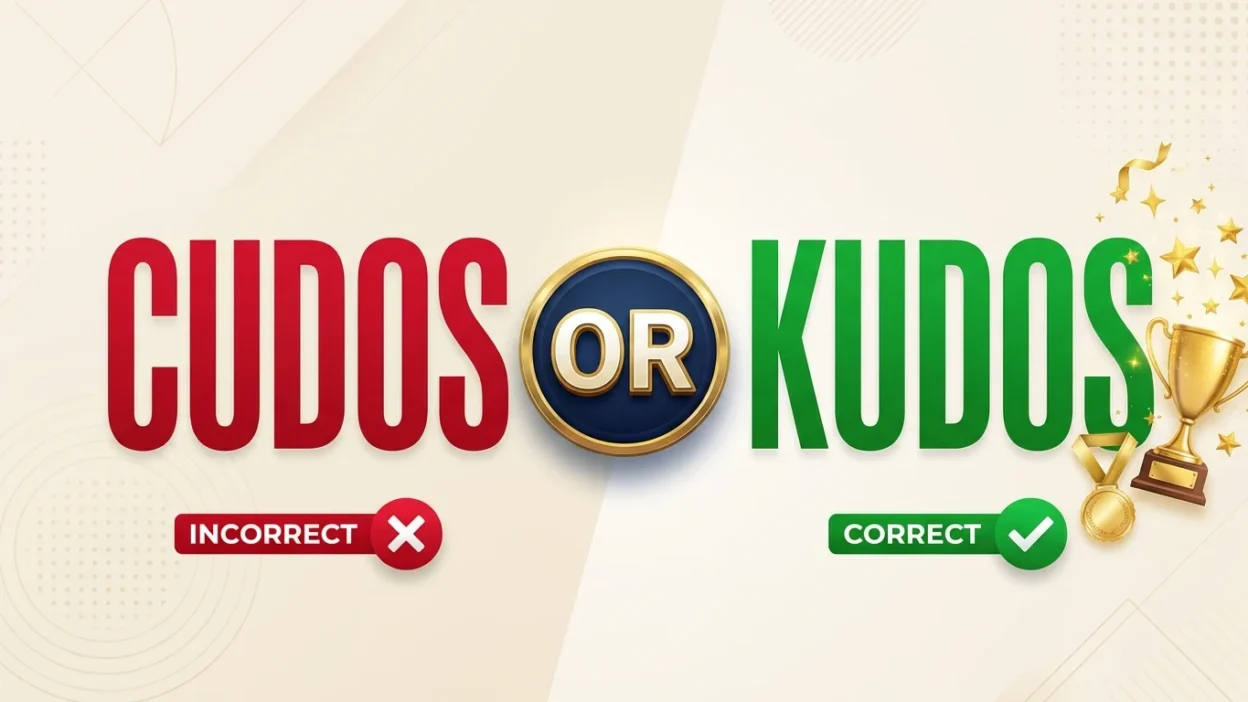
The correct spelling is kudos, not cudos. The word kudos is a noun used to recognize someone’s achievements, hard work, skills, or contributions. You might use it to appreciate a coworker’s performance, congratulate a friend on passing an exam, or recognize a team’s success.
Although cudos sometimes appear in online writing and informal messages, it is generally a misspelling of kudos. Understanding the correct spelling, meaning, pronunciation, and grammatical usage will help you use this word confidently in everyday conversations and professional writing.
Quick Answer:
Kudos is the correct spelling when you mean praise, admiration, credit, or recognition for someone’s achievement. Cudos is a common misspelling and is not the standard English spelling for this meaning. For example, write, “Kudos to Sarah for completing the project successfully,” not “Cudos to Sarah.”
Why Do People Confuse Cudos and Kudos?
People often confuse cudos and kudos because the two spellings look almost identical and are intended to represent the same pronunciation. When someone hears the word kudos without seeing it written, they might assume it starts with C instead of K.
English spelling can make this confusion understandable. The letters C and K can both represent the hard /k/ sound in different words. For example, cat and kite begin with the same consonant sound, even though they use different letters.
There are several reasons for this spelling mistake:
- Similar pronunciation: Both spellings are often intended to sound like KOO-dohz.
- Unfamiliar vocabulary: Some people hear the word in conversations before encountering its written form.
- English spelling patterns: The hard C and K sounds can make the incorrect spelling look believable.
- Typing mistakes: People may accidentally write cudos in emails, messages, comments, or social media posts.
Despite this confusion, kudos is the established English word when expressing praise or recognition. The safest choice is to remember that it always begins with K.
First Word: Kudos (Correct Spelling)
Kudos is the correct word. It is a noun that means praise, admiration, honor, credit, or recognition given to someone for an achievement or something done well.
It is commonly used in everyday conversations, workplaces, schools, emails, and social media.
The word comes from the Greek kydos, meaning glory or fame. It entered English in the late 18th century and developed its modern sense of praise or recognition for an accomplishment.
What Does Kudos Mean?
In simple English, kudos means telling someone that they deserve recognition for doing something well.
Depending on the context, it can express:
- Praise: Showing approval of someone’s work or actions.
- Recognition: Acknowledging an achievement or contribution.
- Admiration: Showing respect for someone’s abilities or efforts.
- Credit: Giving someone acknowledgment for a successful result.
- Appreciation: Recognizing someone’s dedication or hard work.
For example:
“Kudos to you for passing your final exams!”
In this sentence, kudos expresses praise and recognition for the person’s academic achievement.
Is Kudos a Noun?
Yes. Kudos is a noun, not a verb or an adjective. It is generally used as an uncountable noun in modern everyday English.
You can use it in expressions such as:
- Give someone kudos.
- Deserve kudos.
- Receive kudos.
- Get kudos for something.
- Kudos to someone for an achievement.
For example: “The manager gave kudos to the employees for their excellent performance.”
Is Kudos Singular or Plural?
Although kudos ends in S, it is traditionally a singular Greek-derived noun. In modern English, it is commonly used as an uncountable noun meaning praise or recognition.
For example:
- Correct: The kudos she received was well deserved.
- Correct: He deserves a lot of kudos for his hard work.
Avoid assuming that the final S automatically makes the word plural.
Is Kudos Formal or Informal?
Kudos works in both professional and casual situations. It is a friendly, positive expression that recognizes someone’s achievement without sounding overly formal.
Examples:
- Professional: Kudos to our development team for successfully launching the new website.
- Academic: Kudos to the students who achieved excellent examination results.
- Casual: Kudos to you for helping your friend!
- Social media: Kudos to everyone who participated in the competition!
Second Word: Cudos (Incorrect Spelling)
Cudos is generally an incorrect spelling of kudos when someone intends to express praise, admiration, or recognition.
It is not the standard spelling accepted for this meaning in English. People sometimes write it because they associate the pronunciation of kudos with the letter C.
For example:
- Incorrect: Cudos to you for your hard work!
- Correct: Kudos to you for your hard work!
- Incorrect: She deserves cudos for her success.
- Correct: She deserves kudos for her success.
- Incorrect: Cudos to the team for finishing the project early.
- Correct: Kudos to the team for finishing the project early.
If you are writing an academic assignment, professional email, article, or social media post, choose kudos instead of cudos.
Cudos vs. Kudos: Comparison Table
| Feature | Cudos | Kudos |
| Spelling | Incorrect in this meaning | Correct |
| Meaning | Misspelling of kudos | Praise or recognition |
| Part of speech | Not standard in this usage | Noun |
| Pronunciation | Intended as KOO-dohz | KOO-dohz |
| Dictionary usage | Not the standard spelling | Established English word |
| Usage | Avoid in standard writing | American and British English |
| Example | Cudos to you! ❌ | Kudos to you! ✅ |
Important: You may occasionally encounter kudo as a back-formation referring to one expression of praise. However, kudos is the traditional and much more widely established form. In ordinary writing, it is best to use kudos.
When Should You Use Kudos?
Use kudos whenever you want to recognize someone’s accomplishment, effort, ability, or contribution. It is especially useful when a person or group deserves appreciation for something they have done well.
1. Use Kudos to Praise Someone’s Achievement
When someone accomplishes something impressive, you can use kudos to show admiration.
Example: Kudos to Emma for winning the national competition!
2. Use Kudos in the Workplace
You can recognize an employee, coworker, manager, or team for completing a project or performing an important task.
Example: Kudos to our marketing team for delivering excellent results.
3. Use Kudos in School and Education
Teachers, students, and parents can use the word to recognize academic success, dedication, or improvement.
Example: Kudos to all the students who worked hard and improved their grades.
4. Use Kudos to Appreciate Hard Work
Sometimes success comes from dedication and effort rather than winning an award. You can use kudos to recognize that effort.
Example: Kudos to Daniel for never giving up on his goals.
5. Use Kudos on Social Media
The word is also suitable for posts, comments, and messages celebrating someone’s good news.
Example: Kudos to my sister for achieving her dream!
12 Examples of Kudos in Everyday Sentences
Here are 12 practical kudos sentence examples showing how to use the word naturally in different situations.
- Kudos to you for passing your final exams!
- Kudos to Sarah for completing the project ahead of schedule.
- The manager gave kudos to the employees for their hard work.
- Kudos to the entire team for delivering an excellent presentation.
- You deserve kudos for handling the situation so professionally.
- Kudos to James for helping his classmates with their assignments.
- The teacher gave kudos to the students who improved their grades.
- Kudos to everyone who participated in the competition.
- She received kudos for presenting such a creative idea.
- Kudos to our volunteers for making the event successful.
- He deserves kudos for solving such a difficult problem.
- Kudos to you for staying positive and never giving up.
These examples demonstrate that kudos can be used to praise individuals, groups, students, employees, and anyone who deserves recognition.
Common Mistakes to Avoid When Using Kudos
Even though kudos is a relatively simple word, people sometimes misunderstand its spelling, meaning, or grammatical use.
Here are some common mistakes to avoid.
1. Writing Cudos Instead of Kudos
This is the most common spelling mistake.
- Incorrect: Cudos for your achievement!
- Correct: Kudos for your achievement!
Always remember that the correct word starts with K.
2. Thinking Kudos Means Good Luck
Kudos does not mean good luck. It expresses praise or recognition, usually because someone has already done something well.
- Kudos to you for winning the competition!
- Good luck with your upcoming competition!
The first sentence recognizes an achievement, while the second expresses a wish for future success.
3. Using Kudos as a Verb
Kudos is a noun, so it should not be used as a regular verb.
- Incorrect: I kudos your work.
- Correct: I give you kudos for your excellent work.
You can also say, “Your work deserves recognition.”
4. Assuming Kudos Is Always Plural
The final S can make the word look plural, but kudos is traditionally singular and is commonly used as an uncountable noun.
- Correct: She received a lot of kudos.
- Correct: The kudos he received was well deserved.
5. Confusing Kudos With Thank You
Kudos and thank you express different ideas.
- Thank you: Expresses gratitude for someone’s help or kindness.
- Kudos: Expresses praise or recognition for someone’s achievement.
For example:
“Thank you for helping me with my homework.”
“Kudos to you for getting the highest marks in class!”
6. Confusing Kudos With Congratulations
Both expressions can be used when someone succeeds, but their meanings are slightly different.
- Kudos: Recognizes someone’s effort, skill, or achievement.
- Congratulations: Expresses happiness or good wishes about someone’s success.
For example:
“Kudos to you for completing the difficult project!”
“Congratulations on your new job!”
Memory Trick: How to Remember Kudos
A simple way to remember the correct spelling is:
K for Kudos, K for the correct spelling!
You can also connect the word with kindness and recognition. When someone does something worthy of praise, give them kudos.
Remember this sentence:
“Kudos to you for your success!”
Whenever you feel unsure whether to write cudos or kudos, remember that the correct word begins with K.
American vs. British English: Cudos or Kudos?
There is no spelling difference between American English and British English when it comes to kudos.
Both varieties use the same spelling and meaning. The word is also widely understood in other English-speaking countries, including Canada and Australia.
| English Variety | Correct Spelling | Example |
| American English | Kudos | Kudos to the team! |
| British English | Kudos | Kudos to the team! |
| Canadian English | Kudos | Kudos to you! |
| Australian English | Kudos | Kudos to everyone! |
The spelling cudos is not a standard alternative in any of these varieties when expressing praise.
Similar Words and Synonyms of Kudos
If you want to express praise, admiration, or appreciation without repeating the word kudos, you can use several related English words.
However, each synonym has a slightly different meaning and works better in particular situations.
| Synonym | Meaning | Example |
| Praise | Expressing approval or admiration | She received praise for her excellent work. |
| Credit | Recognition for an achievement or contribution | He deserves credit for solving the problem. |
| Recognition | Acknowledgment of someone’s efforts | She received recognition for her research. |
| Appreciation | Showing gratitude or value | We appreciate your dedication. |
| Admiration | Respect for someone’s qualities or achievements | I have great admiration for her courage. |
| Acclaim | Public praise or approval | The writer received widespread acclaim. |
| Congratulations | Expressing happiness about someone’s success | Congratulations on your promotion! |
| Compliment | A positive remark about someone | She gave me a compliment about my presentation. |
| Commendation | Formal recognition for good work | He received a commendation for his bravery. |
| Applause | Approval or appreciation, often expressed by clapping | The audience gave the performers a round of applause. |
These synonyms for kudos can make your writing more varied and help you choose the right expression for different situations.
Final Verdict:
The correct spelling is kudos, not cudos, when you want to express praise, admiration, credit, or recognition.
Use kudos when appreciating someone’s hard work, celebrating an achievement, recognizing a contribution, or praising excellent performance. It is suitable for everyday conversations, school assignments, workplace communication, professional emails, and social media.
Although cudos may look and sound believable, it is not the standard English spelling for this meaning. Remember the simple rule: Kudos starts with K, not C.
FAQs
1. Is it cudos or kudos?
Kudos is the correct spelling when expressing praise, admiration, or recognition. Cudos is a common misspelling. For example, write “Kudos to you for your hard work!”
2. What does kudos mean in simple English?
Kudos means praise or recognition given to someone for doing something well. It is a way to show that you appreciate someone’s achievement, effort, or contribution.
3. Is cudos a real English word?
Cudos is not the standard spelling of the English word meaning praise or recognition. It is generally treated as a misspelling of kudos in this context.
4. How do you pronounce kudos?
Kudos is commonly pronounced KOO-dohz. It has two syllables, with the stress on the first syllable. The pronunciation begins with a K sound.
5. Is kudos singular or plural?
Kudos is traditionally a singular noun, although it ends in S. In modern English, it is commonly used as an uncountable noun meaning praise or recognition. For example, “She received a lot of kudos for her work.”
6. Can I say kudos to you?
Yes! “Kudos to you!” is a natural and widely understood expression used to praise someone for an achievement, effort, or good performance.
7. Is kudos formal or informal?
Kudos can be used in both formal and informal communication. It is appropriate for workplace emails, professional recognition, school discussions, friendly conversations, and social media posts.
8. What is another word for kudos?
Common alternatives include praise, recognition, credit, admiration, appreciation, acclaim, and commendation. The best alternative depends on the situation and the meaning you want to express.
Remember This
When you mean praise, admiration, or recognition, remember these simple points:
- Kudos = Correct spelling.
- Cudos = Common misspelling.
- Kudos = Praise, credit, or recognition.
- Kudos = A noun, traditionally singular.
- Kudos = Used in both American and British English.
- Kudos to you! = A natural expression of praise.
The easiest memory trick is K for Kudos. Whenever someone does something worthy of recognition, give them kudos, not cudos.
Conclusion
Choosing between cudos or kudos becomes easy once you understand the correct spelling and meaning. Kudos is the standard English word used to express praise, admiration, appreciation, and recognition for someone’s achievement or hard work.
On the other hand, cudos is generally a spelling mistake when used with this meaning. Although the two versions may sound similar, they are not interchangeable in standard English writing.
If you are writing a professional email, completing a school assignment, sending a message, or celebrating someone’s success on social media, always choose kudos. Remember that it starts with K, and use it whenever someone deserves praise for doing something well.