
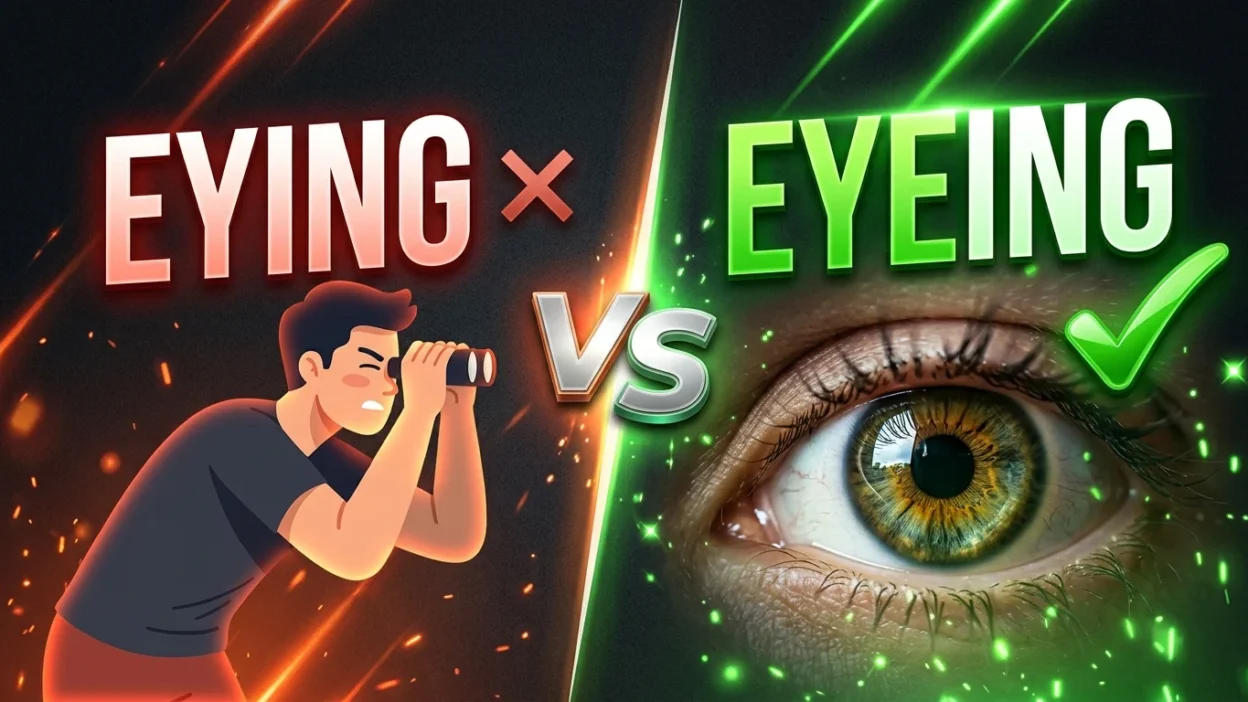
Have you ever stopped while writing because you were unsure whether to spell the word eying or eyeing? Both forms look reasonable, especially because they come from the word eye.
However, their slightly different spellings can make students, English learners, and even experienced writers question which version is correct. Should you remove the final letter e before adding -ing, or should you keep the complete word?
The good news is that both eying and eyeing are correct English spellings. They are alternative forms of the present participle of the verb eye, meaning to look at someone or something carefully, often with interest, curiosity, suspicion, or desire.
The main difference is spelling preference, not meaning or pronunciation. Although eying is an accepted variant, eyeing is a familiar and widely preferred choice for general writing.
This guide explains both spellings, their grammatical uses, spelling rules, and practical examples so you can choose the right form confidently.
Quick Answer:
Both eying and eyeing are correct spellings of the present participle of the verb eye. They have the same meaning, pronunciation, and grammatical function. Both describe looking at someone or something with attention, interest, suspicion, or desire. However, eyeing is the more familiar general-purpose spelling, while eying is an accepted alternative. For everyday, academic, and professional writing, eyeing is a sensible choice.
Why Do People Confuse Eying and Eyeing?
The confusion between eying vs. eyeing comes from the unusual spelling of the base word eye and the way English forms present participles.
In English, we generally add -ing to a verb to describe an ongoing action. However, when a verb ends in a silent e, that final letter is usually removed before adding the suffix.
For example:
- Make → Making
- Write → Writing
- Take → Taking
- Smile → Smiling
- Dance → Dancing
Following this common English spelling rule, some writers expect eye to become eying.
However, English also accepts eyeing, which keeps the complete base word eye before adding -ing. Both forms are recorded as spelling variants.
Another reason for confusion is that both words are pronounced exactly the same way in ordinary English. There is no difference in sound, meaning, or grammatical function.
The important thing to remember is that eying is not automatically a spelling mistake, and eyeing is not the only acceptable form.
What Does Eying Mean?
Eying is an accepted alternative spelling of eyeing. It is the present participle of the verb eye, which means to look at someone or something carefully or with particular interest.
Depending on the context, it can describe looking with curiosity, desire, suspicion, admiration, or careful attention.
For example:
- The little boy was eying the chocolate cake.
- She kept eying the beautiful dress in the shop window.
- The manager was eying the new employee suspiciously.
- He was eying the empty seat near the window.
- Investors are eying opportunities in the technology market.
In these sentences, eying describes the same action as eyeing. It is grammatically correct, although it may look less familiar to some readers.
What Does Eyeing Mean?
Eyeing is the more familiar spelling of the present participle of the verb eye. It means looking at someone or something with special attention, interest, curiosity, suspicion, or desire.
The word often suggests that someone is interested in something, wants to have it, is considering it, or is watching it carefully.
For example:
- She was eyeing the last piece of pizza.
- The cat was eyeing a small bird outside.
- He was eyeing a new car at the dealership.
- The security guard was eyeing the suspicious visitor.
- The company is eyeing international markets.
The word eyeing is useful in everyday conversations, academic writing, business articles, news reports, and professional documents.
It can also describe someone considering an opportunity rather than simply looking at a physical object.
For example, “She is eyeing a promotion” means she is interested in or considering the possibility of getting promoted.
Eying vs. Eyeing: Key Differences at a Glance
The following comparison table explains the similarities and differences between these two spellings.
| Feature | Eying | Eyeing |
| Correct spelling | Yes | Yes |
| Base word | Eye | Eye |
| Part of speech | Verb form | Verb form |
| Grammatical form | Present participle | Present participle |
| Meaning | Looking with attention or interest | Looking with attention or interest |
| Pronunciation | EYE-ing | EYE-ing |
| Accepted in English | Yes | Yes |
| General familiarity | Less familiar | More familiar |
| General writing choice | Accepted alternative | Recommended default |
The main difference between eying and eyeing is their spelling. Both words have the same definition, pronunciation, and grammatical function.
Here is another simple comparison:
- Eyeing: The more familiar spelling, which preserves the complete base word eye.
- Eying: An accepted alternative spelling that follows the shorter spelling pattern.
- Both: Describe looking at or considering someone or something carefully.
Therefore, you do not need to learn two different meanings. You only need to understand that English accepts two spellings of the same verb form.
Are Eying and Eyeing the Same Word?
Yes. Eying and eyeing are alternative spellings of the same word. Both come from the verb eye and function as its present participle.
The verb eye means to look at something or someone carefully. It can also suggest that someone is considering something they want or watching someone with suspicion.
Consider these two sentences:
- Jordan was eyeing the new bicycle in the store.
- Jordan was eying the new bicycle in the store.
Both sentences communicate exactly the same message. Jordan is looking at the bicycle with interest.
Similarly, a customer might be eyeing a new phone, a manager might be eying a candidate for promotion, or an investor might be eying a promising business opportunity.
The spelling does not change the intended meaning. The surrounding sentence provides the context.
When Should You Use Eying or Eyeing?
Although both spellings are correct, choosing one form consistently makes your writing easier to read.
When to Use Eying
Use eying when you prefer the shorter accepted spelling or when it matches the dictionary, publication, or editorial style you follow.
Examples:
- The children were eying the toys.
- He was eying the opportunity to start a business.
- She was eying the delicious food.
- The customer kept eying the expensive headphones.
There is no need to automatically correct eying when you find it in an edited article, book, or other English text.
When to Use Eyeing
Use eyeing when you want the more familiar and widely preferred spelling for general English writing.
Examples:
- She was eyeing the new handbag.
- The dog was eyeing its owner’s dinner.
- Investors are eyeing new business opportunities.
- The manager is eyeing several candidates for the position.
For school assignments, website articles, business reports, and professional emails, eyeing is a sensible default.
Should You Switch Between the Two Spellings?
It is better to choose one spelling and use it consistently throughout a document.
For example, if you begin an article with eyeing, continue using eyeing instead of switching to eying in another paragraph.
Although both forms are correct, consistent spelling gives your writing a more polished appearance.
15 Examples of Eying and Eyeing in Sentences
These eying vs. eyeing examples demonstrate how both spellings work in everyday English.
- She was eyeing the chocolate cake on the kitchen table.
- He kept eying the expensive watch in the store.
- The cat was eyeing a small bird in the garden.
- The children were eying the presents under the Christmas tree.
- I noticed him eyeing my new laptop.
- The businessman was eying a new investment opportunity.
- She was eyeing the last slice of pizza.
- The security guard was eying the stranger suspiciously.
- He stood near the window, eying the beautiful scenery.
- The dog was eying the food on the kitchen counter.
- The company is eyeing international markets.
- The student was eying the clock during the exam.
- She kept eying the shoes she wanted to buy.
- The player was eying the championship trophy.
- The tourist was eyeing the souvenirs in the shop.
Paired Examples: Eying vs. Eyeing
Here are some sentences that use both spellings to make the difference even clearer.
| With Eyeing | With Eying |
| Mia was eyeing the last cookie. | Mia was eying the last cookie. |
| He was eyeing a new apartment. | He was eying a new apartment. |
| The dog was eyeing the food. | The dog was eying the food. |
| She was eyeing the clock. | She was eying the clock. |
| Investors are eyeing the market. | Investors are eying the market. |
As you can see, the meaning remains exactly the same. Only the spelling changes.
Common Mistakes to Avoid
Even though both spellings are correct, writers sometimes misunderstand their meanings, grammatical roles, or regional preferences.
Here are five common mistakes and their corrections.
1. Thinking Eying Is Always Incorrect
Some writers believe that eying is a spelling mistake because eyeing looks more familiar.
Correction: Eying is an accepted English spelling variant. It should not automatically be treated as incorrect.
2. Assuming Both Spellings Have Different Meanings
Another mistake is believing that eyeing means looking with interest while eying means looking suspiciously.
Correction: Both spellings have exactly the same meaning. The context determines whether the action expresses curiosity, desire, suspicion, or attention.
3. Assuming a Strict American and British Difference
Some people think eying is exclusively American and eyeing is exclusively British.
Correction: Both forms are recognized in English. There is no simple rule that assigns each spelling exclusively to one English variety.
4. Switching Spellings Without a Reason
Using eyeing in one paragraph and eying in the next can make an article look inconsistent.
Correction: Select one spelling and maintain it throughout your writing unless you have a specific reason to change it.
5. Confusing the Verb Eye With the Noun Eye
The word eye can function as both a noun and a verb.
- Noun: Her left eye is blue.
- Verb: She was eyeing the beautiful painting.
Correction: Understand the grammatical role of the word before using its different forms.
Memory Trick: How to Remember Eying vs. Eyeing
A simple memory trick can help you remember which spelling to use.
Focus on the original word EYE.
- EYEING: Keeps the complete word eye before adding -ing.
- EYING: Uses the shorter accepted alternative spelling.
Remember this easy sentence:
If you want the more familiar spelling, keep EYE and write EYEING.
This trick is especially helpful for students, ESL learners, and anyone who frequently gets confused by English spelling rules.
American vs. British English: Eying or Eyeing?
Both eying and eyeing are accepted English spellings. However, dictionary entries and regional labeling can vary, so it is not accurate to say that one spelling belongs exclusively to American English and the other exclusively to British English.
For general American English writing, eyeing is a practical and familiar choice. The shorter form eying is also recognized, including in American dictionary usage.
British English also recognizes the spelling eyeing, and eying is an accepted alternative.
| English Variety | Spelling Guidance |
| American English | Eyeing is a familiar choice; eying is accepted. |
| British English | Eyeing is a familiar choice; eying is accepted. |
| Canadian English | Eyeing is a practical general-purpose choice. |
| Australian English | Eyeing is a practical general-purpose choice. |
The safest approach is to follow the dictionary or style guide used by your school, publisher, or workplace.
If you do not have a specific spelling preference to follow, choose eyeing for general writing and use it consistently.
Dictionary-Style Word Details: Eye, Eyeing, and Eying
Understanding the different grammatical forms of eye makes it easier to use both spellings correctly.
Eye as a Noun
The noun eye refers to the organ that allows humans and animals to see.
Example: Her right eye started watering in the cold wind.
Eye as a Verb
The verb eye means to look at someone or something carefully, often with interest, suspicion, or desire.
Example: The customer began to eye the expensive watch.
Eyeing as a Present Participle
Eyeing is the more familiar spelling of the present participle.
Example: She is eyeing a new laptop.
Eying as a Present Participle
Eying is an accepted alternative spelling of the same present participle.
Example: She is eying a new laptop.
Eyed as the Past Tense and Past Participle
The simple past tense and past participle of eye are both eyed.
Examples:
- She eyed the unfamiliar package carefully.
- He has eyed that house for several months.
These forms belong to the same verb and have different grammatical uses.
Word History: Why Does Eyeing Have Two Spellings?
The spelling variation comes from the way English handles verbs ending in the letter e when adding the suffix -ing.
In many cases, the final silent e disappears. For example, make becomes making, and write becomes writing.
The verb eye, however, has two accepted present participle spellings: eyeing and eying.
The spelling eyeing retains the complete base word, while eying uses the shorter form. Both are established spelling variants, rather than words with separate origins or definitions.
The important point is that a general spelling rule does not always explain every established English word. Dictionary usage helps confirm which forms are accepted.
Synonyms of Eying and Eyeing
Because eying and eyeing have the same meaning, they also share the same synonyms.
Depending on the context, useful alternatives include:
- Looking at: Directing your eyes toward someone or something.
- Watching: Paying attention to someone or something over a period of time.
- Observing: Looking carefully to notice details.
- Staring: Looking at someone or something for a long time.
- Gazing: Looking steadily, often with admiration or interest.
- Inspecting: Examining something carefully.
- Studying: Looking at something closely to understand it.
- Peering: Looking closely, especially when something is difficult to see.
- Glancing: Looking quickly at something.
- Eyeing: Looking at someone or something with particular interest or attention.
These words are related but are not always interchangeable.
For example, inspecting suggests a careful examination, while gazing often expresses admiration. Similarly, eyeing can suggest interest, desire, or suspicion depending on the situation.
Common Phrases Containing Eyeing and Eying
Both spellings can appear in similar expressions. Here are some useful phrases and their meanings.
- Eyeing the last slice: Looking at the final piece of food with interest or desire.
- Eying the last slice: The same meaning as the previous phrase.
- Eyeing a job opportunity: Considering or showing interest in a possible job.
- Eying a job opportunity: The same meaning.
- Eyeing the competition: Watching competitors carefully.
- Eying the competition: The same meaning.
- Eyeing a new home: Considering a house someone may want to buy.
- Eying a new home: The same meaning.
- Eyeing a promotion: Showing interest in a possible promotion.
- Eying a promotion: The same meaning.
These expressions show that the spelling choice does not change the message.
FAQs
1. Is it eying or eyeing?
Both eying and eyeing are correct English spellings. They are alternative forms of the present participle of eye and have the same meaning. However, eyeing is the more familiar general-purpose spelling.
2. Is eying a real word?
Yes, eying is a real and accepted English word. It is an alternative spelling of eyeing and means looking at someone or something with interest, attention, suspicion, or desire.
3. What is the difference between eyeing and eying?
There is no difference in meaning, pronunciation, or grammatical function. Both words describe the action of looking at or considering someone or something carefully. The only difference is their spelling.
4. Is eyeing correct in American English?
Yes, eyeing is correct in American English and is a familiar spelling for general writing. The alternative spelling eying is also accepted, so neither should automatically be considered incorrect.
5. Why does eyeing have two spellings?
The verb eye has two accepted present participle forms: eyeing and eying. One retains the complete base word, while the other uses a shorter spelling. Both forms are recognized in English dictionaries.
6. Does eyeing mean staring at someone?
Not necessarily. Eyeing means looking at someone or something with particular attention. It can suggest staring, curiosity, suspicion, admiration, or desire, depending on the context.
7. How do you use eyeing in a sentence?
You can use eyeing to describe someone looking at something with interest or attention. For example: “She was eyeing the chocolate cake on the kitchen counter.”
8. Is eyeing or eying better for formal writing?
Eyeing is a sensible choice for most formal and professional writing because it is familiar to many readers. However, eying is also an accepted spelling. Follow your preferred dictionary or publication style and remain consistent.
9. What is the past tense of eye?
The simple past tense of eye is eyed. Its past participle is also eyed. For example: “He eyed the unfamiliar package carefully.”
10. What are some synonyms for eyeing?
Common synonyms include watching, observing, looking at, inspecting, studying, and peering. The best alternative depends on the context and the type of attention being described.
Remember This: Eying vs. Eyeing
Before you finish, remember these important points:
- Eying is a correct and accepted spelling.
- Eyeing is also correct and more familiar in general writing.
- Both words come from the verb eye.
- Both have the same meaning and pronunciation.
- Neither spelling has a separate grammatical function.
- Eyeing is a sensible choice for everyday, academic, and professional writing.
- The past tense and past participle of eye are eyed.
- Choose one spelling and use it consistently.
Conclusion
The difference between eying and eyeing is a matter of spelling, not meaning. Both are accepted forms of the present participle of the verb eye, which means to look at someone or something carefully, often with interest, curiosity, suspicion, or desire. Although the two forms look slightly different, they have the same pronunciation and grammatical function. Therefore, you should not automatically treat eying as a spelling mistake.
If you are unsure which spelling to use, choose eyeing. It is a familiar and widely preferred form for general English writing, including school assignments, articles, emails, and professional documents. Remember that eying is also correct, and the best practice is to follow your preferred dictionary or style guide. Once you understand that both spellings are acceptable, choosing between them becomes much easier.

Cole Jaxson is the administrator of SymbolPeak, overseeing site management and content integrity. He is dedicated to presenting Bible-based spiritual symbol meanings with accuracy, reverence, and clarity, ensuring the platform remains trustworthy, well-organized, and aligned with biblical teachings and faith-centered understanding for readers worldwide.