
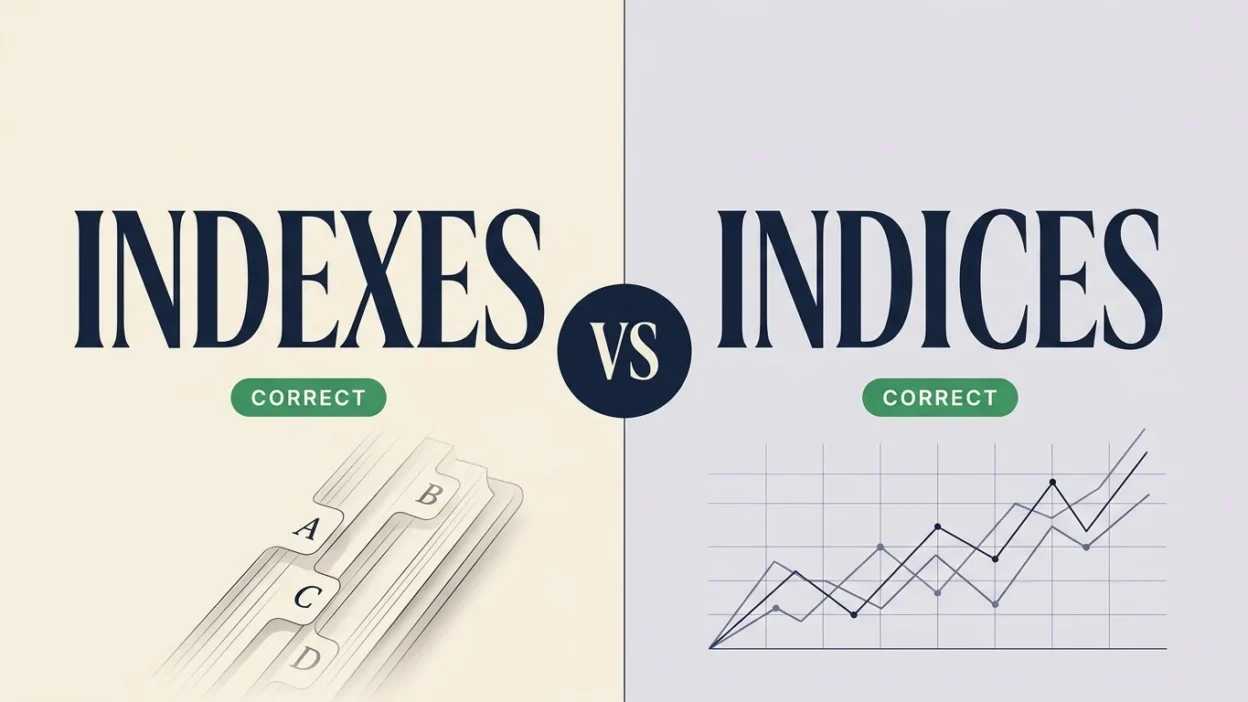
The words indexes and indices are both correct plural forms of the noun index. However, they are not used equally in every situation. While indexes is common in general English, book publishing, databases, and everyday writing, indices is traditionally preferred in mathematics, statistics, economics, and other technical fields. Both forms can also refer to measurements, indicators, and organized lists.
If you are wondering whether to write indexes or indices, the answer depends mainly on your subject, audience, and writing style. The word indices comes from the Latin plural form, while indexes follows the regular English plural pattern.
American writers often prefer indexes in general contexts, whereas indices is widely used in British and international technical writing. Understanding these differences will help you choose the right plural form and use it confidently in academic, professional, and everyday communication.
Quick Answer: Indexes or Indices?
Both indexes and indices are correct plurals of index. Use indexes for general lists, book references, bibliographies, and databases. Use indices more often in mathematics, statistics, science, and technical writing. American English generally favors indexes in everyday contexts, while indices is common in British and international usage. Context and consistency matter most.
Why Do People Confuse Indexes and Indices?
People often confuse indexes vs. indices because English allows two different plural forms for the same singular noun. Most English nouns form their plurals by adding -s or -es, but some words borrowed from Latin and Greek retain their original plural endings.
The word index is one of these nouns. Its regular English plural is indexes, while its traditional Latin-derived plural is indices.
Another reason for the confusion is that both words can describe similar things. For example, a financial publication might discuss stock indexes or stock indices, and both expressions are acceptable.
However, certain subjects have established preferences:
- General English: Indexes is widely used.
- Books and publishing: Indexes is usually preferred.
- Bibliographies and reference lists: Indexes is the natural choice.
- Mathematics: Indices is traditionally preferred.
- Statistics and science: Indices is common.
- Economics and finance: Both forms are used, depending on the publication and terminology.
The important point is that neither spelling is incorrect. The difference is mainly related to language history, subject conventions, and regional preferences.
What Is the Meaning of Index?
An index is a noun that can describe a list, number, indicator, or system used to organize information or measure something.
The word has several meanings depending on the context.
- A reference list: An alphabetical list of names, subjects, topics, or keywords, usually found at the back of a book.
- A measurement: A numerical value used to show or compare changes in something.
- An indicator: A sign or measurement that provides information about a particular condition.
- A database structure: An organized system that helps computers locate and retrieve information efficiently.
- A mathematical expression: A number or symbol associated with a quantity, such as an exponent or subscript.
The word index can also function as a verb. To index something means to arrange, record, or organize information so that it can be found easily.
For example:
- The publisher added an index to the textbook.
- The economic index measures changes in prices.
- The librarian will index the new collection.
- The database uses an index to retrieve records.
Indexes: Meaning, Definition, and Examples
Indexes is the regular English plural of index. It refers to two or more lists, indicators, reference systems, or organized collections of information.
It is particularly common in everyday writing, publishing, libraries, computing, and general communication.
When Should You Use Indexes?
Use indexes in these situations:
1. Books and Publishing
When discussing alphabetical lists of subjects, names, or topics at the end of books, indexes is the natural choice.
Example: The reference books contain detailed indexes to help readers locate specific information.
2. Bibliographies and Reference Materials
Use indexes when referring to organized lists that help readers find books, authors, articles, or other sources.
Example: The librarian updated the indexes of several academic publications.
3. Databases and Computing
In computer science, a database index is a structure that helps retrieve information more efficiently.
Example: The developers created separate indexes for the customer database.
4. General Indicators
The word indexes can describe several measurements or indicators.
Example: Researchers compared different indexes to understand changes in living conditions.
5. Everyday and Nontechnical Writing
When you are not following a specialized technical convention, indexes is a straightforward and widely accepted choice.
Example: The website provides several indexes for its educational resources.
More Examples of Indexes in Sentences
- The encyclopedia contains multiple indexes.
- Students used the indexes to find important topics.
- The publisher prepared separate indexes for each volume.
- Several financial indexes showed positive growth.
- The database contains indexes for customer names and addresses.
- The library maintains indexes of historical documents.
Indices: Meaning, Definition, and Examples
Indices is the traditional Latin-derived plural of index. It is especially common in mathematics, statistics, economics, science, and other technical subjects.
The word is often used when referring to mathematical values, numerical expressions, scientific measurements, and statistical indicators.
When Should You Use Indices?
Use indices in these situations:
1. Mathematics
In mathematics, indices commonly refers to exponents or powers. For example, in the expression (2^3), the number 3 is the index (also called an exponent).
Example: Students learned how to simplify expressions using the laws of indices.
2. Statistics
Statistical indices are numerical measures used to summarize, compare, or evaluate information.
Example: The researchers calculated several statistical indices to analyze the results.
3. Science
Scientists use different indices to measure environmental conditions, health indicators, and other measurable factors.
Example: The scientists compared pollution indices across several cities.
4. Economics
Economic indices help measure changes in prices, employment, production, and other economic conditions.
Example: Economists examined inflation indices to understand changes in purchasing power.
5. Technical and Academic Writing
Many academic and professional publications prefer indices when following traditional mathematical or scientific terminology.
Example: The research paper compares different performance indices.
More Examples of Indices in Sentences
- The teacher explained the rules of indices.
- Scientists developed new environmental indices.
- Economic indices provide useful information about market conditions.
- The equation contains several numerical indices.
- Researchers compared health indices across different populations.
- The mathematician demonstrated how to calculate fractional indices.
Indexes vs. Indices: Comparison Table
| Feature | Indexes | Indices |
| Singular form | Index | Index |
| Plural form | Indexes | Indices |
| Grammatical status | Correct | Correct |
| Word origin | Regular English plural | Latin-derived plural |
| General English | Very common | Less common |
| Books and publishing | Commonly preferred | Less common |
| Bibliographies | Commonly preferred | Less common |
| Mathematics | Accepted | Traditionally preferred |
| Statistics | Accepted | Common |
| Science | Accepted | Common |
| Economics | Common | Common |
| Databases | Common | Also used |
| American English | Common | Accepted |
| British English | Accepted | Widely used |
| Pronunciation | IN-dek-siz | IN-duh-seez |
Both spellings are standard English. The main difference is their traditional usage and the conventions followed in different subjects.
What Is the Difference Between Indexes and Indices?
The difference between indexes and indices is not their basic meaning but their formation and preferred contexts.
Indexes follows the regular English plural rule by adding -es to the singular noun. Indices comes from the traditional Latin plural form.
Consider these differences:
- Indexes: Usually preferred for general lists, book references, bibliographies, and database systems.
- Indices: Traditionally preferred for mathematical expressions, scientific measurements, and statistical calculations.
- Regional usage: Indexes is especially common in American general writing, while indices has a strong presence in British and international technical writing.
- Meaning: Both can describe multiple indicators, lists, or reference systems.
For example:
- The library contains several book indexes.
- The mathematician calculated several mathematical indices.
Both sentences use the correct plural form for their respective contexts.
Indexes vs. Indices in American and British English
The choice between indexes and indices can also depend on regional writing conventions.
American English
In American English, indexes is generally the more familiar choice in ordinary writing, publishing, and reference materials.
American style conventions, including the Associated Press (AP) preference for indexes, favor the regular English plural in general contexts.
However, indices is also accepted and widely used in mathematical, scientific, and financial terminology.
Examples:
- The textbook includes several indexes.
- The researchers examined economic indices.
- The database contains multiple indexes.
British English
In British English, indices has a long tradition, particularly in formal, mathematical, and scientific writing.
However, indexes is also completely correct and commonly used, especially for books and reference lists.
Examples:
- The mathematical textbook explains the laws of indices.
- The library contains several indexes.
- Economists compared international price indices.
American vs. British English Comparison
| Context | American English | British English |
| General writing | Indexes | Both |
| Book references | Indexes | Indexes |
| Mathematics | Indices | Indices |
| Scientific writing | Both | Indices is common |
| Financial writing | Both | Both |
These are general preferences, not strict geographical rules. Always follow your publication’s style guide or the terminology used in your field.
Can You Use Indexes and Indices Interchangeably?
Yes. In many situations, indexes and indices can be used interchangeably without changing the basic meaning.
For example:
- The report compares several stock indexes.
- The report compares several stock indices.
Both sentences are correct.
Similarly:
- The researchers studied different economic indexes.
- The researchers studied different economic indices.
Both forms can work in this context.
However, interchangeability does not mean that every subject treats the two forms equally. Mathematics textbooks traditionally favor indices for powers and exponents, while publishers generally prefer indexes for alphabetical reference lists.
If you are writing an academic paper, business report, or technical document, use the form recommended by your subject or style guide.
Common Mistakes When Using Indexes and Indices
Even though both forms are correct, writers sometimes misunderstand their spelling, meaning, and usage.
1. Thinking Indexes Is Incorrect
Some people believe that indices is the only correct plural because it comes from Latin.
This is incorrect. Indexes is a standard English plural and has been accepted for centuries.
2. Thinking Indices Is Only Used in Mathematics
Although indices is common in mathematics, it is not limited to that subject. It also appears in economics, science, statistics, and finance.
3. Using Indices for Every Book Reference
When discussing alphabetical lists at the back of books, indexes is generally the more natural choice.
Example:
- Natural: The textbook contains detailed indexes.
- Less usual: The textbook contains detailed indices.
4. Assuming American English Does Not Accept Indices
Both forms are accepted in American English. The choice depends on context and writing convention.
5. Confusing Indexes With Indexs
The spelling indexs is incorrect as a standard plural.
The correct forms are:
- One index.
- Two indexes.
- Two indices.
6. Mixing Both Forms Without Consistency
Using indexes in one paragraph and indices in another without a contextual or stylistic reason can make a document feel inconsistent.
Choose a preferred form for your particular subject and use it consistently.
7. Confusing the Noun and Verb Forms
Indexes can also be a verb.
For example:
- Noun: The book contains several indexes.
- Verb: The librarian indexes the new books.
In the second sentence, indexes means that the librarian organizes or records the books in a reference system.
Memory Trick: How to Remember Indexes vs. Indices
A simple memory trick can help you remember which plural to choose.
Think of indexes as the everyday English form and indices as the traditional technical form.
Remember:
- Indexes = Books, lists, references, and databases.
- Indices = Mathematics, science, statistics, and technical measurements.
Another way to remember is to connect indices with mathematical exponents and powers, where it is a familiar term.
This is a useful guideline, but remember that both words can appear in overlapping contexts.
What Are the Singular and Plural Forms of Index?
The singular noun is index, and it has two accepted plural forms: indexes and indices.
| Number | Word | Example |
| Singular | Index | This book has an index. |
| Plural | Indexes | These books have indexes. |
| Plural | Indices | These equations contain indices. |
The verb also has different forms:
- Index: Base form.
- Indexes: Third-person singular present tense.
- Indexed: Simple past and past participle.
- Indexing: Present participle.
Examples:
- The librarian indexes new publications.
- The researcher indexed the documents.
- The company is indexing its records.
Understanding these forms helps prevent confusion between the noun and verb uses of index.
Similar Words With More Than One Plural Form
English contains several nouns with alternative plural forms. Some follow regular English spelling rules, while others retain traditional Latin or Greek endings.
Here are some common examples:
| Singular | Regular Plural | Traditional or Alternative Plural |
| Index | Indexes | Indices |
| Appendix | Appendixes | Appendices |
| Matrix | Matrixes | Matrices |
| Formula | Formulas | Formulae |
| Focus | Focuses | Foci |
| Vertex | Vertexes | Vertices |
| Cactus | Cactuses | Cacti |
| Octopus | Octopuses | Octopodes |
| Bureau | Bureaus | Bureaux |
| Curriculum | Curriculums | Curricula |
These words demonstrate how English has adopted different pluralization patterns from other languages.
Learning regular and irregular plural nouns, including Latin-derived plurals, can improve your spelling, grammar, and vocabulary.
Synonyms and Related Words for Index
The word index has different meanings, so its synonyms depend on the context.
| Meaning of Index | Related Words |
| A list or reference | Catalog, register, directory, listing |
| A measurement | Indicator, measure, ratio, metric |
| A sign or clue | Signal, indication, evidence, pointer |
| A mathematical term | Exponent, power, index number |
| An organized system | Database, reference system, classification |
These words are related in meaning, but they are not always interchangeable. Choose a synonym according to the specific meaning of index in your sentence.
Final Verdict: Indexes or Indices?
The correct answer is that both indexes and indices are grammatically correct plural forms of index.
Choose indexes when writing about books, bibliographies, general lists, databases, and everyday references. Choose indices when discussing mathematical powers, scientific measurements, statistics, and other technical subjects where that form is traditionally preferred.
In American English, indexes is especially common in general writing, while indices is also accepted in specialized contexts. In British English, both forms are correct, with indices frequently appearing in formal and technical writing.
Ultimately, the best choice depends on your audience, subject, and preferred style. Neither spelling is universally more correct than the other.
Frequently Asked Questions
1. Is it indexes or indices?
Both indexes and indices are correct plural forms of index. Indexes is commonly used for books, lists, and databases, while indices is traditionally preferred in mathematics, science, and technical writing.
2. What is the plural of index?
The noun index has two accepted plural forms: indexes and indices. Both are grammatically correct, and the appropriate form depends on the context.
3. Is indices the plural of index?
Yes. Indices is the traditional Latin-derived plural of index. It is widely used in mathematics, statistics, science, economics, and technical writing.
4. Is indexes grammatically correct?
Yes. Indexes is a standard English plural form of index. It is commonly used in everyday English, books, publishing, bibliographies, and computing.
5. Which is correct in American English: indexes or indices?
Both forms are correct in American English. However, indexes is generally preferred in everyday writing and under conventions such as AP style, while indices is common in mathematical and scientific contexts.
6. Which is correct in British English: indexes or indices?
Both forms are accepted in British English. Indices is traditionally common in formal and technical writing, while indexes is widely used for books, lists, and general references.
7. Why do mathematicians use indices instead of indexes?
Mathematicians traditionally use indices when referring to powers, exponents, and mathematical expressions. The word comes from the Latin plural form of index and is established mathematical terminology.
8. Can indexes and indices be used interchangeably?
Yes, in many general contexts, both forms can be used without changing the meaning. However, specialized fields and style guides may prefer one form, so consistency is important.
Remember This
- Index is the singular form.
- Indexes is the regular English plural.
- Indices is the traditional Latin-derived plural.
- Both forms are grammatically correct.
- Indexes is common in books, databases, and general writing.
- Indices is traditionally preferred in mathematics, statistics, and science.
- Both spellings are accepted in American and British English.
- Always follow your subject’s terminology and maintain consistency.
Conclusion
Understanding indexes vs. indices is easier when you remember that both words are correct plurals of the same noun. Their difference comes from their origins and traditional usage. Indexes follows the regular English plural pattern, while indices retains the traditional Latin ending. Although their meanings often overlap, different subjects and writing conventions may favor one form over the other.
For everyday writing, books, bibliographies, and databases, indexes is usually a safe and natural choice. For mathematical expressions, scientific measurements, and statistical terminology, indices is often preferred. If you are a student, teacher, researcher, or general reader, knowing these differences will help you use both words accurately and confidently.