Have you ever wondered whether to write potatoes or potatos and tomatoes or tomatos? These common spelling questions can confuse students, English learners, and even confident writers.
Although many English nouns form their plurals by adding -s, some words ending in -o follow a different pattern. Knowing which ending to use can help you avoid mistakes in school assignments, recipes, shopping lists, and everyday writing.
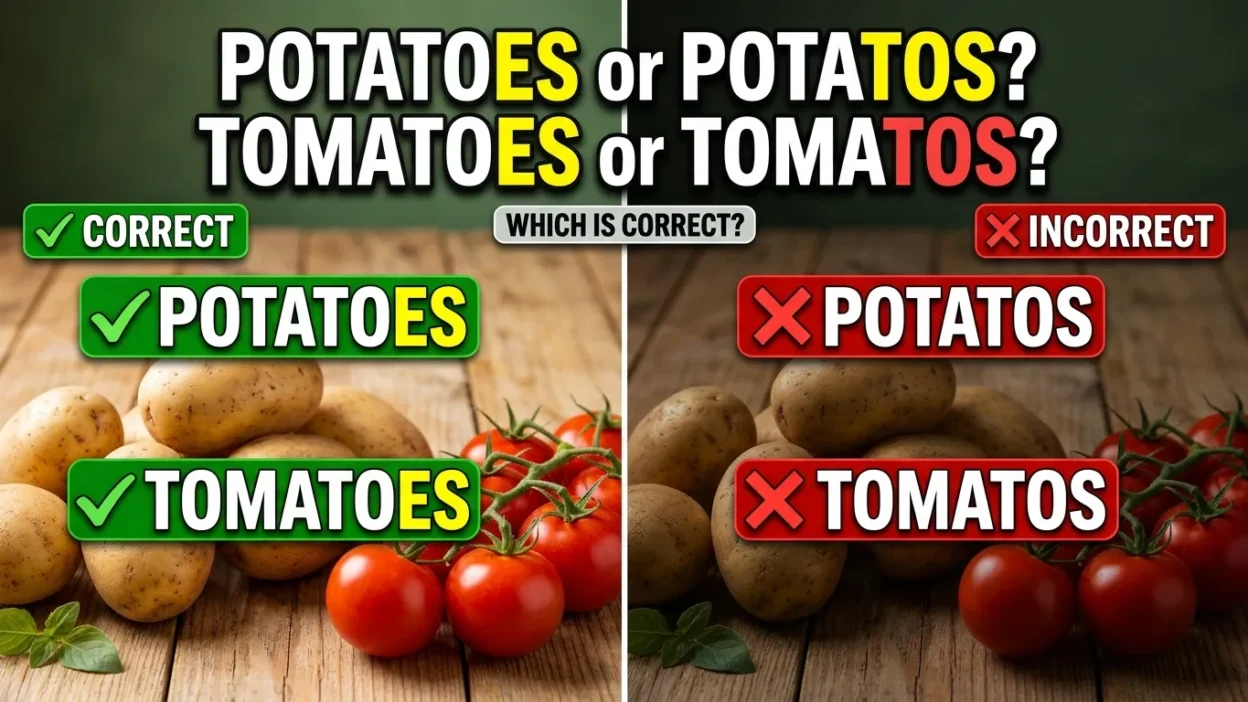
The correct plural spellings are potatoes and tomatoes. The forms potatos and tomatos are incorrect in standard English when used as the plurals of these words. To form the plural of potato or tomato, add -es to the singular form.
For example, one potato becomes two potatoes, and one tomato becomes three tomatoes. In this guide, you will learn the difference between singular and plural forms, understand the spelling rule, explore practical examples, and discover why other words ending in -o do not always follow the same pattern.
Quick Answer: Potatoes or Potatos? Tomatoes or Tomatos?
Potatoes is the correct plural of potato, and tomatoes is the correct plural of tomato. The spellings potatos and tomatos are not standard English plurals. Add -es to both singular words: potato → potatoes and tomato → tomatoes. These spellings are the same in American and British English.
Why Do People Confuse Potatoes, Potatos, Tomatoes, and Tomatos?
People often confuse potatoes vs. potatos and tomatoes vs. tomatos because English plural spelling is not always consistent. Many nouns require only an -s at the end, so writers may assume that the same rule applies to every word.
For example:
- Book → books
- Apple → apples
- Chair → chairs
- Car → cars
Following this familiar pattern, someone might write potatos or tomatos. However, the standard forms are potatoes and tomatoes.
Why Do Some Words Ending in -O Take -ES?
Certain nouns ending in -o form their plurals by adding -es. Common examples include:
- Potato → potatoes
- Tomato → tomatoes
- Hero → heroes
- Echo → echoes
- Veto → vetoes
However, this is not a rule that applies to every noun ending in -o. For example, photo becomes photos, piano becomes pianos, and video becomes videos.
Because English has different plural patterns, the best approach is to learn the common forms and check unfamiliar words when necessary.
What Is the Plural of Potato?
The correct plural of potato is potatoes, not potatos.
A potato is an edible underground tuber commonly used as a food. It is a familiar ingredient in dishes such as French fries, mashed potatoes, baked potatoes, soups, and stews.
Use potato when talking about one vegetable and potatoes when referring to two or more.
Potato: Singular Form
The singular noun potato refers to one potato.
Examples:
- I baked one potato for lunch.
- She bought a large potato at the market.
- This potato is perfect for making fries.
- He planted a potato in the garden.
- The recipe requires one medium potato.
Potatoes: Plural Form
The plural noun potatoes refers to more than one potato.
Examples:
- I bought five potatoes for dinner.
- She peeled three potatoes before cooking.
- The farmer harvested hundreds of potatoes.
- We made mashed potatoes for the family meal.
- Fresh potatoes are available at the market.
The spelling changes from potato to potatoes by adding -es. Writing potatos is a common spelling mistake.
What Is the Plural of Tomato?
The correct plural of tomato is tomatoes, not tomatos.
A tomato is an edible fruit commonly treated as a vegetable in cooking. Tomatoes are used in salads, sauces, soups, sandwiches, and many other dishes.
Just like potato, the word tomato takes -es to form its standard plural.
Tomato: Singular Form
Use tomato when referring to one tomato.
Examples:
- I sliced one tomato for my sandwich.
- She planted a tomato in the garden.
- This tomato is ripe and juicy.
- He added a fresh tomato to the salad.
- The recipe calls for one large tomato.
Tomatoes: Plural Form
Use tomatoes when referring to two or more tomatoes.
Examples:
- We grew fresh tomatoes in our backyard.
- She bought four tomatoes from the supermarket.
- The farmer sells organic tomatoes.
- I added chopped tomatoes to the soup.
- These tomatoes are ready to harvest.
Remember the correct spelling: one tomato, two tomatoes.
Potatoes vs. Potatos vs. Tomatoes vs. Tomatos: Comparison Table
| Word | Correct Form | Incorrect Form | Meaning |
| Potato | Potatoes | Potatos | More than one potato |
| Tomato | Tomatoes | Tomatos | More than one tomato |
| Hero | Heroes | — | More than one hero |
| Echo | Echoes | — | More than one echo |
| Photo | Photos | — | More than one photograph |
| Piano | Pianos | — | More than one piano |
The main point is simple: potatoes and tomatoes are the correct standard plurals. The spellings potatos and tomatos should be avoided in ordinary English writing.
When Should You Use Potatoes, Potatos, Tomatoes, or Tomatos?
Choosing the correct form depends on whether you are talking about one item or more than one. For potato and tomato, the standard plural ending is -es.
When to Use Potato
Use potato when referring to one potato.
Examples:
- I need one potato for this recipe.
- The potato is still too hard to cut.
- She baked a potato for lunch.
When to Use Potatoes
Use potatoes when referring to two or more potatoes.
Examples:
- We bought six potatoes.
- The chef peeled the potatoes.
- I enjoy roasted potatoes with herbs.
When to Use Tomato
Use tomato when referring to one tomato.
Examples:
- Please wash the tomato.
- He sliced a tomato for the sandwich.
- This tomato is not ripe yet.
When to Use Tomatoes
Use tomatoes when referring to more than one tomato.
Examples:
- She bought five tomatoes.
- We grow tomatoes every summer.
- Add the chopped tomatoes to the sauce.
When to Use Potatos or Tomatos
In standard English, do not use potatos or tomatos as the plurals of potato and tomato.
Incorrect: We need three potatos and four tomatos.
Correct: We need three potatoes and four tomatoes.
16 Examples of Potatoes and Tomatoes in Sentences
These examples show how to use both words correctly in everyday English.
Potato and Potatoes Examples
- I bought six potatoes from the grocery store.
- My mother cooked mashed potatoes for dinner.
- We need three large potatoes for this recipe.
- The restaurant serves roasted potatoes with chicken.
- The farmer harvested hundreds of potatoes this year.
- She peeled the potatoes before boiling them.
- I baked one potato for lunch.
- This potato is too small for the recipe.
Tomato and Tomatoes Examples
- I sliced one tomato for my sandwich.
- We grew fresh tomatoes in the backyard.
- The recipe requires two ripe tomatoes.
- She added chopped tomatoes to the soup.
- The supermarket sells several varieties of tomatoes.
- He planted a tomato in a pot.
- These tomatoes are perfect for making sauce.
- Please wash the tomatoes before cutting them.
These sentences demonstrate the difference between singular and plural nouns. Use the singular form for one item and the correct plural form for multiple items.
Common Mistakes to Avoid
1. Writing Potatos Instead of Potatoes
Incorrect: The farmer sold twenty potatos.
Correct: The farmer sold twenty potatoes.
Why? The standard plural of potato takes -es.
2. Writing Tomatos Instead of Tomatoes
Incorrect: She bought three tomatos.
Correct: She bought three tomatoes.
Why? The standard plural of tomato also takes -es.
3. Using the Singular After a Plural Number
Incorrect: I bought five potato and three tomato.
Correct: I bought five potatoes and three tomatoes.
Why? In these sentences, the numbers indicate more than one item, so the plural forms are needed.
4. Assuming All Words Ending in -O Take -ES
Incorrect assumption: Every noun ending in -o must add -es.
- Potato → potatoes
- Tomato → tomatoes
- Photo → photos
- Piano → pianos
- Video → videos
Why? English nouns ending in -o do not all follow the same plural pattern. Learn the standard form of each word.
5. Confusing Spelling With Pronunciation
Some speakers pronounce potato and tomato differently depending on their accent. These pronunciation differences do not change the standard plural spellings.
Whether you say potato or tomato with a particular regional accent, write potatoes and tomatoes when using the plural forms.
Memory Trick: How to Remember Potatoes and Tomatoes
The easiest way to remember these spellings is to learn the words as pairs.
- One potato, two potatoes
- One tomato, two tomatoes
Both plural forms add -es.
You can also remember this short rule:
Potato + es = potatoes. Tomato + es = tomatoes.
Think of the extra letter E as part of the plural ending. When you write about several potatoes or tomatoes, do not leave it out.
Another helpful technique is to group similar words together:
- Potato → potatoes
- Tomato → tomatoes
- Hero → heroes
- Echo → echoes
Remember that this pattern does not apply to every word ending in -o. For example, photo becomes photos.
American vs. British English: Potatoes or Potatos?
The correct spellings potatoes and tomatoes are the same in American and British English. There is no regional spelling difference for these plural forms.
| English Variety | Singular Potato | Plural Potato | Singular Tomato | Plural Tomato |
| American English | Potato | Potatoes | Tomato | Tomatoes |
| British English | Potato | Potatoes | Tomato | Tomatoes |
| Canadian English | Potato | Potatoes | Tomato | Tomatoes |
| Australian English | Potato | Potatoes | Tomato | Tomatoes |
For example, an American writer might say, “We bought fresh potatoes and tomatoes,” and a British writer would spell the words in exactly the same way.
The spellings potatos and tomatos are not the standard plurals in these varieties. Use potatoes and tomatoes for school assignments, recipes, professional documents, and everyday communication.
Similar Words: Other Plurals Ending in -O
Learning related plural forms can help you understand English spelling patterns.
Words That Commonly Add -ES
Some nouns ending in -o form their plurals with -es.
| Singular | Plural |
| Potato | Potatoes |
| Tomato | Tomatoes |
| Hero | Heroes |
| Echo | Echoes |
| Torpedo | Torpedoes |
| Veto | Vetoes |
Examples:
- The chefs prepared roasted potatoes.
- The garden produced ripe tomatoes.
- The story celebrates everyday heroes.
- We heard several echoes in the tunnel.
Words That Commonly Add -S
Other nouns ending in -o usually add only -s.
| Singular | Plural |
| Photo | Photos |
| Piano | Pianos |
| Video | Videos |
| Radio | Radios |
| Studio | Studios |
Examples:
- I took several photos.
- The music school owns two pianos.
- She watched three videos.
- The station has several radios.
These examples show why it is helpful to learn each plural form rather than rely on one rule for every noun ending in -o.
Final Verdict: Potatoes or Potatos? Tomatoes or Tomatos?
Potatoes and tomatoes are the correct plural spellings. Potatos and tomatos are incorrect in standard English when intended as the plurals of potato and tomato.
Use potato and tomato for one item, and use potatoes and tomatoes for two or more. Both plural forms are spelled the same way in American, British, Canadian, and Australian English.
The easiest way to remember the rule is to repeat these pairs: one potato, two potatoes; one tomato, two tomatoes. Learning this simple pattern will help you avoid common spelling mistakes in recipes, schoolwork, shopping lists, and everyday writing.
FAQs
1. Is it potatoes or potatos?
Potatoes is correct. Potatos is a misspelling of the standard plural form of potato.
2. Is it tomatoes or tomatos?
Tomatoes is correct. Tomatos is not the standard plural spelling of tomato.
3. Why do potatoes and tomatoes end in -ES?
The standard plural forms of potato and tomato are made by adding -es. This gives us potatoes and tomatoes.
4. What is the singular of potatoes and tomatoes?
The singular forms are potato and tomato. Use potato or tomato for one item and their plural forms for two or more.
5. Are potatoes and tomatoes spelled the same in American and British English?
Yes. Potatoes and tomatoes are the standard spellings in both American and British English.
6. Do all words ending in -O take -ES in the plural?
No. Some nouns take -es, such as potatoes, tomatoes, and heroes. Others take only -s, such as photos, pianos, and videos.
7. How can I remember the correct spelling of potatoes and tomatoes?
Remember these phrases: one potato, two potatoes and one tomato, two tomatoes. Both plural forms add -es.
8. Are potatos and tomatos ever correct in standard English?
No. When you mean the plural forms of potato and tomato, use potatoes and tomatoes in standard English writing.
Remember This
- Potato is singular; potatoes is plural.
- Tomato is singular; tomatoes is plural.
- Potatos and tomatos are not the standard plural spellings.
- Add -es to form the standard plurals of potato and tomato.
- Not every noun ending in -o follows the same rule.
- American and British English use the same spellings.
- Remember: one potato, two potatoes; one tomato, two tomatoes.
Conclusion
The difference between potatoes or potatos and tomatoes or tomatos comes down to correct plural spelling. The standard forms are potatoes and tomatoes, while potatos and tomatos are common spelling errors. Both words take -es in the plural, even though many other English nouns form their plurals by adding only -s.
When writing recipes, school assignments, shopping lists, or everyday messages, use potatoes and tomatoes whenever you mean more than one. Remember the simple pairs “one potato, two potatoes” and “one tomato, two tomatoes” to keep your spelling accurate and your writing clear.