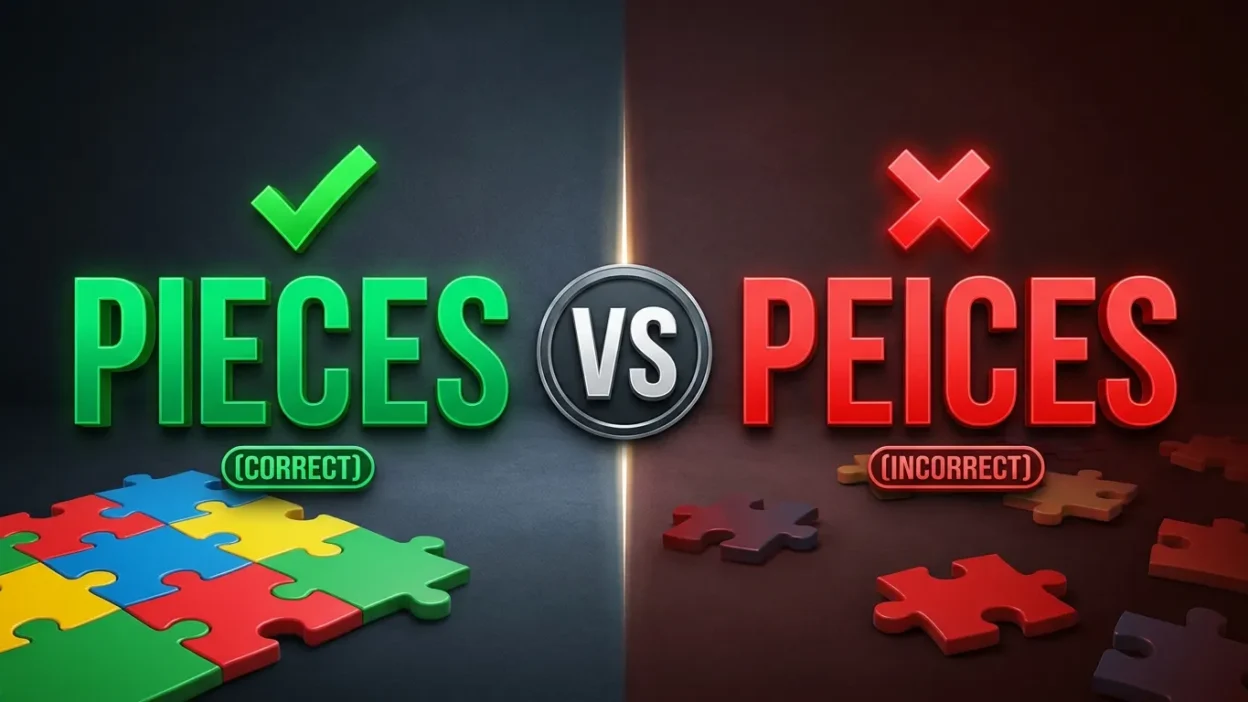
Have you ever wondered whether to write pieces or peices? These spellings look similar, but only one is correct in standard English. If you want to describe parts of something, portions of food, puzzle components, or individual items, the correct word is pieces. The spelling peices is a common mistake caused by placing the letters e and i in the wrong order.
Understanding piece vs. peice and pieces vs. peices can help you avoid spelling errors in school assignments, emails, essays, and everyday conversations. The word piece means one part or item, while pieces is its plural form.
Both follow the same spelling pattern, so learning the singular word makes the plural easier to remember. In this guide, you will discover the correct spelling, meanings, grammatical forms, practical examples, common mistakes, and simple memory tricks to help you spell these words confidently.
Quick Answer: Pieces or Peices?
Pieces is the correct spelling, and peices is incorrect. The singular form is piece, meaning one part or item, while pieces refers to two or more parts or items. Remember that piece is spelled with ie, not ei. The correct spellings are piece, pieces, pieced, and piecing.
Why Do People Confuse Pieces and Peices?
People often confuse pieces and peices because the letters i and e appear together in both versions. When writing quickly, it is easy to reverse their order, especially when the spelling does not seem obvious from pronunciation.
Another reason is the familiar English spelling rule, “i before e, except after c.” Although this rule has several exceptions, it helps with the word piece. The same spelling pattern appears in words such as believe and field.
Common reasons for this spelling mistake include:
- Letter-order confusion: Accidentally writing ei instead of ie.
- Typing errors: Entering the letters too quickly.
- Unfamiliar spelling patterns: Remembering how a word sounds but forgetting how it is written.
- Incorrect word forms: Assuming that peiced and peicing are acceptable variations.
- Limited proofreading: Overlooking a small spelling error while reading a sentence.
The simplest solution is to remember the correct word family: piece, pieces, pieced, and piecing. Each form retains the letters ie.
1. Piece and Pieces: Meaning, Spelling, and Usage
Piece and pieces are correct English words. They belong to the same word family but differ in number.
- Piece: A singular noun referring to one part, portion, or item.
- Pieces: A plural noun referring to two or more parts, portions, or items.
For example, you might eat one piece of cake or share several pieces with your friends.
What Does Piece Mean?
The word piece has several meanings depending on the context. It can describe a physical part, an amount of food, an individual object, or a work of art or writing.
Examples include:
- A part of something: A piece of broken glass lay on the floor.
- A portion of food: I ate one piece of pizza.
- An individual item: She packed a piece of clothing.
- A work of art: The artist created a beautiful piece of pottery.
- A work of writing or music: He composed a short piece of music.
- An amount of information: I need one more piece of information.
In each example, piece refers to one part, item, or work.
What Does Pieces Mean?
Pieces is the plural form of piece. It is used when referring to multiple parts, portions, objects, or works.
Examples:
- The glass broke into several pieces.
- We ordered four pieces of chicken.
- The children assembled the puzzle pieces.
- She collected several pieces of artwork.
- The detective found important pieces of evidence.
The word can also appear in common expressions such as pieces of advice, pieces of information, and pieces of furniture.
Notice that some nouns following pieces of are uncountable. For example, advice and information are generally uncountable nouns in standard English, so we say two pieces of advice, not two advices.
2. Peice and Peices: Are They Correct Words?
Peice and peices are common misspellings of piece and pieces. They are not accepted standard spellings when you mean a part, portion, or item.
The same correction applies to related forms. The correct spelling is pieced, not peiced, and piecing, not peicing.
Compare these forms:
| Incorrect spelling | Correct spelling |
| Peice | Piece |
| Peices | Pieces |
| Peiced | Pieced |
| Peicing | Piecing |
Examples of Incorrect and Correct Spelling
Incorrect: I need three peices of paper.
Correct: I need three pieces of paper.
Incorrect: The toy broke into small peices.
Correct: The toy broke into small pieces.
Incorrect: She peiced the fabric together.
Correct: She pieced the fabric together.
Incorrect: He is peicing the story together.
Correct: He is piecing the story together.
The key is to keep the letters ie in the correct order throughout the word family.
3. Pieces vs. Peices: Comparison Table
| Feature | Pieces | Peices |
| Spelling | Correct | Incorrect |
| Part of speech | Plural noun | Misspelling |
| Singular form | Piece | Intended word: piece |
| Meaning | Multiple parts or items | No standard meaning in this context |
| American English | Correct | Incorrect |
| British English | Correct | Incorrect |
| Formal writing | Acceptable | Avoid |
| Example | The pieces fit together. | The peices fit together. |
The difference between pieces vs. peices is a spelling issue, not a difference in meaning. When you want to describe multiple parts of something, always use pieces.
4. When Should You Use Piece, Pieces, Pieced, and Piecing?
Choosing the correct form depends on whether you are talking about one item, multiple items, a completed action, or an action in progress.
Use Piece for One Item
Use piece when referring to a single part or item.
Examples:
- I found one piece of the puzzle.
- She ate a piece of chocolate.
- This piece of furniture is expensive.
Use Pieces for Multiple Items
Use pieces when referring to more than one part or item.
Examples:
- The puzzle has 500 pieces.
- He picked up the broken pieces.
- We bought two pieces of cake.
Use Pieced for a Completed Action
Pieced is the simple past tense and past participle of piece when the verb means to assemble, join, or put parts together.
Examples:
- She pieced the torn paper together.
- They pieced together the events of the day.
- The detective has pieced together the evidence.
Use Piecing for an Action in Progress
Piecing is the -ing form of the verb piece. It often appears in continuous verb forms or after certain verbs and prepositions.
Examples:
- She is piecing the quilt together.
- We are piecing together the missing information.
- He spent hours piecing the broken model back together.
Remember the complete word family: piece, pieces, pieced, piecing.
5. Examples of Pieces in Everyday Sentences
Here are 15 practical examples showing how to use pieces correctly in different situations.
- I cut the sandwich into four pieces.
- The children found the missing puzzle pieces.
- She bought two pieces of chocolate cake.
- The window shattered into tiny pieces of glass.
- Please put the paper pieces in the recycling bin.
- We need several pieces of information before deciding.
- The artist displayed three beautiful pieces of pottery.
- My teacher gave us two pieces of advice.
- The mechanic replaced the damaged pieces of the machine.
- They divided the pizza into eight equal pieces.
- I found a few missing pieces in the box.
- The detective collected important pieces of evidence.
- These furniture pieces look perfect in the living room.
- The musician performed several short pieces of classical music.
- The children worked together to fit the wooden pieces into place.
These sentences demonstrate that pieces can describe physical objects, food, information, evidence, furniture, and creative works.
6. Common Mistakes With Pieces and Peices
Even experienced writers can make small spelling mistakes. Understanding the most common errors will help you avoid them.
Mistake 1: Reversing I and E
Incorrect: I bought five peices of fruit.
Correct: I bought five pieces of fruit.
The vowels are reversed in the incorrect spelling. Remember that piece contains ie.
Mistake 2: Using Peiced Instead of Pieced
Incorrect: She peiced the clues together.
Correct: She pieced the clues together.
The correct verb is pieced, which means joined or assembled parts to form a whole.
Mistake 3: Writing Peicing Instead of Piecing
Incorrect: He is peicing together the broken model.
Correct: He is piecing together the broken model.
The -ing form keeps the same vowel order as piece.
Mistake 4: Using the Plural for One Item
Incorrect: I would like one pieces of cake.
Correct: I would like one piece of cake.
Use the singular form piece with one. Use pieces with numbers greater than one when counting individual items.
Mistake 5: Treating Both Spellings as Acceptable
Incorrect: You can write either pieces or peices.
Correct: Pieces is the standard spelling.
Unlike genuine spelling variants such as color and colour, pieces and peices are not alternative regional spellings.
7. Easy Memory Tricks for Spelling Pieces Correctly
If you often confuse pieces or peices, try these simple memory tricks.
Trick 1: Remember a Piece of Pie
Think of a piece of pie. Both piece and pie begin with the letters pi.
Picture a slice of pie on a plate and remember:
A PIEce of PIE.
This visual association makes the spelling easier to recall.
Trick 2: Use the I-Before-E Rule
The familiar spelling guideline says, “i before e, except after c.” In piece, the letter i comes before e, so the rule is helpful here.
However, English has many exceptions to this rhyme. Treat it as a memory aid rather than a rule that works for every word.
Trick 3: Learn the Whole Word Family
Practice writing these four words together:
- Piece — one part
- Pieces — multiple parts
- Pieced — joined parts in the past
- Piecing — joining parts
Learning the entire word family helps you avoid related mistakes such as peiced and peicing.
Trick 4: Check the Vowel Order
Before submitting an assignment or sending an important message, check whether you have written ie or ei.
If you mean a part or item, the correct spelling begins with p followed by i-e-c-e: piece.
8. Pieces in American vs. British English
The spelling pieces is identical in American and British English. Canadian and Australian English also use pieces.
| English variety | Correct spelling | Incorrect spelling |
| American English | Pieces | Peices |
| British English | Pieces | Peices |
| Canadian English | Pieces | Peices |
| Australian English | Pieces | Peices |
Examples:
- American English: I bought two pieces of cake.
- British English: I bought two pieces of cake.
- Australian English: The puzzle pieces are on the table.
There is no standard regional spelling difference for this word. You do not need to change its spelling depending on your audience.
9. Similar Words and Related Spelling Patterns
Learning related words can improve your spelling and help you recognize common English patterns.
| Word | Meaning | Example |
| Piece | One part or item | I found one piece. |
| Pieces | Multiple parts or items | The pieces are missing. |
| Pieced | Joined parts together | She pieced the clues together. |
| Piecing | Joining parts together | He is piecing the model together. |
| Peace | A state without conflict | Everyone hopes for peace. |
| Part | One section of a whole | This part is damaged. |
| Fragment | A small broken or separated part | A fragment of glass fell. |
| Portion | A share or amount | She ate a small portion. |
| Section | A division of something | Read the final section. |
| Item | An individual thing | Each item has a label. |
Piece vs. Peace
Although piece and peace sound alike in many English accents, they have different meanings.
- Piece: A part or item. Example: I ate a piece of bread.
- Peace: Freedom from conflict or disturbance. Example: The agreement brought peace to the region.
These words are homophones in many varieties of English, meaning they share a pronunciation but differ in spelling and meaning.
Do not confuse piece with peace, and remember that neither word is spelled peice.
Frequently Asked Questions
1. Is it pieces or peices?
Pieces is correct. Peices is a misspelling. Use pieces when referring to multiple parts, portions, or individual items.
2. Is peice a real English word?
Peice is not the standard spelling of the noun piece. When referring to a part or item, write piece.
3. How do you spell piece and pieces?
The correct spellings are piece for one item and pieces for multiple items. Both contain the letters ie in that order.
4. Is it pieced or peiced?
Pieced is correct. It is the past-tense and past-participle form of the verb piece, as in “She pieced the puzzle together.”
5. Is it piecing or peicing?
Piecing is correct. It is the -ing form of piece, as in “He is piecing together the evidence.”
6. Why is piece spelled with ie?
The standard spelling of piece uses ie. The familiar “i before e” rhyme can help you remember this letter order, although the rhyme has exceptions in English.
7. Is pieces spelled the same in American and British English?
Yes. Pieces is the standard spelling in both American and British English. The word does not have a regional spelling variant.
8. What is the easiest way to remember the spelling of pieces?
Remember the phrase “a PIEce of PIE.” The visual connection between pie and piece helps you recall that i comes before e.
Remember This
- Piece is the correct singular spelling.
- Pieces is the correct plural spelling.
- Peice and peices are misspellings.
- Pieced is correct, not peiced.
- Piecing is correct, not peicing.
- American and British English use the same spelling.
- The phrase “a PIEce of PIE” can help you remember the correct vowel order.
Conclusion
The difference between pieces and peices is simple: pieces is the correct spelling, while peices is a common spelling mistake. The singular form is piece, and its related verb forms are pieced and piecing. These words are useful in everyday English when talking about parts, portions, objects, evidence, information, and putting things together.
To remember the correct spelling, think of a PIEce of PIE and keep the letters i and e in the right order. Practice using piece, pieces, pieced, and piecing in your own sentences. With a little practice, you can avoid this common spelling error and write more confidently in school, at work, and in everyday communication.

Cole Jaxson is the administrator of SymbolPeak, overseeing site management and content integrity. He is dedicated to presenting Bible-based spiritual symbol meanings with accuracy, reverence, and clarity, ensuring the platform remains trustworthy, well-organized, and aligned with biblical teachings and faith-centered understanding for readers worldwide.