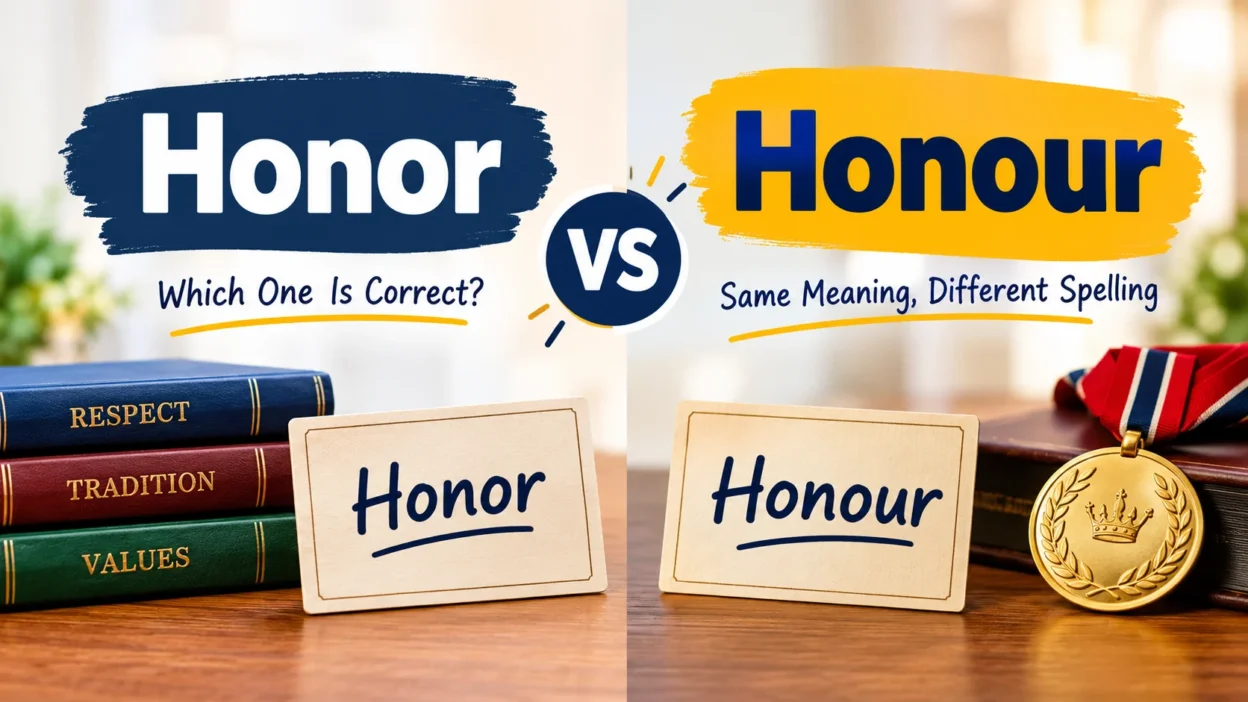
The words honor and honour have the same meaning, but their spelling depends on the variety of English you use. Honor is the standard spelling in American English, while honour is the standard spelling in British English.
Both words refer to respect, dignity, integrity, recognition, or the privilege of doing something important. Neither spelling is universally more correct than the other.
Understanding the difference between honor vs. honour helps you write accurately in school assignments, professional documents, emails, and articles. Both spellings can function as a noun or a verb.
For example, you can receive an honor or honour, show honor or honour to someone, and honor or honour an agreement. The same regional spelling pattern appears in related words, including honored vs. honoured and honorable vs. honourable.
However, some related words, such as honorary, retain the same spelling in both American and British English.
Quick Answer: Honor or Honour?
Honor is correct in American English, and honour is correct in British English. Both spellings have the same meaning and pronunciation. They can describe respect, integrity, recognition, or the act of showing respect or fulfilling an obligation. Choose honor for American writing and honour for British writing, and use your chosen spelling consistently.
Why Do People Confuse Honor and Honour?
People often confuse honor and honour because the words sound the same and have identical meanings. The only difference in their spelling is the letter u.
American and British English follow different spelling conventions for several words. American English generally uses -or in words where British English uses -our.
Here are some common examples:
- Honor vs. honour
- Color vs. colour
- Favor vs. favour
- Behavior vs. behaviour
- Labor vs. labour
- Neighbor vs. neighbour
- Humor vs. humour
These spelling differences do not change the meaning of the words. They simply reflect regional English conventions.
What Does Honor Mean?
Honor is the standard American English spelling of a word that describes respect, dignity, integrity, recognition, or a privilege. It can refer to a person’s moral character, an award, or an action that shows respect for someone.
Honor as a Noun
As a noun, honor can mean respect, a good moral reputation, special recognition, or a privilege.
Examples:
- It was an honor to meet such an accomplished doctor.
- She received an award in honor of her achievements.
- He believes that honesty is a matter of honor.
- It is a great honor to represent my school.
- The award recognized her service and dedication.
In these sentences, honor refers to respect, recognition, or the privilege of doing something meaningful.
Honor as a Verb
As a verb, honor means to show respect, recognize someone’s achievements, or fulfill a promise, agreement, or obligation.
Examples:
- We honor our teachers for their hard work.
- The company will honor the terms of the agreement.
- They honored their grandfather’s memory.
- The organization honors people who help their communities.
In American English, forms such as honors, honored, and honoring follow the standard American spelling convention.
What Does Honour Mean?
Honour is the standard British English spelling of the same word. It carries the same meanings as honor, including respect, dignity, integrity, recognition, and a special privilege.
Honour as a Noun
As a noun, honour refers to respect, good character, recognition, or the privilege of doing something important.
Examples:
- It was an honour to meet such an accomplished doctor.
- She received an award in honour of her achievements.
- He believes that honesty is a matter of honour.
- It is a great honour to represent my school.
- The award recognized her service and dedication.
Honour as a Verb
As a verb, honour means to respect someone, recognize an achievement, or fulfill a promise or commitment.
Examples:
- We honour our teachers for their hard work.
- The company will honour the terms of the agreement.
- They honoured their grandfather’s memory.
- The organization honours people who help their communities.
In British English, the related forms generally include honours, honoured, and honouring.
Honor vs. Honour: Comparison Table
| Feature | Honor | Honour |
| Standard spelling | American English | British English |
| Meaning | Respect, integrity, recognition, or privilege | Respect, integrity, recognition, or privilege |
| Pronunciation | Same | Same |
| Part of speech | Noun and verb | Noun and verb |
| Past tense | Honored | Honoured |
| Present participle | Honoring | Honouring |
| Related adjective | Honorable | Honourable |
| Example | It is an honor to help. | It is an honour to help. |
The main difference is regional spelling. Both forms are grammatically correct when used according to the relevant English convention.
When Should You Use Honor or Honour?
Choose the spelling that matches your audience, location, or required style guide.
When to Use Honor
Use honor when writing in American English. It is the preferred form in American schools, publications, professional documents, and websites.
Examples:
- It is an honor to receive this award.
- We honor those who serve our country.
- The company will honor its commitment.
- The ceremony was held in honor of the volunteers.
When to Use Honour
Use honour when writing in British English or following a style guide that uses British spelling conventions.
Examples:
- It is an honour to receive this award.
- We honour those who serve our country.
- The company will honour its commitment.
- The ceremony was held in honour of the volunteers.
British-style spellings are also common in countries such as Australia and in many other Commonwealth contexts. Canadian English commonly uses honour as well, although individual spelling conventions may vary.
Should You Mix Honor and Honour in the Same Article?
Generally, no. Choose one spelling convention and follow it throughout your writing.
For example, American English normally uses honor, color, and favor, while British English normally uses honour, colour, and favour.
Consistent spelling makes your writing clearer and more professional. If a school, employer, publisher, or style guide specifies a particular variety of English, follow that requirement.
15 Examples of Honor and Honour in Sentences
The following examples show how the two spellings work in everyday English.
- American: It was an honor to meet you.
British: It was an honour to meet you. - American: We honor our brave soldiers.
British: We honour our brave soldiers. - American: She received an award in honor of her father.
British: She received an award in honour of her father. - American: He is a man of honor.
British: He is a man of honour. - American: The school will honor its outstanding students.
British: The school will honour its outstanding students. - American: They held a ceremony to honor the victims.
British: They held a ceremony to honour the victims. - American: It was an honor to represent my school.
British: It was an honour to represent my school. - American: The company will honor the agreement.
British: The company will honour the agreement. - American: She acted with honor and courage.
British: She acted with honour and courage. - American: We should honor our promises.
British: We should honour our promises. - American: The award was given in his honor.
British: The award was given in his honour. - American: The organization honors community volunteers.
British: The organization honours community volunteers. - American: The young doctor felt it was an honor to learn from an expert.
British: The young doctor felt it was an honour to learn from an expert. - American: The memorial honors those who lost their lives.
British: The memorial honours those who lost their lives. - American: Please honor the terms of our agreement.
British: Please honour the terms of our agreement.
The meaning and grammar remain the same in each pair. Only the spelling changes to match American or British English.
Honored vs. Honoured: Which Spelling Is Correct?
Honored and honoured are both correct spellings of the past tense and past participle of the verb honor/honour.
- Honored: Standard American English.
- Honoured: Standard British English.
Examples:
- American: I felt honored to receive the award.
- British: I felt honoured to receive the award.
- American: The school honored its best students.
- British: The school honoured its best students.
The same pattern applies to the related forms honoring and honouring.
- American: We are honoring our teachers today.
- British: We are honouring our teachers today.
Remember that these are spelling variations, not differences in meaning or grammar.
Honorable vs. Honourable: What Is the Difference?
Honorable is the standard American English spelling, while honourable is the standard British English spelling.
Both adjectives describe someone or something worthy of respect because of honesty, fairness, good character, or honorable conduct.
Examples:
- American: She is an honorable person.
- British: She is an honourable person.
- American: He made an honorable decision.
- British: He made an honourable decision.
Other related words follow a similar pattern:
| American English | British English |
| Honor | Honour |
| Honored | Honoured |
| Honoring | Honouring |
| Honorable | Honourable |
| Honorably | Honourably |
| Dishonor | Dishonour |
| Dishonorable | Dishonourable |
When writing in one variety of English, keep these related forms consistent.
Is Honorary Spelled With or Without a U?
Honorary is the standard spelling in both American and British English. The word is not normally spelled honourary.
An honorary title, degree, or position is given as a recognition of achievement or contribution, often without the usual requirements associated with that qualification or position.
Examples:
- Andrew received an honorary doctorate for his contribution to engineering.
- She was appointed an honorary member of the organization.
- The university awarded him an honorary degree.
Other related words that retain the spelling honor- in both varieties include honorific and honorarium.
This is an important exception to remember: although British English uses honour, it still uses honorary, honorific, and honorarium.
Common Mistakes With Honor and Honour
1. Assuming One Spelling Is Wrong
Incorrect assumption: Honour is always a spelling mistake.
Correct explanation: Honor and honour are both correct. Their usage depends on the variety of English.
2. Mixing American and British Spellings
Using honor in one section and honour in another can create inconsistency.
Tip: Choose American or British English before writing and apply that choice throughout the document.
3. Changing the Meaning of the Word
The words do not have different meanings. Both can refer to respect, integrity, recognition, or fulfilling an obligation.
4. Misspelling Related Words
Remember the standard forms:
- American: honored, honoring, honorable
- British: honoured, honouring, honourable
- Both varieties: honorary, honorific, honorarium
5. Writing Honourary Instead of Honorary
Even in British English, the standard spelling is honorary. The letter u is not added to this word.
Memory Trick: How to Remember Honor vs. Honour
Use this simple rule:
- Honor = American English: No u.
- Honour = British English: Includes u.
You can remember the pattern with other familiar words:
- American: color, favor, honor
- British: colour, favour, honour
If you remember color vs. colour, you can apply the same pattern to honor vs. honour.
However, remember the exception: honorary is spelled the same way in both varieties.
Similar American and British Spelling Differences
Honor and honour belong to a larger group of words with regional spelling differences.
| American English | British English |
| Color | Colour |
| Favor | Favour |
| Labor | Labour |
| Neighbor | Neighbour |
| Behavior | Behaviour |
| Favorite | Favourite |
| Humor | Humour |
| Rumor | Rumour |
| Valor | Valour |
| Honor | Honour |
Other spelling differences follow different patterns, including center vs. centre and theater vs. theatre. These examples show why it is useful to identify your preferred variety of English before preparing a document.
Frequently Asked Questions
1. What is the difference between honor and honour?
The difference is spelling. Honor is the standard American English form, and honour is the standard British English form. Both words have the same meaning and pronunciation.
2. Is honor or honour correct in the UK?
Honour is the standard spelling in the United Kingdom. The related forms include honoured, honouring, and honourable.
3. Is honor American or British English?
Honor is the standard American English spelling. It is used in sentences such as “It is an honor to meet you” and “We honor our teachers.”
4. Is it honouring or honoring?
Both are correct. Honoring is the American English spelling, while honouring is the British English spelling.
5. Is it honored or honoured?
Honored is standard in American English, and honoured is standard in British English. Both are past-tense and past-participle forms of the verb.
6. Is it honorable or honourable?
Use honorable in American English and honourable in British English. Both adjectives describe someone or something worthy of respect.
7. Is honorary spelled the same in American and British English?
Yes. Honorary is the standard spelling in both American and British English. Honourary is not the standard spelling.
8. Does honor mean respect?
Yes. Honor can mean respect, dignity, integrity, recognition, or a privilege. As a verb, it can mean showing respect, recognizing an achievement, or fulfilling a commitment.
Remember This
Honor = American English. Honour = British English.
Both spellings are correct and have the same meaning. Use the form that matches your readers and keep related spellings consistent. Remember the important exception: honorary is spelled the same in both American and British English.
Conclusion
The difference between honor vs. honour comes down to regional spelling conventions. American English uses honor, while British English uses honour.
Both words can function as nouns and verbs and describe respect, integrity, recognition, or the act of fulfilling an obligation. Related forms follow the same general pattern, including honored/honoured, honoring/honouring, and honorable/honourable.
To choose the correct spelling, consider your audience and any style guide you need to follow. Use American spellings for American English and British spellings for British English, and avoid switching between them without a clear reason.
Finally, remember that honorary, honorific, and honorarium retain their spelling in both varieties. With these simple rules, you can use the words confidently in essays, emails, professional documents, and everyday writing.

Cole Jaxson is the administrator of SymbolPeak, overseeing site management and content integrity. He is dedicated to presenting Bible-based spiritual symbol meanings with accuracy, reverence, and clarity, ensuring the platform remains trustworthy, well-organized, and aligned with biblical teachings and faith-centered understanding for readers worldwide.