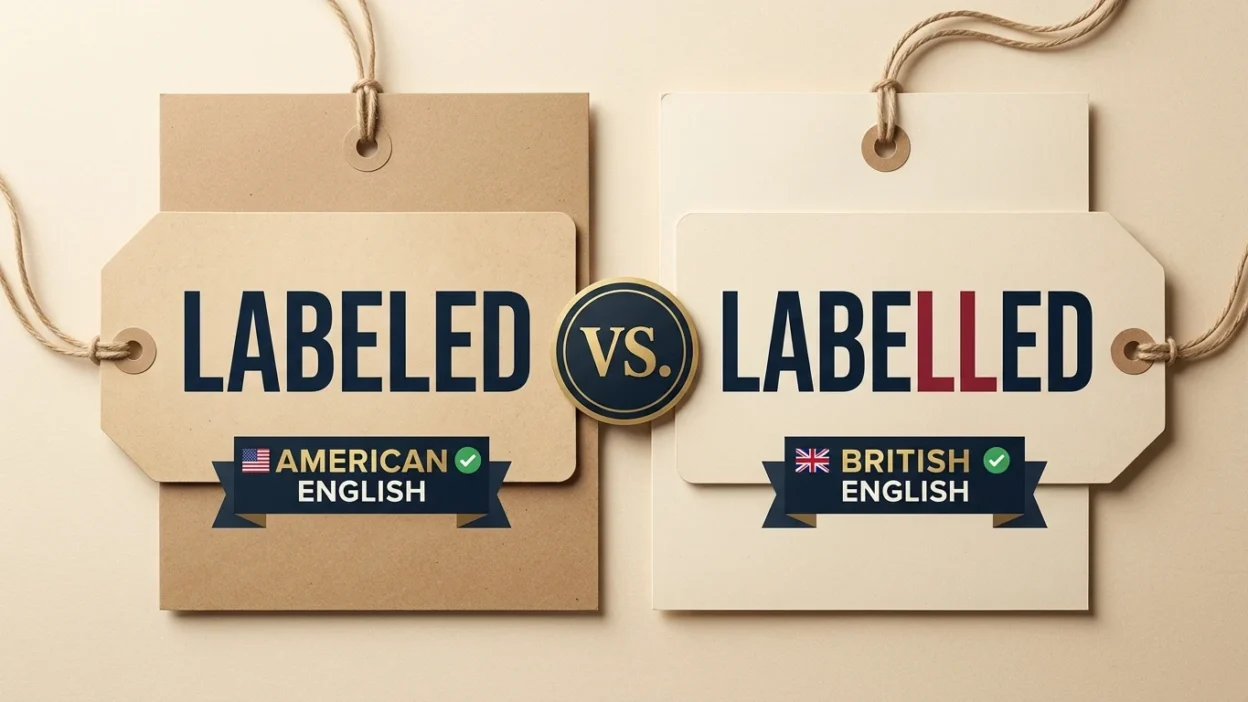
The correct spelling is labeled in American English and labelled in British English. Both words are correct and have the same meaning. They are the past tense and past participle of the verb label, which means to attach a label to something, identify an object, or describe someone or something with a particular name or category.
People often search for labeled or labelled because both spellings appear in books, newspapers, educational materials, and everyday writing. The difference comes from regional spelling conventions. American English generally uses one L in labeled, while British English uses two Ls in labelled.
Understanding this difference also helps explain related forms such as labeling and labelling. Whether you are writing a school assignment, business document, product description, or article, choosing the correct spelling for your audience will make your writing more consistent and professional.
Quick Answer
Labeled is the preferred American English spelling, while labelled is the preferred British English spelling. Both are correct forms of the past tense and past participle of label. They have the same meaning and pronunciation. Use labeled for American readers and labelled for British readers.
Why Do People Confuse Labeled and Labelled?
People confuse labeled vs. labelled because both spellings look correct and communicate exactly the same meaning. The only difference is the extra letter L in the British version.
The confusion comes from differences between American and British English spelling rules. American English generally does not double the final L in certain words when adding the suffix -ed. British English usually doubles it.
For example:
- Label → Labeled (American English)
- Label → Labelled (British English)
- Travel → Traveled (American English)
- Travel → Travelled (British English)
- Cancel → Canceled (American English)
- Cancel → Cancelled (British English)
Neither spelling is incorrect. The choice depends on the English variety you are following.
First Word: Labeled
Labeled is the standard American English spelling. It is formed by adding the suffix -ed to the verb label without doubling the final L.
It means that someone or something has been given a label, name, description, or identification. This can refer to physical labels on products and containers or descriptions assigned to people, objects, and situations.
Examples of Labeled in Sentences
- The teacher labeled each student’s notebook with a name.
- The jar was labeled as sugar, but it actually contained salt.
- All the boxes were labeled before shipping.
- The company labeled its products with clear instructions.
- The police labeled the incident as suspicious.
- Each chemical container was properly labeled.
- The school labeled the lockers with identification numbers.
When Should You Use Labeled?
Use labeled when writing in American English, especially when:
- Writing for readers in the United States.
- Preparing American school assignments.
- Creating product descriptions for American customers.
- Writing business reports and professional documents.
- Following an American English dictionary or style guide.
Example: Every package was labeled with the customer’s address.
Second Word: Labelled
Labelled is the standard British English spelling. It is formed by adding -ed to the verb label and doubling the final L.
It has exactly the same meaning as labeled. This describes something that has received a label, identification, name, or particular description.
The spelling is commonly used in British English and is also preferred in many Australian and New Zealand English contexts.
Examples of Labelled in Sentences
- The teacher labelled each student’s notebook with a name.
- The jar was labelled as sugar, but it actually contained salt.
- All the boxes were labelled before shipping.
- The company labelled its products with clear instructions.
- The police labelled the incident as suspicious.
- Each chemical container was properly labelled.
- The school labelled the lockers with identification numbers.
When Should You Use Labelled?
Use labelled when writing in British English, particularly when:
- Writing for readers in the United Kingdom.
- Preparing educational materials using British spelling.
- Creating content for British publications.
- Writing for Australian or New Zealand audiences.
- Following a British English style guide.
Example: Every package was labelled with the customer’s address.
Labeled vs. Labelled: Comparison Table
| Feature | Labeled | Labelled |
| Correctness | Correct | Correct |
| English variety | American English | British English |
| Number of Ls | One L in the ending | Two Ls in the ending |
| Base verb | Label | Label |
| Suffix | -ed | -ed |
| Meaning | Given a label | Given a label |
| Pronunciation | Same | Same |
| Example | The box was labeled. | The box was labelled. |
The main difference is regional spelling. Both forms are grammatically correct and can be used in formal and informal writing.
When to Use Each Spelling
Choosing between labeled and labelled depends mainly on your readers and the spelling conventions you follow.
Use Labeled When:
- Your target audience is American.
- You follow American English spelling rules.
- You are writing for US-based businesses or publications.
- Your educational materials use American spelling.
- Your organization’s style guide prefers one L.
Example: The products were labeled with their prices.
Use Labelled When:
- Your target audience is British.
- You follow British English spelling rules.
- You are writing for UK-based publications.
- Your educational materials use British spelling.
- Your organization’s style guide prefers double L.
Example: The products were labelled with their prices.
Remember that consistency matters more than choosing one spelling over the other.
12 Examples of Labeled and Labelled in Sentences
The following examples show how both spellings work in everyday English. Each pair has the same meaning.
| American English | British English |
| The bottles were labeled correctly. | The bottles were labelled correctly. |
| She labeled all the folders. | She labelled all the folders. |
| The food was labeled as organic. | The food was labelled as organic. |
| Every box was labeled before delivery. | Every box was labelled before delivery. |
| The teacher labeled the classroom materials. | The teacher labelled the classroom materials. |
| The chemicals were labeled clearly. | The chemicals were labelled clearly. |
| He was unfairly labeled a troublemaker. | He was unfairly labelled a troublemaker. |
| The company labeled its new products. | The company labelled its new products. |
| Each file was labeled with a date. | Each file was labelled with a date. |
| The containers were labeled by category. | The containers were labelled by category. |
| The diagram was labeled correctly. | The diagram was labelled correctly. |
| The incident was labeled an accident. | The incident was labelled an accident. |
These examples demonstrate that the spelling changes, but the meaning, pronunciation, and grammatical use remain the same.
Common Mistakes to Avoid
Even though both forms are correct, writers sometimes make mistakes when using them.
1. Thinking Labelled Is Always Incorrect
Some American English writers assume that labelled is misspelled because American dictionaries commonly use labeled.
However, labelled is correct in British English and other varieties that follow British spelling conventions.
2. Thinking Labeled Is Always Incorrect
The opposite mistake happens when British English writers assume that labeled is incorrect.
In reality, labeled is the standard American English spelling.
3. Mixing American and British Spellings
Using both forms in the same document can make your writing inconsistent.
For example, writing labeled in one paragraph and labelled in another without a reason may confuse readers.
Better approach: Choose one English variety and follow it throughout your document.
4. Confusing Labeled With Labeling
These words have different grammatical functions:
- Labeled / Labelled: Past tense and past participle.
- Labeling / Labelling: Present participle and gerund.
Examples:
- The box was labeled yesterday.
- She is labeling the boxes today.
5. Forgetting the Correct Past Tense
The base verb is label, not lable. Its correct past forms are labeled and labelled, depending on the English variety.
Memory Trick: How to Remember Labeled vs. Labelled
A simple trick can help you remember which spelling to use.
- American English = Labeled: One L before the -ed ending.
- British English = Labelled: Double L before the -ed ending.
You can remember the same pattern with other words:
- American: Traveled, Canceled, Modeled.
- British: Travelled, Cancelled, Modelled.
Think of the extra L as a common feature of British spelling. This simple association can help you avoid confusion.
American vs. British English: Why Does the Spelling Change?
American and British English developed different spelling conventions over time. One noticeable difference involves doubling the final L when adding suffixes such as -ed and -ing.
In British English, the final L is commonly doubled in words such as label and travel. American English often keeps a single L when the final syllable is unstressed.
Here are some common examples:
| British English | American English |
| Labelled | Labeled |
| Labelling | Labeling |
| Travelled | Traveled |
| Travelling | Traveling |
| Cancelled | Canceled |
| Cancelling | Canceling |
| Modelled | Modeled |
| Modelling | Modeling |
| Fuelled | Fueled |
| Fuelling | Fueling |
These differences do not change the meaning of the words. They simply reflect different spelling standards.
Related Words: Label, Labeled, Labelled, Labeling, and Labelling
Understanding the different forms of label makes it easier to use the word correctly.
| Word | Meaning or grammatical use |
| Label | Base verb or noun |
| Labeled | American past tense and past participle |
| Labelled | British past tense and past participle |
| Labeling | American present participle and gerund |
| Labelling | British present participle and gerund |
Label
Label is the base form of the verb. It means to attach a label or identify something.
Example: Please label the storage boxes.
Labeled or Labelled
These are the past tense and past participle forms.
Example: The storage boxes were labelled yesterday.
Labeling or Labelling
These forms describe the action of attaching or assigning labels.
Example: She is labeling the storage boxes.
Similar British and American Spelling Differences
The difference between labeled and labelled is part of a wider pattern in English spelling.
Here are other commonly confused British and American spellings:
| British English | American English |
| Colour | Color |
| Favourite | Favorite |
| Organise | Organize |
| Realise | Realize |
| Jewellery | Jewelry |
| Travelling | Traveling |
| Cancelled | Canceled |
| Modelling | Modeling |
| Signalling | Signaling |
| Counselling | Counseling |
Learning these spelling differences can improve your understanding of British vs. American English and help you write consistently for different audiences.
Final Verdict: Labeled or Labelled?
The correct spelling depends on the English variety you follow:
- Labeled is correct in American English.
- Labelled is correct in British English.
Both words are the past tense and past participle of label. They have the same meaning and pronunciation, so neither spelling is wrong.
If you are writing for an American audience, choose labeled. If you are writing for a British audience, choose labelled. For Australian and New Zealand readers, labelled is generally the preferred form.
The best approach is to follow your audience’s spelling conventions and remain consistent throughout your writing.
Frequently Asked Questions
1. Is it labeled or labelled?
Both spellings are correct. Labeled is the preferred American English spelling, while labelled is the preferred British English spelling. Both mean that something has been given a label or description.
2. Is labeled American or British English?
Labeled is the standard American English spelling. It uses one L before the -ed ending and is commonly used in American books, newspapers, and professional writing.
3. Is labelled British or American English?
Labelled is the standard British English spelling. It doubles the final L before adding -ed and is also commonly preferred in Australian and New Zealand English.
4. Why does labelled have two Ls?
British English generally doubles the final L in words such as label before adding suffixes like -ed and -ing. That is why the British forms are labelled and labelling.
5. Is labeling or labelling correct?
Both are correct. Labeling is the American English spelling, while labelling is the British English spelling. Both refer to attaching a label, identifying an object, or assigning a description.
6. What is the past tense of label?
The past tense of label is labeled in American English and labelled in British English. Both forms are correct and have the same meaning.
7. Is it labeled or labelled in Canada?
Both spellings are understood in Canada, but labelled is generally the more traditional Canadian English spelling. Canadian usage can vary, so follow the spelling style of your publication or organization.
8. Which spelling should I use in formal writing?
Use labeled when following American English and labelled when following British English. Both are acceptable in formal writing. The important thing is to use the same spelling convention consistently.
Remember This
- Labeled = American English.
- Labelled = British English.
- Both spellings are correct.
- Both have the same meaning and pronunciation.
- Labeling is American English.
- Labelling is British English.
- Choose one spelling system and use it consistently.
Conclusion
The difference between labeled and labelled is simply a matter of American and British English spelling conventions. American English prefers the single-L form, labeled, while British English uses the double-L form, labelled. Both spellings are correct and describe the same action of giving something a name, identification, or label.
Understanding these regional differences also makes it easier to use related forms such as labeling and labelling. If you are writing an academic assignment, business document, product description, or everyday message, choose the spelling that suits your audience. Consistent spelling will make your writing clearer and more professional.

Cole Jaxson is the administrator of SymbolPeak, overseeing site management and content integrity. He is dedicated to presenting Bible-based spiritual symbol meanings with accuracy, reverence, and clarity, ensuring the platform remains trustworthy, well-organized, and aligned with biblical teachings and faith-centered understanding for readers worldwide.