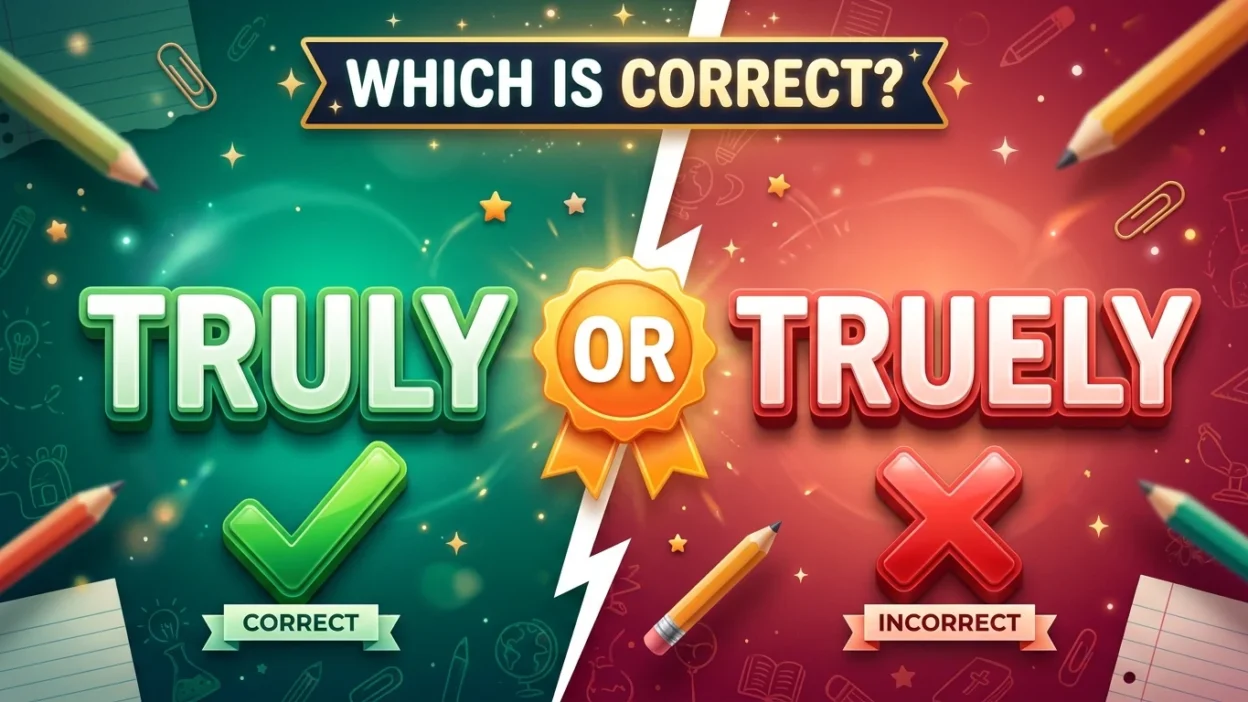
Have you ever wondered whether the correct spelling is truly or truely? These two spellings look almost identical, so it is easy to understand why people confuse them. However, only one spelling is accepted in standard English. Whether you are writing a school assignment, sending an email, or having an everyday conversation, choosing the correct spelling helps make your writing clear and professional.
The correct spelling is truly, while truely is a common spelling mistake. The word truly is an adverb derived from the adjective true. It means genuinely, honestly, sincerely, or completely. For example, you might write, “I truly appreciate your support” or “She is truly talented.”
The confusion usually occurs because many adjectives keep their final e when the suffix -ly is added. However, true follows a different spelling pattern. In this guide, you will learn the meaning of truly, why truely is incorrect, the spelling rule, and how to use the correct word in everyday sentences.
Quick Answer: Truly or Truely?
Truly is the only correct spelling in standard English. Truely is a common misspelling and is not an accepted alternative. Truly is an adverb formed from the adjective true by removing its final e before adding -ly. It means genuinely, honestly, or sincerely. Example: “I truly believe in you.”
Why Do People Confuse Truly and Truely?
People often confuse truly and truely because the word true ends with the letter e. When adding the suffix -ly to an adjective, the original spelling is sometimes retained, making truely look like a reasonable choice.
For example:
- Nice → Nicely
- Fine → Finely
- Wise → Wisely
- Complete → Completely
- Gentle → Gently
These examples can make people assume that true + ly should become truely. However, the correct spelling is truly because the final e in true is dropped before adding the suffix.
This is why you should remember that not every adjective ending in e follows exactly the same spelling pattern.
First Word: Truly (Correct Spelling)
Truly is the correct spelling and the standard adverbial form of the adjective true. It describes something that is genuine, sincere, honest, or completely real.
The word is commonly used in everyday English, academic writing, professional communication, and personal conversations.
What Does Truly Mean?
The word truly means:
- Genuinely: Something is real or authentic.
- Honestly: Something is expressed with honesty.
- Sincerely: A person genuinely means what they say.
- Really: Something actually exists or happens.
- Completely: Something is true to a significant degree.
For example, in the sentence “I truly appreciate your help,” the word truly emphasizes that the speaker genuinely feels grateful.
How to Use Truly in a Sentence
Here are some examples showing the correct use of truly:
- I truly appreciate everything you have done for me.
- She is truly a kind and helpful person.
- He truly believes that education changes lives.
- This was a truly unforgettable experience.
- I am truly sorry for what happened.
- They are truly happy with their new home.
- Your advice has truly helped me.
In these examples, truly modifies a verb, adjective, or other expression to emphasize sincerity, genuineness, or degree.
Second Word: Truely (Incorrect Spelling)
Truely is an incorrect spelling of truly. It is a common spelling error that occurs when writers mistakenly keep the final e from the word true before adding -ly.
Although people sometimes use truely in emails, social media posts, messages, and online articles, it is not considered a standard alternative spelling.
Does Truely Have a Meaning?
No. Truely does not have a separate accepted meaning in standard modern English. It is simply a misspelling of truly.
If you want to express something honestly, genuinely, or sincerely, you should always write truly.
Incorrect and Correct Examples
| Incorrect Spelling | Correct Spelling |
| I truely appreciate your help. | I truly appreciate your help. |
| She is truely beautiful. | She is truly beautiful. |
| He truely loves his family. | He truly loves his family. |
| We truely enjoyed the event. | We truly enjoyed the event. |
| I truely believe you. | I truly believe you. |
| This is truely amazing. | This is truly amazing. |
The important point is that truely should be corrected to truly whenever it appears in standard English writing.
Truly vs. Truely: Comparison Table
Understanding the difference between these spellings is simple once you know which one follows standard English spelling rules.
| Feature | Truly | Truely |
| Spelling | Correct | Incorrect |
| Part of speech | Adverb | Misspelling |
| Base word | True | True |
| Suffix | -ly | -ly (incorrect formation) |
| Meaning | Genuinely or sincerely | No standard meaning |
| Standard English | Accepted | Not accepted |
| Formal writing | Recommended | Avoid |
| Correct usage | Yes | No |
Key difference: Truly is the correct adverb formed from true, while truely is an incorrect spelling that retains an unnecessary e.
When Should You Use Truly or Truely?
Knowing when to use each spelling is straightforward because only one is correct.
When to Use Truly
Use truly when you want to express honesty, sincerity, genuineness, or a strong degree of something.
It is appropriate in:
- Everyday conversations: “I truly understand how you feel.”
- Formal writing: “We truly appreciate your cooperation.”
- Academic writing: “This discovery is truly significant.”
- Personal messages: “You are truly special to me.”
- Professional emails: “I truly value your feedback.”
- Creative writing: “It was a truly magical evening.”
When to Use Truely
You should avoid truely because it is not a correct standard English spelling.
Do not use it in:
- School assignments and examinations.
- Professional emails and business documents.
- Blog posts and website articles.
- Academic papers and essays.
- Social media captions and personal messages.
Whenever you need this adverb, use truly instead.
15 Examples of Truly in Sentences
The following examples demonstrate how to use truly correctly in different situations.
- I truly believe that everything happens for a reason.
- She is truly one of the most generous people I know.
- We truly appreciate your kindness and support.
- He was truly surprised by the birthday celebration.
- This book is truly worth reading.
- I am truly happy to see you again.
- They truly care about their children’s future.
- You are truly an inspiration to everyone around you.
- I truly enjoyed spending time with my family.
- Her performance was truly outstanding.
- This opportunity is truly special to me.
- He truly understands the importance of education.
- I truly regret making that mistake.
- Your friendship means more than you can truly imagine.
- We are truly grateful for everything you have done.
These truly sentence examples show how the word can express genuine feelings, strong opinions, appreciation, and sincere thoughts.
Common Mistakes with Truly and Truely
Even though the difference is small, several spelling and grammar mistakes can occur when using these words.
1. Keeping the Final E in True
Incorrect: I truely love this song.
Correct: I truly love this song.
The final e in true is removed before adding -ly.
2. Assuming Both Spellings Are Correct
Incorrect: Both truly and truely are acceptable spellings.
Correct: Only truly is the standard spelling.
Do not treat truely as an alternative spelling.
3. Using Truely in Formal Writing
Incorrect: We truely appreciate your cooperation.
Correct: We truly appreciate your cooperation.
Always check the spelling before submitting an assignment or professional document.
4. Confusing True with Truly
Although true and truly are related, they have different grammatical functions.
- True (adjective): Describes something that is correct, genuine, or factual.
- Truly (adverb): Describes something done or expressed genuinely, honestly, or sincerely.
Examples:
- This information is true.
- I truly believe this information.
5. Using Truly When True Is Needed
Incorrect: Your answer is truly.
Correct: Your answer is true.
Use true after linking verbs such as is when describing whether something is correct or factual. Use truly when you need an adverb.
Memory Trick: How to Remember Truly or Truely
The easiest way to remember the correct spelling is to use this simple formula:
TRUE − E + LY = TRULY
Follow these steps:
- Start with the adjective true.
- Remove the final letter e.
- Add the suffix -ly.
- The correct result is truly.
You can also remember this sentence:
“I truly believe in telling the truth.”
Both truly and truth begin with the letters tru, which can help you remember the correct spelling.
Whenever you feel unsure whether to write truly or truely, remember to remove the final e.
American vs. British English: Is Truly Spelled Differently?
No. There is no spelling difference between American and British English when it comes to truly.
Both varieties use truly as the correct spelling. The misspelling truely is not an accepted alternative in either variety.
| English Variety | Correct Spelling | Incorrect Spelling |
| American English | Truly | Truely |
| British English | Truly | Truely |
| Canadian English | Truly | Truely |
| Australian English | Truly | Truely |
Unlike words such as color and colour, or organize and organise, the spelling of truly remains the same across these major varieties of English.
Similar Words and Synonyms of Truly
Learning synonyms of truly can help you improve your vocabulary and express yourself more naturally. Depending on the context, several words can communicate a similar meaning.
| Synonym | Meaning | Example |
| Genuinely | In a real or sincere way | She genuinely cares about others. |
| Honestly | In an honest way | I honestly believe you. |
| Sincerely | With genuine feelings | He sincerely apologized. |
| Really | Actually or genuinely | I really enjoyed the movie. |
| Indeed | Certainly or without doubt | It is indeed a great achievement. |
| Actually | In reality | She actually knows the answer. |
| Authentically | In a genuine or original way | He expressed himself authentically. |
| Certainly | Without doubt | She certainly deserves recognition. |
These words are related in meaning, but they are not always interchangeable. Choose the synonym that best fits your sentence.
Final Verdict: Truly or Truely?
The correct spelling is truly, not truely. Truly is the standard English adverb formed from the adjective true. It means genuinely, honestly, sincerely, or really.
The confusion happens because people assume that the final e in true should remain when adding -ly. However, the correct spelling drops that letter. Remember the simple formula TRUE − E + LY = TRULY, and you will avoid this common spelling mistake.
Frequently Asked Questions
1. Is it truly or truely?
Truly is the correct spelling. Truely is a common misspelling and is not accepted as a standard alternative in English. Always write truly when you mean genuinely or sincerely.
2. Why is truly spelled without an E?
The final e in the adjective true is dropped before adding the suffix -ly. This creates the correct adverb truly. Therefore, truely is an incorrect spelling.
3. Is truely ever a correct English word?
No. Truely is not a standard English word or accepted alternative spelling. It is a spelling error commonly made by people who incorrectly retain the final e in true.
4. What does truly mean?
Truly means genuinely, honestly, sincerely, or really. It is an adverb used to emphasize that something is real, sincere, or completely true.
5. Is truly the same in American and British English?
Yes. Both American and British English use truly. There is no difference in spelling, and truely is incorrect in both varieties.
6. What is the difference between true and truly?
True is an adjective that describes something correct, factual, or genuine. Truly is an adverb that means genuinely, honestly, or sincerely.
Examples:
- Her story is true.
- I truly believe her story.
7. What are the synonyms of truly?
Common synonyms for truly include genuinely, honestly, sincerely, really, indeed, actually, and certainly. The best synonym depends on the context and intended meaning.
8. How do you remember the correct spelling of truly?
Remember this simple formula: TRUE − E + LY = TRULY. Remove the final e from true before adding -ly. This will help you remember the correct spelling every time.
Remember This
Here are the most important points to remember about truly vs. truely:
- Truly is the only correct standard spelling.
- Truely is a common spelling mistake.
- True is an adjective.
- Truly is an adverb.
- Truly means genuinely, honestly, sincerely, or really.
- Remove the final e from true before adding -ly.
- American and British English both use truly.
- Never use truely in standard English writing.
Conclusion
Understanding the difference between truly and truely is easy once you learn the correct spelling rule. Truly is the only accepted standard spelling, while truely is a common mistake caused by keeping the final e in the word true. Whether you are writing an essay, sending a professional email, or having an everyday conversation, always choose truly.
Remember that truly means genuinely, honestly, or sincerely. The simple formula TRUE − E + LY = TRULY will help you avoid this spelling mistake in the future. With regular practice, you can use the correct spelling confidently in all kinds of English writing