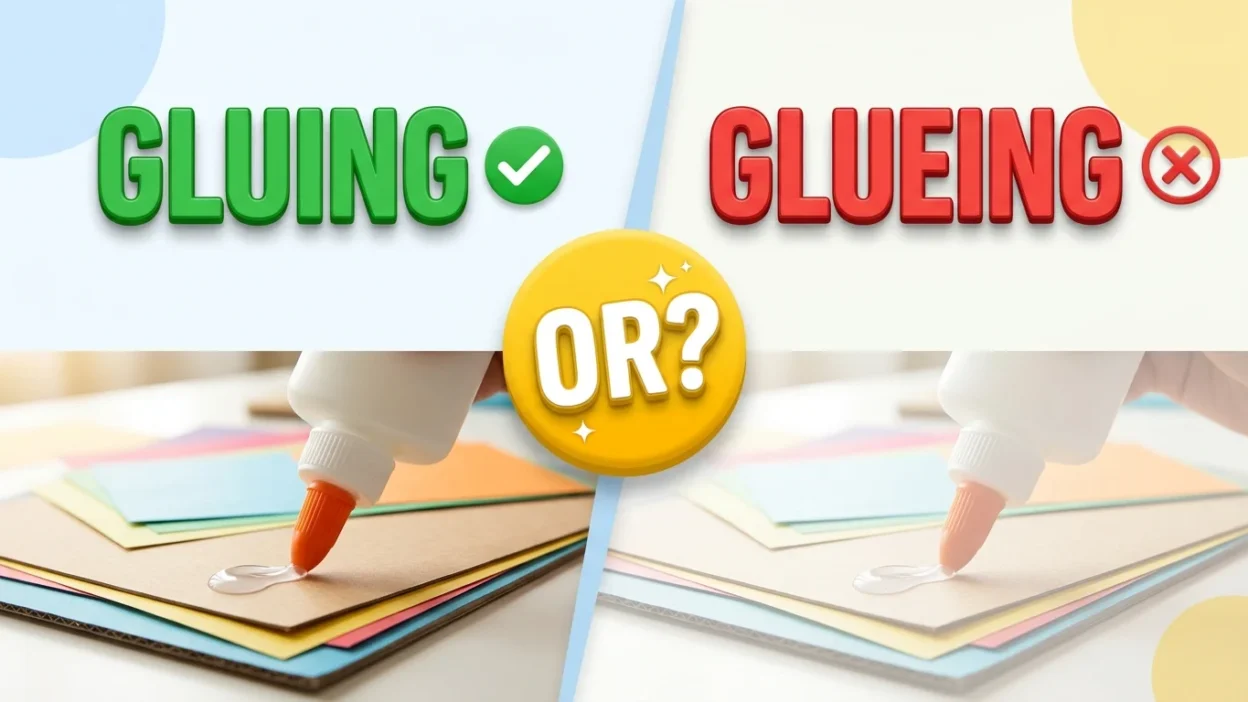
Have you ever wondered whether to write gluing or glueing? Both spellings look correct at first because they come from the verb glue, which means to stick or attach two or more things using an adhesive. However, when writing in standard English, choosing the correct spelling matters, especially in school assignments, professional documents, and everyday communication. So, is it gluing or glueing?
The correct and widely accepted spelling is gluing, with one E removed. It is the present participle of the verb glue and describes the action of joining objects with an adhesive substance. Although glueing has appeared in written English, it is a nonstandard variant and is not the recommended spelling in modern American or British English.
The difference follows a common English spelling rule: when a verb ends in a silent E, that letter is usually dropped before adding -ing. Understanding this rule will also help you spell words such as making, writing, baking, and dancing correctly.
Quick Answer:
Gluing is the correct standard spelling, while glueing is a nonstandard variant. Gluing means joining, attaching, or sticking objects together with glue. To form the present participle, remove the final silent E from glue and add -ing. For example: “She is gluing the pictures into her scrapbook.”
Why Do People Confuse Gluing and Glueing?
People often confuse gluing and glueing because both spellings appear logical. The original verb is glue, so some writers assume that the final E should remain when adding the suffix -ing. However, English spelling rules generally require dropping a silent final E before adding this suffix.
For example:
- Glue + ing = Gluing
- Make + ing = Making
- Write + ing = Writing
- Bake + ing = Baking
- Dance + ing = Dancing
Another reason for the confusion is that glueing has appeared in some historical and informal writing. Its appearance does not make it the preferred spelling in modern standard English.
Both forms are intended to describe the same action, but gluing is the spelling you should choose in formal writing, educational work, and everyday communication.
What Does Gluing Mean?
Gluing is the present participle of the verb glue. It means joining, attaching, or sticking two or more objects together by using glue or another adhesive substance.
The word can also function as a gerund, which means it can act as a noun in a sentence.
For example:
- Present participle: She is gluing the paper to the cardboard.
- Gerund: Gluing requires patience and attention.
Common Uses of Gluing
The word gluing is commonly used when discussing:
- Arts and crafts: Attaching paper, beads, decorations, and other materials.
- School projects: Joining pictures, cardboard, and colored paper.
- Woodworking: Connecting wooden pieces with wood glue.
- Home repairs: Fixing broken toys, furniture, and household objects.
- Model making: Attaching small parts to create models.
- Scrapbooking: Adding photographs and decorations to albums.
Examples of Gluing in Sentences
- The children are gluing colorful pictures onto their school projects.
- She is gluing the broken pieces of the vase together.
- My brother enjoys gluing wooden models in his free time.
- The teacher showed us how to make flowers by gluing paper petals.
- I spent the afternoon gluing photographs into my scrapbook.
- The carpenter is gluing two pieces of wood together.
What Does Glueing Mean?
Glueing is a nonstandard spelling variant of gluing. People who use this spelling generally intend to describe the same action: joining or attaching objects with glue.
However, glueing is not the conventional spelling recommended in modern standard English. The final E in glue is normally removed before adding -ing.
Why Is Glueing Considered Nonstandard?
The confusion comes from keeping the original spelling of the base verb instead of applying the usual silent-E spelling rule.
Compare these forms:
- Incorrect: She is glueing the paper to the wall.
- Correct: She is gluing the paper to the wall.
- Incorrect: He is glueing the broken toy.
- Correct: He is gluing the broken toy.
- Incorrect: They are glueing pictures into their notebooks.
- Correct: They are gluing pictures into their notebooks.
Although readers can usually understand glueing, it is better to use gluing to follow standard English spelling conventions.
Gluing vs. Glueing: What Is the Difference?
The main difference between gluing and glueing is their spelling, not their intended meaning. Both forms refer to the action of joining things with an adhesive, but only gluing is the recommended standard spelling.
| Feature | Gluing | Glueing |
| Spelling | Correct standard form | Nonstandard variant |
| Meaning | Joining things with glue | Intended same meaning |
| Base verb | Glue | Glue |
| Grammar | Present participle/gerund | Intended participle/gerund |
| Final silent E | Removed | Retained |
| American English | Standard | Not recommended |
| British English | Standard | Not recommended |
| Recommended usage | Yes | No |
Remember: If you are unsure which spelling to use, choose gluing.
When Should You Use Gluing or Glueing?
Knowing when to use these spellings is simple because gluing is the standard form.
When to Use Gluing
Use gluing when describing the action of attaching or joining objects with glue.
It is appropriate in:
- Academic assignments and school projects.
- Professional documents and instructions.
- Everyday conversations and messages.
- Arts and crafts descriptions.
- Woodworking and repair instructions.
Examples:
- The students are gluing paper flowers onto their projects.
- She enjoys gluing beads onto handmade decorations.
- He is gluing the wooden pieces together.
- I finished gluing the photographs into my album.
When to Use Glueing
Avoid glueing in standard English writing. Although the intended meaning is understandable, it is not the conventional spelling.
Instead of writing glueing, always choose gluing.
15 Examples of Gluing in Everyday Sentences
Here are 15 useful examples showing how to use gluing correctly in different situations.
- The little girl is gluing colorful stars onto her birthday card.
- My father is gluing the broken chair back together.
- We spent the morning gluing pictures onto construction paper.
- The teacher is gluing the students’ artwork onto the classroom wall.
- He is gluing the wooden pieces to complete his model.
- I got glue on my fingers while gluing the cardboard box.
- They are gluing posters to the classroom walls.
- She enjoys gluing beads onto handmade decorations.
- The carpenter is gluing two wooden boards together.
- I finished gluing the photographs into my family album.
- The children were gluing colorful leaves onto their art projects.
- Please wait until the glue dries before gluing another piece.
- My sister is gluing a paper flower onto her greeting card.
- We are gluing small parts together to build a model airplane.
- He spent the entire afternoon gluing labels onto the packages.
These sentences demonstrate how gluing is used in everyday English, including school activities, home repairs, creative projects, and professional tasks.
Common Spelling Mistakes with Gluing and Glueing
Writers sometimes make mistakes when adding -ing to verbs that end in a silent E. Understanding the spelling pattern can help you avoid these errors.
1. Writing Glueing Instead of Gluing
Incorrect: She is glueing the pictures into her notebook.
Correct: She is gluing the pictures into her notebook.
2. Keeping the Final Silent E
Incorrect: He is glueing two pieces of cardboard together.
Correct: He is gluing two pieces of cardboard together.
3. Assuming Both Spellings Are Equally Standard
Although both spellings may be understood, they are not equally recommended. Gluing is the conventional spelling in modern standard English.
4. Confusing Glue, Gluing, and Glued
These words come from the same base verb but have different grammatical forms.
- Glue: Base form of the verb.
- Gluing: Present participle or gerund.
- Glued: Past tense and past participle.
Examples:
- I glue pictures into my scrapbook.
- I am gluing pictures into my scrapbook.
- I glued pictures into my scrapbook yesterday.
5. Forgetting That English Has Spelling Exceptions
The silent-E rule is common, but it does not apply to every word. For example, see becomes seeing, not seing. Always consider the spelling and pronunciation of the original word.
Memory Trick: How to Remember Gluing or Glueing
Here is a simple memory trick to help you remember the correct spelling.
Drop the final silent E before adding -ing.
Think of the following examples:
- Glue → Gluing
- Make → Making
- Write → Writing
- Bake → Baking
- Dance → Dancing
- Smile → Smiling
You can also remember this simple rule:
Glue + ing = Gluing, not Glueing.
If you see the extra E in glueing, remember that it is the nonstandard form. This trick makes it easier to choose the correct spelling whenever you write about sticking or attaching objects.
American vs. British English: Is Gluing or Glueing Correct?
There is no standard American-versus-British spelling difference for this word. Both American English and British English generally use gluing as the correct spelling.
| English Variety | Standard Spelling |
| American English | Gluing |
| British English | Gluing |
| Canadian English | Gluing |
| Australian English | Gluing |
Some English words have different regional spellings, such as color in American English and colour in British English. However, gluing follows the same standard spelling convention across these varieties.
Therefore, whether you are writing for an American, British, Canadian, or Australian audience, use gluing.
Similar Words That Follow the Same Spelling Rule
Learning similar words can help you understand how to form the present participle of verbs ending in a silent E.
| Base Verb | Correct -ing Form |
| Glue | Gluing |
| Make | Making |
| Write | Writing |
| Bake | Baking |
| Dance | Dancing |
| Take | Taking |
| Smile | Smiling |
| Hope | Hoping |
| Drive | Driving |
| Use | Using |
| Close | Closing |
| Move | Moving |
| Give | Giving |
| Save | Saving |
| Change | Changing |
In most of these examples, the final silent E is dropped before adding -ing.
Are There Exceptions to the Silent-E Rule?
Yes. English has some exceptions where the final E remains to preserve pronunciation or distinguish meaning.
For example:
- See → Seeing
- Agree → Agreeing
- Free → Freeing
- Dye → Dyeing
- Singe → Singeing
These examples show why it is useful to learn common spelling patterns along with their exceptions.
Final Verdict:
The correct spelling is gluing, not glueing.
Use gluing when describing the action of joining, attaching, or sticking two or more objects together with glue. It is the standard present participle of the verb glue, formed by removing the final silent E before adding -ing.
Although glueing has appeared in written English, it is a nonstandard variant and is not recommended in modern standard American or British English. Whether you are writing an assignment, an email, a craft instruction, or a professional document, always choose gluing.
FAQs
1. Is it gluing or glueing?
Gluing is the correct standard spelling. It is formed by removing the final silent E from glue before adding -ing. Glueing is a nonstandard variant, so use gluing in standard English writing.
2. Why is gluing spelled without an E?
Gluing follows the common English spelling rule of dropping a silent final E before adding the suffix -ing. Since glue ends in a silent E, the correct form is gluing.
3. Is glueing ever correct?
Glueing appears occasionally as a spelling variant, but it is not the conventional spelling in modern standard English. For academic, professional, and everyday writing, gluing is the recommended form.
4. Is gluing correct in American and British English?
Yes. Gluing is the standard spelling in both American and British English. There is no commonly accepted regional spelling difference for this word.
5. What is the past tense of glue?
The past tense of glue is glued. For example: “She glued the photographs into her scrapbook yesterday.” The past participle is also glued.
6. Is gluing a verb or a noun?
Gluing can function as a present participle or a gerund. As a present participle, it describes an ongoing action: “She is gluing the paper.” As a gerund, it names an activity: “Gluing takes patience.”
7. What is the difference between glue, gluing, and glued?
Glue is the base form of the verb, gluing is its present participle or gerund, and glued is its past tense and past participle. For example: “I glue paper,” “I am gluing paper,” and “I glued paper yesterday.”
8. What is the spelling rule for adding -ing to glue?
When adding -ing to glue, remove the final silent E and add the suffix. The result is gluing. This is the same general pattern used in words such as making, writing, and baking.
Remember This
Here is everything you need to remember about gluing vs. glueing:
- Gluing = Correct standard spelling.
- Glueing = Nonstandard spelling.
- Glue = Base form of the verb.
- Gluing = Present participle and gerund.
- Glued = Past tense and past participle.
- Meaning = Joining or attaching objects with an adhesive.
- American English = Gluing.
- British English = Gluing.
The easiest way to remember the correct spelling is: Glue + ing = Gluing. Drop the silent E!
Conclusion
Choosing between gluing or glueing becomes easy when you understand the English silent-E spelling rule. The correct standard spelling is gluing, which describes the action of joining, attaching, or sticking objects together with an adhesive. Although glueing may look logical, it is a nonstandard variant and is not the recommended spelling in modern English.
Remember to use gluing in school assignments, professional documents, emails, and everyday communication. The same spelling is used in both American and British English. By learning this simple rule, you can avoid a common spelling mistake and improve your understanding of other English words that take the -ing suffix.

Cole Jaxson is the administrator of SymbolPeak, overseeing site management and content integrity. He is dedicated to presenting Bible-based spiritual symbol meanings with accuracy, reverence, and clarity, ensuring the platform remains trustworthy, well-organized, and aligned with biblical teachings and faith-centered understanding for readers worldwide.