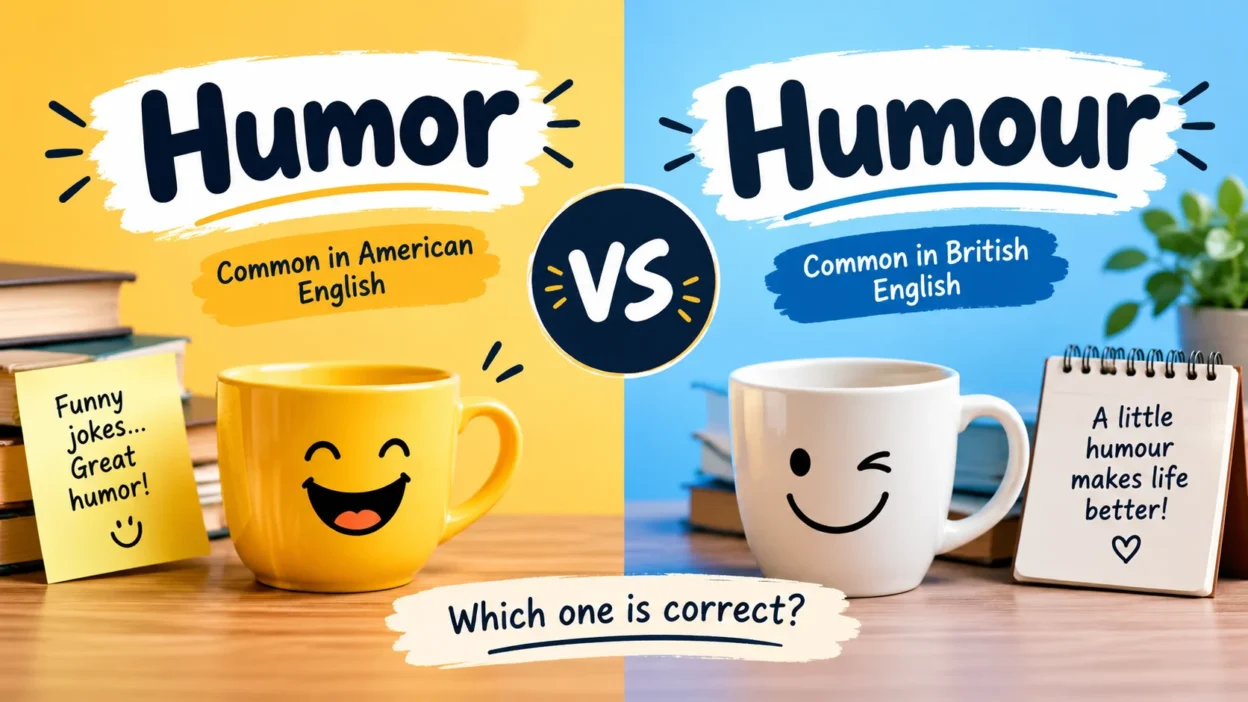
The words humor and humour have the same meaning, but their spelling depends on the variety of English you use. Humor is the standard spelling in American English, while humour is the standard spelling in British English.
Both words can describe something funny, a person’s ability to make others laugh, or the quality of finding amusement in everyday situations. Knowing which spelling to choose can help you write clearly and avoid common spelling mistakes.
For example, an American writer would say, “She has a great sense of humor,” while a British writer would write, “She has a great sense of humour.” The pronunciation and meaning remain the same.
The spelling difference also appears in related verb forms, such as humored/humoured and humoring/humouring. However, the adjective humorous is spelled the same way in both varieties of English.
In this guide, you will learn the difference between humor vs. humour, how to use each spelling, the meanings of related words, and practical examples to help you choose the correct form.
Quick Answer:
Humor is correct in American English, and humour is standard in British English. Both spellings refer to something amusing, a person’s sense of comedy, or the ability to make people laugh. Choose humor for American readers and humour for British readers. Keep your spelling consistent throughout your writing.
Why Do People Confuse Humor and Humour?
People often confuse humor and humour because both words have the same pronunciation and meaning. The only difference is the letter u. This difference follows a familiar pattern in British and American English spelling.
British English generally retains u in many words ending in -our, whereas American English usually removes it.
For example:
- British English: humour, colour, favour, honour, and neighbour.
- American English: humor, color, favor, honor, and neighbor.
Neither spelling is incorrect. The right choice depends on your audience and the spelling convention you follow.
Here are some common reasons for confusion:
- Different English varieties: British and American English follow different spelling conventions.
- Online reading: International websites often use both forms.
- School assignments: Teachers may expect either British or American spelling.
- Writing tools: Spell-checkers may flag a spelling that does not match their selected language.
- Related word forms: Words such as humored, humoured, humoring, and humouring follow the same regional pattern.
The easiest solution is to choose one variety of English and use it consistently.
First Word: Humor
Humor is the standard American English spelling of the noun. It describes the quality of being funny, the ability to appreciate jokes, or a person’s way of making others laugh.
The word can also be used as a verb meaning to accommodate someone, indulge a person’s wishes, or go along with an idea, sometimes to keep the peace.
What Does Humor Mean?
The noun humor has several common meanings:
- Something amusing: A joke, funny remark, or entertaining situation.
- A sense of humor: The ability to recognize, understand, and enjoy funny things.
- A comic style: The particular way a person, book, film, or performance creates amusement.
- A lighthearted attitude: The ability to find something amusing even in a difficult situation.
As a verb, to humor someone means to go along with that person’s wishes or ideas, often to avoid an argument or make the person feel comfortable.
Examples of Humor in Sentences
- My father has a wonderful sense of humor.
- The comedian’s humor made the audience laugh.
- Her dry humor is difficult to understand sometimes.
- A little humor can make a stressful day easier.
- The movie combines adventure with clever humor.
- I decided to humor my younger brother by listening to his unusual story.
- She tried to humor the child until he felt calmer.
Notice that the last two examples use humor as a verb rather than a noun.
Related American English Forms
American English uses these forms:
- Humor: Present-tense noun or verb.
- Humored: Simple past tense and past participle of the verb.
- Humoring: Present participle or gerund.
- Humorous: An adjective meaning funny or amusing.
Examples:
- He humored his friend’s unusual suggestion.
- She is humoring the child by pretending to believe the story.
- Their conversation was humorous and entertaining.
Second Word: Humour
Humour is the standard British English spelling of the same noun. It has the same meanings as humor and is used in British books, newspapers, websites, and everyday communication.
The word can describe something funny, a person’s ability to appreciate comedy, or a lighthearted way of responding to a situation. It can also be used as a verb, particularly when someone accommodates another person’s wishes.
What Does Humour Mean?
The noun humour commonly refers to:
- Amusement: Something that makes people laugh or smile.
- A sense of humour: The ability to appreciate jokes and funny situations.
- Comic expression: A style of comedy used in writing, conversation, television, or film.
- A lighthearted outlook: The ability to respond to everyday challenges with amusement.
As a verb, to humour someone means to indulge, accommodate, or go along with a person’s wishes.
Examples of Humour in Sentences
- My grandmother has a wonderful sense of humour.
- His gentle humour made everyone feel welcome.
- The film combines adventure with British humour.
- She used humour to make an awkward conversation easier.
- His dry humour often surprises his friends.
- I decided to humour my friend by listening to his unusual idea.
- The nurse humoured the older gentleman by patiently listening to his stories.
Related British English Forms
British English generally uses these forms:
- Humour: Present-tense noun or verb.
- Humoured: Simple past tense and past participle of the verb.
- Humouring: Present participle or gerund.
- Humorous: An adjective meaning funny or amusing.
Examples:
- She humoured her younger brother.
- He is humouring his friend by pretending to agree.
- The author wrote a humorous story.
The adjective remains humorous, even though the British noun is spelled humour.
Humor vs. Humour: Comparison Table
| Feature | Humor | Humour |
| Correctness | Correct | Correct |
| Main variety | American English | British English |
| Meaning | Something funny or the ability to appreciate comedy | Same meaning |
| Pronunciation | Generally the same | Generally the same |
| Letter u | Omitted | Included |
| Noun phrase | Sense of humor | Sense of humour |
| Past-tense verb | Humored | Humoured |
| Present participle | Humoring | Humouring |
| Adjective | Humorous | Humorous |
The main difference between humor vs. humour is regional spelling. Both words are correct, and neither changes the meaning of a sentence.
When Should You Use Humor or Humour?
Choose the spelling that matches your intended readers, school requirements, publication, or organization’s style guide.
When to Use Humor
Use humor when writing in American English.
You would normally choose this spelling when:
- Writing for readers in the United States.
- Preparing an assignment that requires American English.
- Publishing an article for an American website.
- Writing a sentence such as, “He has an excellent sense of humor.”
- Using related spellings such as color, favor, and honor.
When to Use Humour
Use humour when writing in British English.
You would normally choose this spelling when:
- Writing for readers in the United Kingdom.
- Completing work that requires British English.
- Publishing for a British newspaper or website.
- Writing a sentence such as, “She has a wonderful sense of humour.”
- Using related spellings such as colour, favour, and honour.
What About International English?
For an international audience, either spelling can be appropriate. What matters most is consistency.
If you start with humour, use related British spellings throughout the document. Weather you choose humor, follow American spelling conventions. If a publisher or institution specifies a style guide, follow its instructions.
15 Examples of Humor and Humour in Sentences
The following examples demonstrate how both spellings work in everyday English.
- American: She has a great sense of humor.
British: She has a great sense of humour. - American: His humor makes everyone smile.
British: His humour makes everyone smile. - American: The comedian’s humor entertained the audience.
British: The comedian’s humour entertained the audience. - American: I enjoy your sense of humor.
British: I enjoy your sense of humour. - American: Her humor helped us relax.
British: Her humour helped us relax. - American: The teacher used humor to explain the lesson.
British: The teacher used humour to explain the lesson. - American: His dry humor is difficult to understand.
British: His dry humour is difficult to understand. - American: The book combines adventure and humor.
British: The book combines adventure and humour. - American: A little humor can improve a difficult day.
British: A little humour can improve a difficult day. - American: They share the same sense of humor.
British: They share the same sense of humour. - American: He humored his friend’s unusual suggestion.
British: He humoured his friend’s unusual suggestion. - American: She is humoring the child by listening patiently.
British: She is humouring the child by listening patiently. - American: The author wrote a humorous poem.
British: The author wrote a humorous poem. - American: Their humor made the long journey enjoyable.
British: Their humour made the long journey enjoyable. - American: He responded with humor instead of anger.
British: He responded with humour instead of anger.
These examples show that the noun and its regional verb forms follow different spelling conventions, while the adjective humorous stays the same.
Other Forms of Humor and Humour
The spelling difference between American and British English also appears in the verb forms humored/humoured and humoring/humouring.
Humored vs. Humoured
Humored is the American English spelling, while humoured is the British English spelling. Both are the past tense and past participle forms of the verb to humor/humour.
The verb means to indulge someone, accommodate their wishes, or go along with their ideas.
Examples:
- American: Ethan humored his friend’s wild idea, even though he thought it was impractical.
- British: Ethan humoured his friend’s wild idea, even though he thought it was impractical.
- American: She humored the child until he stopped crying.
- British: She humoured the child until he stopped crying.
Humoring vs. Humouring
Humoring is standard in American English, whereas humouring is standard in British English.
Both forms can describe the act of accommodating someone’s wishes or going along with an idea.
Examples:
- American: Humoring the older gentleman, the nurse patiently listened to his stories.
- British: Humouring the older gentleman, the nurse patiently listened to his stories.
- American: He was humoring his friend by pretending to agree.
- British: He was humouring his friend by pretending to agree.
Humorous vs. Humourous
The correct adjective is humorous in both American and British English.
Humourous is generally considered a misspelling in standard modern English. Although the noun humour contains a u, the adjective does not.
Examples:
- Her humorous story made everyone laugh.
- The film has a humorous ending.
- Their humorous conversation made the journey enjoyable.
Remember this important rule: write humor or humour according to your English variety, but use humorous in both.
Common Mistakes When Using Humor and Humour
1. Assuming One Spelling Is Incorrect
Incorrect assumption: Humour is always wrong.
Correction: Both forms are correct. Humour is standard in British English, and humor is standard in American English.
2. Mixing British and American Spellings
Using humour alongside color in the same document can create inconsistency if you are following a single spelling convention.
Correction: Choose either British English or American English and apply that choice throughout your writing.
3. Writing Humourous Instead of Humorous
Incorrect: The comedian told a humourous story.
Correct: The comedian told a humorous story.
The adjective is spelled humorous in both varieties.
4. Confusing the Noun With the Verb
The noun describes something funny or a sense of amusement. The verb means to indulge or accommodate someone.
Examples:
- Noun: Her humor is contagious.
- Verb: I will humor his suggestion for now.
The British spellings are humour and humour respectively.
5. Forgetting the Audience
A British reader may expect humour, while an American reader generally expects humor.
Correction: Check your audience and any relevant style guide before finalizing your work.
Memory Trick: How to Remember Humor vs. Humour
Use this simple rule:
British English keeps the “u”; American English drops it.
- Humour = British English.
- Humor = American English.
- Humoured = British English.
- Humored = American English.
- Humouring = British English.
- Humoring = American English.
- Humorous = Both varieties.
You can remember the difference by grouping similar words together:
| British English | American English |
| Humour | Humor |
| Colour | Color |
| Favour | Favor |
| Neighbour | Neighbor |
| Honour | Honor |
This pattern makes it easier to identify the correct spelling when writing for a particular audience.
American English vs. British English: Main Spelling Differences
Humor and humour are part of a wider set of spelling differences between American and British English. Learning these patterns can help you recognize related words and maintain consistency.
| Spelling pattern | American English | British English |
| -or / -our | Humor, color, favor | Humour, colour, favour |
| -er / -re | Center, theater | Centre, theatre |
| -ize / -ise | Organize, recognize | Organise, recognise |
| -ed / -t | Learned, dreamed | Learnt, dreamt (also learned and dreamed) |
| Single or double consonant | Traveling, canceled | Travelling, cancelled |
| Retaining or dropping e | Aging, acknowledgment | Ageing, acknowledgement (both forms may occur) |
These are general patterns rather than absolute rules. Some British publications use -ize, and some spellings are accepted in both varieties. Always follow the relevant style guide when exact consistency matters.
Is It Humor or Humour in Australia?
Humour is generally the preferred spelling in Australian English, which usually follows British spelling conventions. For example, an Australian writer would commonly write, “She has a great sense of humour.”
However, Australian English has its own style and usage conventions, so follow the requirements of your publisher or institution when applicable.
Is It Sense of Humour or Sense of Humor?
Both phrases are correct, but the choice depends on the English variety.
- British English: sense of humour
- American English: sense of humor
- Australian English: sense of humour is generally preferred.
The expression describes someone’s ability to recognize, understand, and appreciate things that are funny.
Similar Words: Other British and American Spelling Differences
Here are more common examples of words that follow different spelling conventions in American and British English.
| American English | British English |
| Behavior | Behaviour |
| Favorite | Favourite |
| Flavor | Flavour |
| Rumor | Rumour |
| Splendor | Splendour |
| Center | Centre |
| Theater | Theatre |
| Analyze | Analyse |
| Organize | Organise |
| Traveling | Travelling |
| Canceled | Cancelled |
| Gray | Grey |
| License (noun and verb) | Licence (noun), license (verb) |
| Practice (noun and verb) | Practice (noun), practise (verb) |
| Airplane | Aeroplane |
Some entries have additional accepted variants depending on the country and style guide. The table shows common differences, not an exhaustive list of every regional spelling.
Final Verdict:
The correct spelling depends on the variety of English you are using.
- Use humor in American English.
- Use humour in British English.
- Use humored and humoring in American English.
- Use humoured and humouring in British English.
- Use humorous in both American and British English.
Both humor and humour have the same meaning and pronunciation. The difference is a spelling convention, not a difference in grammar or definition.
If you are writing for readers in the United States, choose humor. If you are writing for readers in the United Kingdom or Australia, humour is generally the preferred form. For international writing, select one convention and use it consistently.
Frequently Asked Questions
1. Is it humor or humour?
Both are correct. Humor is the standard American English spelling, while humour is the standard British English spelling. Both words have the same meaning and pronunciation.
2. Is humor American or British English?
Humor is the standard American English spelling. It is commonly used in American books, newspapers, websites, and everyday communication.
3. Is humour British English?
Yes. Humour is the standard British English spelling. It is also generally preferred in Australian English and used in Canadian English, although Canadian spelling conventions vary by word.
4. Is it sense of humour or sense of humor?
Both phrases are correct. Use sense of humor in American English and sense of humour in British English. Both refer to a person’s ability to appreciate jokes and funny situations.
5. Is it humorous or humourous?
Humorous is the standard spelling in both American and British English. Humourous is generally considered a misspelling, even when the noun is written as humour.
6. Is it humored or humoured?
Humored is the American English spelling, while humoured is the British English spelling. Both are past-tense forms of the verb meaning to indulge or accommodate someone.
7. Is it humoring or humouring?
Humoring is standard in American English, and humouring is standard in British English. Both mean indulging or accommodating someone’s wishes or ideas.
8. Is it vitreous humor or vitreous humour?
Both spellings appear in English medical terminology, depending on the regional convention. Vitreous humor is common in American medical English, while vitreous humour is used in British English. The term refers to the clear, gel-like substance that fills the space between the lens and the retina of the eye.
Remember This
Humor = American English. Humour = British English.
Both words have the same meaning. The American spelling omits the u, while the British spelling retains it. The same pattern applies to humored/humoured and humoring/humouring. However, humorous is the correct adjective in both varieties.
Conclusion
Understanding the difference between humor and humour helps you choose the right spelling for your readers. American English uses humor, while British English uses humour.
Both forms refer to something funny, a person’s sense of comedy, or the ability to find amusement in everyday life. The spelling difference also appears in the verb forms humored/humoured and humoring/humouring, but the adjective remains humorous in both varieties.
When writing an article, email, school assignment, or professional document, consider your audience and follow the spelling conventions they expect.
Keep related words consistent, check your style guide when necessary, and remember that neither humor nor humour is universally more correct. Choosing the appropriate spelling makes your writing clearer and more consistent.

Cole Jaxson is the administrator of SymbolPeak, overseeing site management and content integrity. He is dedicated to presenting Bible-based spiritual symbol meanings with accuracy, reverence, and clarity, ensuring the platform remains trustworthy, well-organized, and aligned with biblical teachings and faith-centered understanding for readers worldwide.