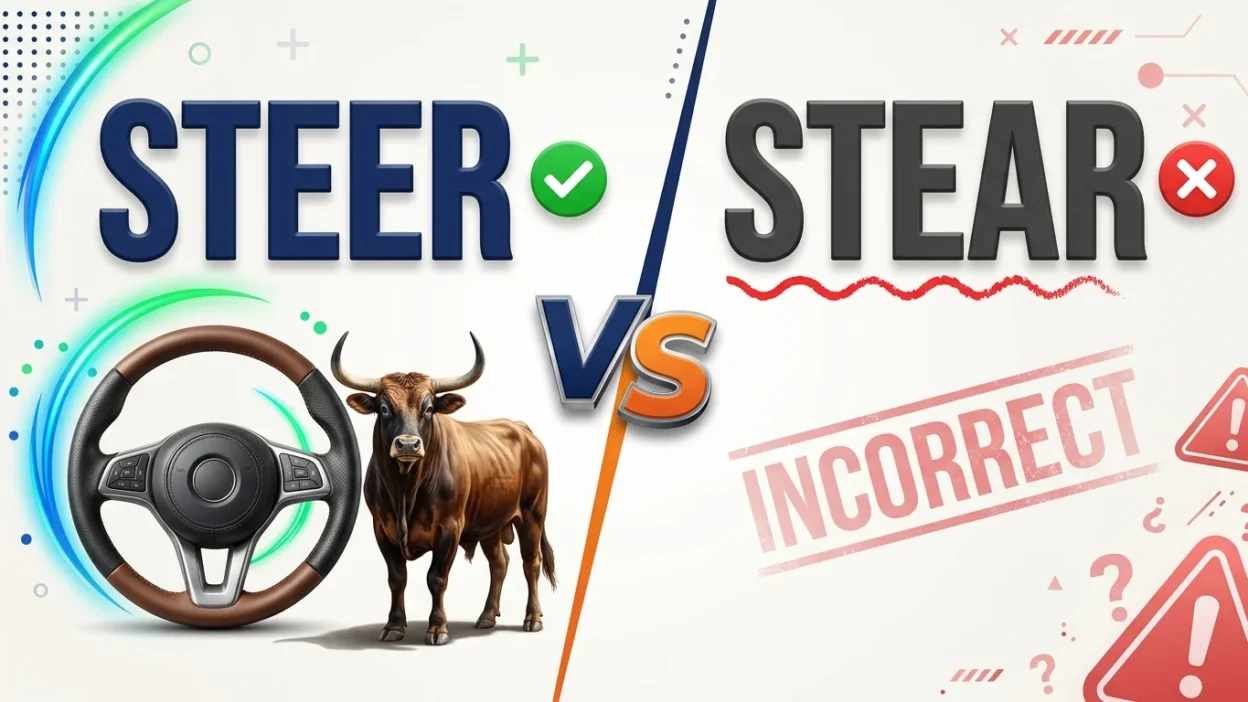
Have you ever wondered whether to write steer or stear? Although these spellings look similar, steer is the standard spelling in modern English when you mean to guide, direct, or control the direction of something.
The spelling stear is uncommon and is not the accepted spelling of this everyday verb. If you are writing an essay, completing a school assignment, or improving your English vocabulary, choosing the correct spelling will help you communicate clearly.
The word steer has several uses. It can describe controlling a car, bicycle, or boat, guiding a conversation, leading a team, or directing a business toward a particular goal. As a noun, a steer is a male bovine animal, typically a castrated male raised for beef.
In this guide, you will learn the difference between steer and stear, their meanings, correct usage, spelling rules, common mistakes, and practical examples. You will also discover whether stear has any historical or regional use and how American and British English spell these words.
Quick Answer:
Steer is the correct standard spelling when you mean to guide or control the direction of something. For example, “She learned to steer a car safely.” It can also refer to a male bovine animal, typically a castrated male raised for beef. Stear is not the standard spelling of this common verb or noun, so use steer in everyday, academic, and professional writing.
| Word | Meaning | Standard modern usage |
| Steer | To guide or direct; also a type of male bovine animal | Correct |
| Stear | An uncommon spelling sometimes encountered in historical or dialectal contexts | Not the standard spelling for the intended meaning |
| Steered | The past tense of steer | Correct |
| Steering | The act of directing or controlling movement | Correct |
Why Do People Confuse Steer and Stear?
People often confuse steer vs. stear because the words look alike and contain vowel combinations that can be difficult to remember. English spelling does not always follow one predictable pattern, so writers sometimes choose the wrong letters even when they know how a word sounds.
For example, meet and meat have the same pronunciation in many English accents but different spellings and meanings. Similarly, some people assume that steer should use ea instead of ee.
Typing errors and unfamiliarity with the word can also contribute to the confusion.
However, the standard spelling is straightforward: use steer when referring to guiding, directing, or controlling something. The same spelling applies whether you are talking about driving, boating, leadership, or livestock.
What Does Steer Mean?
Steer is an English word that functions as both a verb and a noun. Its meaning depends on how it is used in a sentence.
1. Steer as a Verb
As a verb, steer means to guide, direct, or control the movement or direction of something.
It is commonly used when talking about vehicles, boats, bicycles, and other objects that need to be directed. It can also describe influencing a discussion, decision, organization, or situation.
Examples:
- She learned to steer a bicycle when she was six.
- Please steer the car carefully around the corner.
- The captain steered the boat toward the harbor.
- The manager helped steer the team through a difficult project.
- He tried to steer the conversation away from an argument.
In figurative expressions, steer means to guide something toward a particular outcome rather than physically control its movement.
For example, “The teacher steered the discussion toward the main topic” means the teacher guided the conversation in a particular direction.
2. Steer as a Noun
As a noun, steer refers to a male bovine animal, typically a castrated male raised for beef production.
This meaning is common in farming, livestock management, and agricultural writing.
Examples:
- The farmer sold several steers at the livestock auction.
- A young steer grazed peacefully in the field.
- The rancher moved the steers into another pasture.
Remember that the noun and verb have different meanings, but they share the same spelling.
What Does Stear Mean?
Stear is not the standard spelling of the common English verb meaning to guide or control direction. If you see it in an ordinary sentence such as “Please stear the car,” it is most likely a spelling mistake for steer.
Some older spellings and regional forms can appear in historical texts or specialized sources. However, the existence of an unusual spelling does not make it an appropriate substitute in modern standard English.
If you encounter stear in an old book, historical document, or dialect study, consider the original context before interpreting it. Do not automatically assume that it has the same status as the standard word steer.
For everyday writing, schoolwork, emails, and professional communication, choose steer.
Steer vs. Stear: What Is the Main Difference?
The main practical difference between steer and stear is standard spelling and usage.
- Steer is the accepted modern spelling for guiding or controlling direction.
- Stear is not the standard spelling for this meaning.
- Steered is the correct past-tense form of steer.
- Steering is the correct -ing form.
- Steers is the plural noun when referring to more than one steer.
Compare these sentences:
Correct: She learned to steer the boat.
Incorrect: She learned to stear the boat.
Correct: He steered the car into the parking space.
Incorrect: He steared the car into the parking space.
If you want to write clearly in standard English, use steer and its correct grammatical forms.
Steer vs. Stear: Comparison Table
| Feature | Steer | Stear |
| Standard spelling | Yes | No, for the intended meaning |
| Part of speech | Verb and noun | Not the standard form of the intended verb |
| Verb meaning | To guide, direct, or control | No standard equivalent meaning in this context |
| Noun meaning | A male bovine animal, typically raised for beef | Not the standard spelling of this noun |
| Past tense | Steered | Steared is incorrect for the intended verb |
| Present participle | Steering | Stearing is incorrect for the intended verb |
| American English | Steer | Not the standard alternative |
| British English | Steer | Not the standard alternative |
When Should You Use Steer?
Use steer whenever you want to describe guiding, directing, or controlling the direction of something.
Driving and Vehicles
The verb is especially common when discussing cars, trucks, bicycles, and other vehicles.
Examples:
- Always steer carefully on wet roads.
- She steered the car around the obstacle.
- The driver corrected the vehicle’s direction.
- He is learning how to steer a truck safely.
Boating and Navigation
The word also describes controlling the direction of a boat or ship.
Examples:
- The captain steered the ship through rough waters.
- We learned to steer a small boat.
- She carefully steered the boat into the harbor.
Leadership and Decision-Making
In professional and everyday English, steer can describe guiding people, organizations, plans, or decisions.
Examples:
- The manager helped steer the company through a challenging year.
- A good teacher can steer students toward better learning habits.
- The committee will steer the project in a new direction.
Conversations and Situations
The word can also describe guiding a conversation or avoiding an unwanted situation.
Examples:
- He tried to steer the conversation toward a solution.
- She steered the discussion away from personal criticism.
- We should steer clear of unnecessary arguments.
The expression steer clear of means to avoid someone, something, or a situation.
15 Examples of Steer in Sentences
Here are 15 examples that demonstrate the correct spelling and different meanings of steer.
- I learned to steer a bicycle without help.
- Please steer the car carefully around the corner.
- The captain continued to steer the boat through the water.
- She tried to steer the conversation toward a positive topic.
- Good leaders know how to steer a team toward its goals.
- The driver had to steer away from a fallen branch.
- He helped his younger brother steer the shopping cart.
- The coach tried to steer the players toward better decisions.
- We should steer clear of unnecessary arguments.
- The company hopes to steer its business in a new direction.
- The farmer led the steer into the enclosure.
- She used the controls to steer the remote-controlled boat.
- The teacher steered the class discussion toward the lesson.
- He carefully steered the vehicle into a narrow parking space.
- The rancher moved several steers into a larger pasture.
These examples show how steer works in physical, figurative, and agricultural contexts.
Common Mistakes With Steer and Stear
Understanding the correct spelling also means recognizing related grammatical errors.
1. Writing Stear Instead of Steer
Incorrect: She can stear the car.
Correct: She can steer the car.
Use steer when describing control over direction.
2. Using Steared Instead of Steered
Incorrect: He steared the truck carefully.
Correct: He steered the truck carefully.
The past tense of steer is formed by adding -ed to the correctly spelled base word, producing steered.
3. Misspelling Steering
Incorrect: She is stearing the boat.
Correct: She is steering the boat.
When adding -ing, the word becomes steering, not stearing.
4. Confusing Steer With the Noun Steer
The word steer can describe either an action or an animal.
- Verb: The driver will steer the car.
- Noun: The farmer raised a steer.
The surrounding words and sentence structure help you identify the intended meaning.
5. Assuming Every Similar-Sounding Word Has the Same Spelling Pattern
English includes many words with different vowel combinations that sound similar. Learning the standard spelling of each word is more reliable than guessing from pronunciation alone.
How Can You Remember the Correct Spelling?
A simple memory trick can help you remember steer vs. stear.
Steer has “ee,” just like wheel.
Think of a steering wheel. You use the wheel to steer a car, and both steer and wheel contain the letters ee.
Remember this sentence:
“I use the wheel to steer.”
You can also connect the word to steering, as in steering wheel. Seeing the correct spelling in this familiar expression reinforces the spelling pattern.
Whenever you are unsure whether to write steer or stear, picture a steering wheel and choose steer.
Is Steer Spelled Differently in American and British English?
No. There is no standard American-versus-British spelling difference for steer.
Both American English and British English use the same spelling when referring to guiding a vehicle, directing a conversation, or describing the animal.
| English variety | Correct spelling | Example |
| American English | Steer | I can steer the car. |
| British English | Steer | I can steer the car. |
This differs from spelling pairs such as color and colour, which have recognized regional variations.
For standard writing in either country, use steer, steered, and steering.
What Are Some Words Similar to Steer?
Learning synonyms for steer can help you understand its meaning and express yourself more clearly. The best alternative depends on the context.
- Guide: To show the way or help direct someone.
- Direct: To point, guide, or control something toward a destination.
- Navigate: To find or follow a route.
- Control: To manage or regulate movement or behavior.
- Lead: To guide a person or group toward a destination or goal.
- Drive: To operate and control a motor vehicle.
- Channel: To direct something toward a particular purpose.
- Maneuver: To move or guide something skillfully, especially in a limited space.
- Steering: The process or mechanism used to control direction.
For example, “She helped steer the discussion” can be rewritten as “She helped guide the discussion.”
However, these synonyms are not interchangeable in every situation. You would normally say steer a car, while guide a student may be more natural when describing educational support.
Final Verdict:
Steer is the correct standard spelling when you mean to guide, direct, or control the direction of something. It can refer to vehicles, boats, conversations, teams, business decisions, and other situations. As a noun, it also refers to a male bovine animal, typically a castrated male raised for beef.
Stear is not the standard spelling for these everyday meanings. Although unusual forms may appear in historical or dialectal contexts, you should not use stear as a substitute for steer in modern standard writing.
For school assignments, professional documents, emails, and everyday communication, choose steer. Remember the simple connection between steer and wheel, and you will have an easy way to recall the correct spelling.
Frequently Asked Questions
1. Is it steer or stear?
Steer is the correct standard spelling when you mean to guide or control the direction of something. Stear is not the standard spelling of this common verb.
2. What is the difference between steer and stear?
The main difference is their standard usage. Steer is the accepted modern spelling and can function as a verb or noun. Stear is not the standard spelling for the same everyday meanings.
3. Is stear a real English word?
The spelling stear may appear in historical or dialectal sources, but it is not the standard modern spelling of the common verb meaning to guide or direct. In ordinary writing, use steer.
4. How do you use steer in a sentence?
Use steer when describing how someone guides or controls direction. For example: “She learned to steer the boat safely through the water.”
5. What is the past tense of steer?
The past tense of steer is steered. For example: “He steered the car into the parking space.” The spelling steared is incorrect for this verb in standard English.
6. Is steering or stearing correct?
Steering is the correct spelling. For example: “She is steering the car.” The spelling stearing is incorrect when you mean controlling or guiding direction.
7. Is steer spelled the same in American and British English?
Yes. Both American and British English use steer. There is no standard regional spelling difference for this word.
8. What does steer mean as a noun?
As a noun, a steer is a male bovine animal, typically a castrated male raised for beef. The same word is also used as a verb meaning to guide or control direction.
Remember This
- Steer: The correct standard spelling for guiding or controlling direction.
- Stear: Not the standard spelling for the everyday meanings discussed here.
- Steered: The correct past tense of steer.
- Steering: The correct -ing form.
- Steer: Also a noun referring to a male bovine animal, typically raised for beef.
- American and British English: Both use steer.
Conclusion
Choosing between steer or stear is straightforward once you remember that steer is the standard spelling in modern English. Use it when describing how someone guides a car, controls a boat, directs a conversation, or leads a team toward a goal. It also has a separate noun meaning related to livestock. Understanding both meanings will help you use the word accurately in different contexts.
To remember the spelling, think of the phrase “I use the wheel to steer.” Both steer and wheel contain ee, giving you a simple way to recall the correct letters. If you are writing for school, work, or everyday communication, choosing steer, steered, and steering will help you avoid common spelling mistakes.