
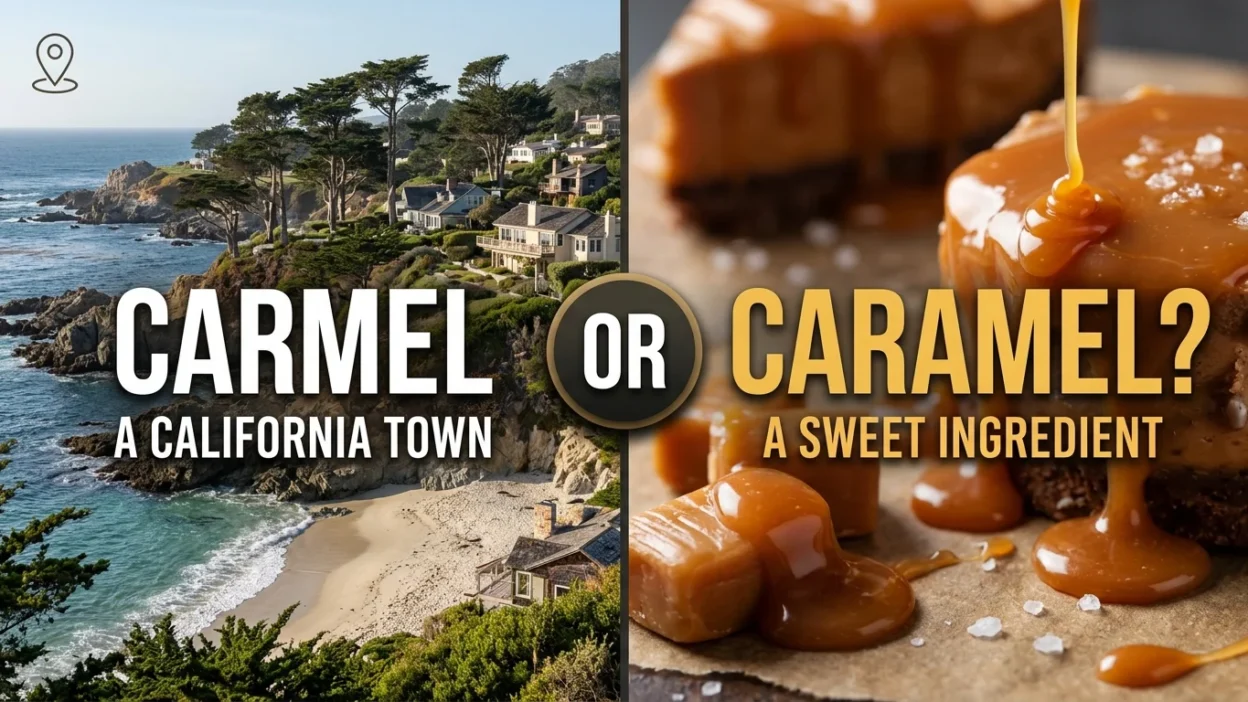
Have you ever wondered whether to write Carmel or caramel? These two words look similar and may sound almost identical when spoken, but they have different meanings and uses. If you are writing about candy, dessert, or a sweet flavor, caramel is the correct spelling. Carmel is generally used as a proper noun, such as the name of a person, place, or religious reference.
The confusion often comes from pronunciation. Some English speakers pronounce caramel with two syllables, making it sound like “car-mel,” while others pronounce it with three syllables. This difference in speech can lead people to leave out the extra letter “a” when writing.
However, the standard spelling of the sweet food remains caramel in both American and British English. In this guide, you will learn the difference between Carmel and caramel, their meanings, pronunciation, correct usage, common spelling mistakes, and practical examples to help you choose the right word every time.
Quick Answer:
Caramel is the correct spelling for the sweet substance made by heating sugar, as well as the candy, sauce, flavor, and light brown color associated with it.
Carmel is generally a proper noun used for names and places, such as Carmel-by-the-Sea in California and Mount Carmel. Although both words may sound alike, they are not interchangeable. Use caramel for food and Carmel when referring to a specific name or place.
Why Do People Confuse Carmel and Caramel?
People often confuse Carmel vs. caramel because the words have similar spellings and can sound alike in everyday conversation. The main difference is that caramel contains an extra “a” after the first “r.”
There are three common reasons for this confusion.
- Similar pronunciation: Some speakers pronounce caramel with two syllables, making it sound like “car-mel.”
- Similar spelling: Both words contain nearly the same letters, so it is easy to omit the extra “a.”
- Pronunciation-based spelling: People sometimes spell words according to how they hear them rather than their standard written forms.
For example:
Incorrect: I love carmel candy.
Correct: I love caramel candy.
The second sentence uses the standard spelling because it refers to a sweet food. Even when caramel is pronounced with two syllables, its spelling does not change.
What Does Caramel Mean?
Caramel is a noun that refers to a sweet substance produced by heating sugar until it melts and develops a golden-brown color. The heating process creates a distinctive flavor that can be sweet, toasted, buttery, or slightly bitter, depending on how the caramel is prepared.
The word caramel has several common meanings.
1. Caramel as a Sweet Substance
Caramel forms when sugar is heated and undergoes caramelization, a process that changes its color, flavor, and aroma.
Example: The chef heated the sugar until it turned into golden caramel.
2. Caramel as a Candy
Caramel can also refer to a soft, chewy candy commonly made with sugar, butter, milk, or cream.
Example: My grandmother makes delicious homemade caramel candies.
3. Caramel as a Sauce or Flavor
Sauce caramel is often poured over ice cream, cakes, pancakes, and other desserts. Caramel flavor is also popular in coffee, milkshakes, chocolates, and confectionery.
Examples:
- I added caramel sauce to my ice cream.
- She ordered a caramel latte.
- The cake had a rich caramel filling.
4. Caramel as a Color
The word can describe a warm, light-to-medium brown shade similar to the color of caramelized sugar.
Examples:
- She bought a caramel-colored handbag.
- His jacket was a beautiful caramel brown.
- The room had warm caramel tones.
What Is the Verb Form of Caramel?
The related verb is caramelize in American English and caramelise in British English. Both spellings refer to the process of heating sugar or other ingredients to develop a browned color and characteristic flavor.
Examples:
- Let the sugar caramelize slowly.
- The onions caramelise as they cook over low heat.
The spelling difference between caramelize and caramelise is a regional variation. It does not change the meaning of the word.
What Does Carmel Mean?
Carmel is generally a proper noun used for a person’s name, a geographical location, or a religious reference. Unlike caramel, it is not the standard spelling of the sweet food.
Here are some common uses of Carmel.
1. Carmel as a Place Name
Carmel is the name of several places. One well-known example is Carmel-by-the-Sea, a coastal city in California, United States. Mount Carmel is another geographical name associated with Israel.
Example: We visited Carmel-by-the-Sea during our vacation in California.
2. Carmel as a Personal Name
Carmel is also used as a given name.
Example: Carmel enjoys visiting historical places and museums.
3. Carmel in Religious References
Mount Carmel appears in biblical contexts, and the name is also associated with religious traditions, including the title Our Lady of Mount Carmel.
Example: The book discusses the religious significance of Mount Carmel.
Can Carmel Ever Be Correct?
Yes. Carmel is a correct word when it is the intended name of a person, place, or other named entity. It is generally considered a misspelling when used to refer to caramel candy, caramel sauce, or caramel flavor.
Carmel vs. Caramel: Comparison Table
| Feature | Carmel | Caramel |
| Main meaning | A proper name or place | A sweet substance, candy, flavor, or color |
| Part of speech | Usually a proper noun | Usually a noun; sometimes used as an adjective |
| Used for desserts | Not the standard spelling | Yes |
| Used for geographical names | Yes | Not normally |
| Example | Carmel, California | Caramel sauce |
| Capitalization | Usually capitalized as a name | Usually lowercase |
| Correct spelling for candy | No | Yes |
| Related word | Depends on the name or context | Caramelize or caramelise |
The most important distinction is simple: Carmel is a name, while caramel is the standard word for the sweet food.
When Should You Use Carmel or Caramel?
Choose the word according to what you want to describe.
When to Use Carmel
Use Carmel when referring to a specific person, place, or religious name.
Examples:
- We stayed in Carmel, California, for three days.
- Carmel is my cousin’s name.
- Mount Carmel is mentioned in biblical history.
- The travelers explored Carmel-by-the-Sea.
Because these examples use proper nouns, the first letter is capitalized.
When to Use Caramel
Use caramel when referring to food, desserts, sauces, flavors, or a particular shade of brown.
Examples:
- I prefer caramel sauce over chocolate sauce.
- She made caramel candy for the party.
- He ordered a caramel macchiato.
- The bakery sells caramel cheesecake.
- The shoes have a caramel-colored finish.
In ordinary writing, caramel is lowercase unless it begins a sentence or appears in a title.
14 Examples of Carmel and Caramel in Sentences
The following examples demonstrate how to use both words correctly in everyday English.
Examples Using Carmel
- We spent our summer vacation in Carmel, California.
- Carmel is the name of a woman in my family.
- The tourists enjoyed walking around Carmel-by-the-Sea.
- Mount Carmel has religious and historical significance.
- The travel guide included information about Carmel.
- My friend Carmel enjoys reading historical books.
- The documentary explored the history of Mount Carmel.
Examples Using Caramel
- I poured caramel sauce over my vanilla ice cream.
- She bought a box of caramel candies.
- He prefers caramel coffee to plain coffee.
- The recipe requires sugar to make homemade caramel.
- We ordered a caramel cheesecake for dessert.
- Her handbag was a lovely caramel color.
- The chef allowed the sugar to caramelize slowly.
These examples show that the spelling depends on the intended meaning. A person’s name or geographical location may be Carmel, but the sweet ingredient is caramel.
Common Mistakes With Carmel and Caramel
Although the difference is straightforward, these words are frequently confused in writing.
Mistake 1: Writing Carmel Candy
Incorrect: I bought some carmel candy at the store.
Correct: I bought some caramel candy at the store.
Explanation: Caramel is the standard spelling for the sweet, chewy confection.
Mistake 2: Writing Caramel, California
Incorrect: We visited Caramel, California.
Correct: We visited Carmel, California.
Explanation: Carmel is the name of the city. Caramel would be incorrect when referring to that place.
Mistake 3: Treating the Words as Interchangeable
Incorrect: Carmel and caramel are two spellings of the same dessert.
Correct: Caramel is the standard spelling of the dessert, while Carmel is generally a proper noun.
Explanation: Similar pronunciation does not mean two words have the same meaning.
Mistake 4: Spelling According to Pronunciation
Incorrect: I made carmel sauce because I pronounce caramel with two syllables.
Correct: I made caramel sauce.
Explanation: English spelling does not always match pronunciation exactly. Even if you pronounce caramel as “car-mel,” the standard written form remains caramel.
Mistake 5: Forgetting Capitalization
Incorrect: We visited caramel-by-the-sea.
Correct: We visited Carmel-by-the-Sea.
Explanation: The name of the California city is a proper noun, so its established capitalization should be preserved.
What Is an Easy Way to Remember Carmel vs. Caramel?
A simple memory trick can help you remember the difference.
Caramel has an extra “a” for a sweet treat.
Imagine pouring caramel sauce over a bowl of ice cream. The word for the sweet topping contains the extra letter “a,” which helps distinguish it from Carmel.
You can also use this quick rule:
- Carmel = Name or place
- Caramel = Candy or dessert
If the sentence mentions a sauce, candy, coffee flavor, or dessert, choose caramel. If it refers to a person, geographical location, or religious name, use Carmel when that is the correct proper noun.
Carmel vs. Caramel in American and British English
The spelling distinction is the same in American and British English: caramel refers to the sweet food, while Carmel is used for proper names.
However, there are some regional differences in related vocabulary.
| Feature | American English | British English |
| Sweet food | Caramel | Caramel |
| Proper name | Carmel | Carmel |
| Verb | Caramelize | Caramelise |
| Noun for the sweet food | Caramel | Caramel |
| Pronunciation | Two or three syllables | Pronunciation varies by speaker |
In the United States, caramel is commonly pronounced with either two or three syllables. British speakers also vary in how they pronounce the word.
The main point is that pronunciation does not determine the spelling. Whether you speak American or British English, use caramel when writing about the sweet substance.
Similar Words That People Often Confuse
Learning the difference between Carmel and caramel can also help you understand other commonly confused English words.
- Dessert vs. desert: Dessert is a sweet course after a meal; a desert is a dry geographical region.
- Advice vs. advise: Advice is a noun that means a recommendation; advise is a verb that means to recommend.
- Affect vs. effect: Affect usually means to influence, while effect usually means a result.
- Compliment vs. complement: A compliment is an expression of praise; a complement completes or enhances something.
- Principal vs. principle: Principal can refer to a school leader or something most important; principle means a rule, belief, or basic idea.
- Caramelize vs. caramelise: Both words describe the same process, but caramelize is the usual American spelling and caramelise is a common British spelling.
Understanding these distinctions improves spelling accuracy and helps you express your ideas clearly.
Final Verdict:
The correct spelling depends on the meaning of the word.
Use caramel for the sweet substance made by heating sugar, as well as caramel candy, caramel sauce, caramel flavor, and caramel-colored objects.
Use Carmel for a proper name, such as Carmel-by-the-Sea, Mount Carmel, or a person named Carmel.
For example, “I love caramel ice cream” is correct because the sentence refers to a dessert. “We visited Carmel, California” is correct because Carmel is the name of a city.
Although both words may sound similar, they are not interchangeable. Remembering that caramel has an extra “a” for a sweet treat is an easy way to avoid this common spelling mistake.
Frequently Asked Questions
1. Is it Carmel or caramel for the sweet food?
Caramel is the correct spelling for the sweet food. It refers to sugar that has been heated until it develops a brown color and distinctive flavor. It is also used for caramel candies, sauces, and desserts.
2. Why is caramel sometimes spelled carmel?
Some people pronounce caramel with two syllables, so it sounds like “car-mel.” This pronunciation can lead to the mistaken spelling carmel. However, caramel remains the standard spelling for the food in written English.
3. Is Carmel a real word?
Yes. Carmel is a proper noun used for places, personal names, and religious references. Examples include Carmel-by-the-Sea in California and Mount Carmel. It is not the standard spelling of the sweet food.
4. Is caramel spelled differently in American and British English?
No. Both American and British English use caramel for the sweet food. A related verb is spelled caramelize in American English and caramelise in British English.
5. Is caramel pronounced with two or three syllables?
Both pronunciations are used. Some speakers say caramel with two syllables, while others pronounce it with three. Regional and individual differences influence pronunciation, but the standard spelling remains caramel.
6. Is it caramel sauce or Carmel sauce?
Caramel sauce is the standard spelling. It refers to a sweet sauce commonly served with ice cream, cakes, and other desserts. Carmel sauce would generally be a spelling mistake unless it were the specific name of a product or brand.
7. Is Carmel or caramel a color?
Caramel is the standard word for a warm golden-brown color. For example, you can describe a handbag, hair color, or jacket as caramel-colored. Carmel is not the standard spelling for this color.
8. What is the easiest way to remember Carmel vs. caramel?
Remember that caramel has an extra “a” and refers to candy or a sweet treat. Carmel is generally used for names and places. This simple memory trick can help you select the correct spelling when writing.
Remember This
- Caramel: A sweet substance, candy, sauce, flavor, or golden-brown color.
- Carmel: A proper name used for people, places, and certain religious references.
- Caramelize: The American English spelling of the related verb.
- Caramelise: A common British English spelling of the same verb.
- Pronunciation: Caramel may have two or three syllables, depending on the speaker.
- Correct spelling: Use caramel when writing about food, even if you pronounce it as “car-mel.”
Conclusion
The difference between Carmel and caramel becomes easy to understand when you focus on meaning rather than pronunciation. Caramel is the standard spelling for the sweet substance made by heating sugar, including candies, sauces, flavors, and brown-colored foods or objects. Carmel is generally a proper noun used for people, places, and religious references.
To avoid mistakes, remember the extra “a” in caramel whenever you write about desserts or sweet flavors. Use Carmel when referring to a specific name, such as Carmel-by-the-Sea or Mount Carmel. By learning this simple distinction and practicing the examples in this guide, you can improve your spelling, strengthen your vocabulary, and use both words confidently in everyday English.