
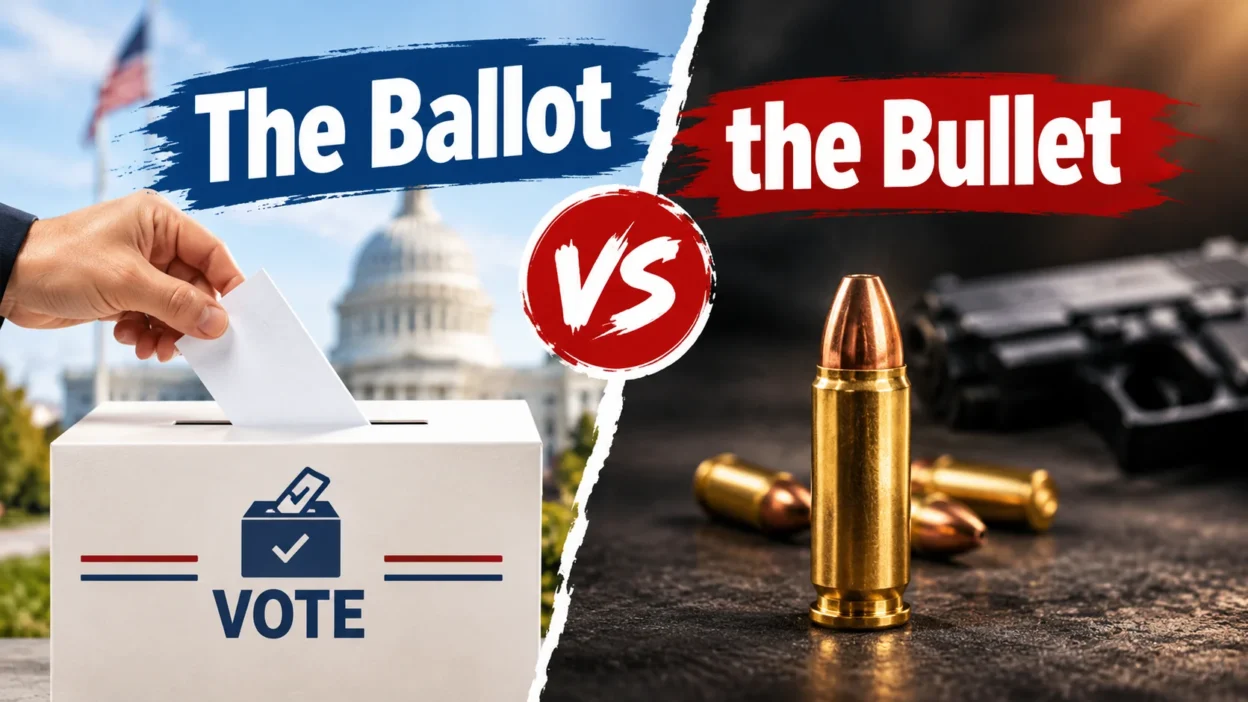
The phrase “The Ballot or the Bullet” is best known as the title of a powerful speech delivered by Malcolm X on April 3, 1964, in Cleveland, Ohio. The speech addressed racial discrimination, voting rights, political representation, economic inequality, and the struggle for freedom among African Americans during the American Civil Rights Movement. Malcolm X used the contrast between the ballot and the bullet to emphasize the urgency of achieving justice and equality.
In this famous speech, a ballot represents voting, political participation, and the opportunity to bring about change through the electoral process. A bullet represents the possibility of armed resistance when people believe peaceful political methods have failed to protect their rights.
The phrase expresses Malcolm X’s warning that continued oppression and broken political promises could lead to greater conflict. Understanding The Ballot or the Bullet speech, its historical background, and its central arguments helps readers understand Malcolm X’s political philosophy and the wider struggle for African American civil rights in the 1960s.
Quick Answer: What Does “The Ballot or the Bullet” Mean?
“The Ballot or the Bullet” is a famous 1964 speech by Malcolm X that highlights the urgency of securing freedom, voting rights, and equal treatment for African Americans. The ballot symbolizes political action and the power of voting, while the bullet symbolizes the threat of resistance if injustice continues. The speech calls for political awareness, unity, self-determination, and meaningful change.
Why Do People Confuse Ballot and Bullet?
People sometimes confuse ballot and bullet because the words look similar and share several letters. However, they have different meanings and uses. Their contrast also gives Malcolm X’s speech its memorable title.
What Does Ballot Mean?
A ballot is a vote, a voting form, or a method of recording a person’s choice in an election or other formal decision.
The word is closely connected to democracy, elections, political representation, and voting rights.
Examples:
- Citizens used their ballots to choose their representatives.
- Every eligible voter should have a fair opportunity to cast a ballot.
- Malcolm X emphasized the importance of political power and voting rights.
In the context of the speech, the ballot represents the ability of African Americans to influence government decisions and demand accountability from elected officials.
What Does Bullet Mean?
A bullet is a projectile fired from a firearm. In ordinary writing, the word can also refer to a symbol used to introduce an item in a list, known as a bullet point.
In Malcolm X’s speech, however, the word has a political and historical meaning. It represents the possibility of armed resistance in response to continued oppression and the failure to secure equal rights.
Malcolm X used the contrast to communicate the seriousness of the situation facing African Americans in 1964. The title was a warning about the consequences of injustice, rather than simply a comparison between two words.
Who Was Malcolm X?
Malcolm X was an influential African American Muslim minister, public speaker, and civil rights activist. He became widely known for his criticism of racism, racial segregation, political inequality, and the economic disadvantages experienced by Black Americans.
Unlike civil rights leaders who emphasized nonviolent protest as a central strategy, Malcolm X stressed Black self-determination, political independence, community control, and the right to self-defense. His political views evolved throughout his life, particularly following his break with the Nation of Islam and his travels abroad in 1964.
Malcolm X believed that African Americans needed to understand the political and economic systems affecting their lives. He challenged political leaders who sought Black votes but failed to deliver meaningful improvements in civil rights and living conditions.
His speeches encouraged audiences to question political promises, organize their communities, and pursue freedom with urgency.
What Is the Historical Background of “The Ballot or the Bullet”?
To understand The Ballot or the Bullet, it is important to understand the conditions facing African Americans during the early 1960s.
Although slavery had been abolished nearly a century earlier, racial discrimination remained widespread throughout the United States. Jim Crow laws enforced racial segregation in many Southern states, while discrimination in housing, education, employment, and public services affected Black communities across the country.
Many African Americans, particularly in the South, faced serious barriers to voting. These included discriminatory registration practices, intimidation, threats, and other methods designed to prevent them from participating in elections.
The wider Civil Rights Movement challenged these injustices through demonstrations, boycotts, voter-registration campaigns, legal action, and other forms of political organizing.
In 1964, the Civil Rights Act was being debated in Congress. Malcolm X criticized politicians who made promises about racial equality but, in his view, failed to act quickly or effectively enough.
He delivered his speech in Cleveland on April 3, 1964, arguing that African Americans needed to exercise greater political power and stop accepting empty promises.
The speech emerged during a critical period in American history, when questions about racial justice, voting rights, political responsibility, and self-defense were central to national debate.
What Is the Main Message of “The Ballot or the Bullet”?
The main message of Malcolm X’s speech is that African Americans should demand freedom and equality rather than continue accepting discrimination and unfulfilled political promises.
He presented voting as an important source of political power. However, he argued that voting alone was insufficient if elected officials ignored the needs of Black communities.
His message included several connected ideas:
- Political empowerment: African Americans should understand how elections and government decisions affect their lives.
- Voting rights: People must be able to participate meaningfully in elections without discrimination or intimidation.
- Political accountability: Candidates and elected officials should be judged by their actions, not simply their promises.
- Economic independence: Black communities should work toward greater control over their businesses, employment opportunities, and economic resources.
- Unity: People should cooperate across religious and organizational differences when pursuing shared goals.
- Human rights: Malcolm X argued that the struggle against racial oppression should be understood as a broader human rights issue, not only a domestic civil rights matter.
The title captures the urgency of these arguments. Malcolm X wanted his audience to recognize that the continued denial of freedom and equality could have serious consequences.
Major Themes in “The Ballot or the Bullet”
1. Voting Rights and Political Power
One of the most important themes is the connection between voting rights and political influence.
Malcolm X argued that African Americans possessed significant potential electoral power, particularly when elections were closely contested. However, he believed that this power was weakened when voters supported politicians without demanding results.
He encouraged people to understand what their votes could accomplish and to hold elected officials accountable.
The speech therefore presents voting as more than a civic responsibility. It presents the ballot as a tool for influencing public policy, challenging discrimination, and demanding representation.
2. Racial Discrimination and Inequality
Malcolm X criticized the racial discrimination that affected Black Americans in education, housing, employment, public services, and political participation.
He challenged the idea that the United States had already achieved equal opportunity for everyone. In his view, the language of democracy and freedom did not match the experiences of many African Americans.
This theme connects the speech to the broader history of racial segregation, institutional discrimination, and the struggle for civil rights.
3. Political Hypocrisy and Broken Promises
Another central theme is Malcolm X’s distrust of political leaders who sought African American support without delivering meaningful reform.
He criticized politicians who made promises during election campaigns but allowed discriminatory practices to continue.
His argument was that voters should examine political records rather than accept campaign statements at face value.
This remains an important lesson about political accountability: democratic participation is most meaningful when citizens can evaluate leaders, question their decisions, and demand results.
4. Black Nationalism and Self-Determination
Malcolm X also emphasized Black nationalism, a political philosophy that, in his speech, focused on Black political participation, economic control, community organization, and self-determination.
He argued that African Americans should have greater influence over the institutions that shaped their communities.
His vision included supporting Black-owned businesses, strengthening local organizations, developing political awareness, and creating opportunities within Black communities.
This theme reflected his belief that lasting change required more than promises from outside authorities. Communities also needed the ability to organize, make decisions, and develop their own resources.
5. Unity Across Religious Differences
Although Malcolm X was a Muslim minister, he argued that religious differences should not prevent people from working together against injustice.
He referred to Christians, Muslims, nationalists, and people with other beliefs as potential partners in the struggle for equality.
His point was that people facing common problems could cooperate without abandoning their individual religious or philosophical identities.
This theme emphasizes solidarity, cooperation, and collective action.
6. Civil Rights and Human Rights
Malcolm X argued that the struggle of African Americans should be viewed as a human rights issue, not merely a domestic civil rights matter.
He believed that presenting racial discrimination as a human rights concern could help draw international attention and support.
The distinction was important to his political strategy. He wanted the international community to recognize that racial inequality in the United States was connected to wider questions of freedom, dignity, and equal treatment.
7. Economic Independence
The speech also addresses the importance of economic power.
Malcolm X argued that communities should pay attention to where their money went, who owned local businesses, and who benefited from economic activity.
He believed that greater community control over businesses and financial resources could create jobs, strengthen local institutions, and improve economic opportunities.
This argument connects economic empowerment with political freedom. In his view, voting rights were important, but economic independence was another essential part of meaningful self-determination.
The Ballot vs. the Bullet: Comparison Table
| Feature | Ballot | Bullet |
| Literal meaning | A vote or voting form | A firearm projectile |
| Meaning in the speech | Political participation and electoral power | The possibility of armed resistance |
| Main association | Elections and democracy | Conflict and resistance |
| Role in Malcolm X’s argument | A way to demand political change | A warning about the consequences of continued injustice |
| Related themes | Voting rights and representation | Self-defense and the urgency of freedom |
| Central question | Can political action bring meaningful change? | What happens if oppression continues? |
The distinction is essential to understanding the title. Malcolm X used two words with sharply different literal meanings to communicate the seriousness of the struggle for racial justice.
Why Was “The Ballot or the Bullet” Important?
The speech was important because it challenged audiences to reconsider the relationship between voting, political power, and racial equality.
Rather than treating elections as an automatic solution to discrimination, Malcolm X asked listeners to consider whether political institutions were responding to their needs.
The speech also broadened the discussion beyond voting. It connected political participation with economic opportunity, community leadership, international human rights, and self-defense.
Its significance can be understood in several ways:
- It highlighted the importance of Black political participation.
- It criticized political leaders who failed to deliver meaningful civil rights reforms.
- It emphasized community organization and economic self-determination.
- It challenged audiences to think critically about the limits of existing political strategies.
- It presented racial injustice as an issue with consequences beyond individual communities.
The speech remains a significant text for studying Malcolm X, the Civil Rights Movement, African American political thought, and debates about the most effective ways to achieve social change.
What Literary and Rhetorical Techniques Did Malcolm X Use?
Malcolm X used several persuasive techniques to make his speech memorable and forceful.
Contrast
The central contrast between ballot and bullet organizes the speech around two possible responses to injustice. The words represent different approaches and different possible consequences.
This contrast makes the title memorable while communicating the urgency of the subject.
Repetition
Malcolm X repeatedly returned to the central phrase throughout the speech.
Repetition reinforced his main argument, helped maintain the audience’s attention, and gave the speech a strong spoken rhythm.
Rhetorical Questions
He asked questions about political representation, broken promises, and the effectiveness of existing government policies.
These questions encouraged listeners to examine the relationship between political promises and actual results.
Emotional Appeal
Malcolm X discussed the experiences of African Americans facing racial discrimination and unequal treatment.
These references appealed to the audience’s sense of injustice and emphasized the human consequences of political failure.
Direct Address
He spoke directly to his listeners, using conversational language and addressing them as participants in a shared struggle.
This technique made the speech feel immediate and encouraged the audience to consider its own political responsibilities.
Analogy and Metaphor
The ballot and bullet function as symbols of broader political choices. The ballot represents the opportunity for electoral change, while the bullet evokes the danger of escalating conflict.
Together, these symbols communicate the seriousness of the historical moment Malcolm X was addressing.
How Does “The Ballot or the Bullet” Relate to the Civil Rights Movement?
The speech belongs to the wider history of the American Civil Rights Movement, which sought to end racial segregation and secure equal rights for African Americans.
During this period, activists used different strategies, including nonviolent demonstrations, legal challenges, boycotts, voter-registration campaigns, and political organizing.
Malcolm X’s approach differed in important ways from the nonviolent philosophy associated with leaders such as Martin Luther King Jr. Malcolm X emphasized Black nationalism, self-determination, and the right to self-defense, while King became internationally known for advocating nonviolent resistance.
Their approaches were not identical, and the differences between them were part of the wider debate about how best to achieve racial equality.
Despite their differences, both figures challenged racial injustice and demanded meaningful change. Studying their ideas helps explain the diversity of political strategies within the Civil Rights Movement.
Ballot vs. Bullet in Everyday English
Outside the historical speech, ballot and bullet retain their ordinary meanings.
Use ballot when talking about a vote, election, or formal decision. Use bullet when referring to a firearm projectile or a symbol used in a list.
Examples of Ballot
- Every eligible voter received a ballot.
- She completed her ballot before leaving the polling station.
- The organization elected its president by secret ballot.
- The candidates’ names appeared on the ballot.
- Voters used their ballots to express their choices.
Examples of Bullet
- Investigators recovered a bullet at the scene.
- The report contains five bullet points.
- The teacher asked students to organize their answers into a bullet list.
- The documentary discussed the dangers of a stray bullet.
- The writer used bullet points to summarize the main ideas.
Related to the Speech
- Malcolm X used the ballot as a symbol of political power.
- The title The Ballot or the Bullet reflects the urgency of his argument.
- The speech challenged African Americans to demand meaningful political representation.
- Malcolm X connected voting rights with economic independence.
- Students study the speech to understand different approaches to civil rights.
These examples show how the literal definitions of the words connect with their symbolic meanings in Malcolm X’s speech.
Common Misunderstandings About “The Ballot or the Bullet”
Misunderstanding 1: The Speech Is Only About Voting
The speech discusses voting rights, but its subject is much broader. Malcolm X also addressed economic inequality, political accountability, Black nationalism, community organization, and human rights.
Misunderstanding 2: Ballot and Bullet Have the Same Meaning
They do not. A ballot is associated with voting, while a bullet is a projectile. In the speech, the words function as symbols of different responses to injustice.
Misunderstanding 3: Malcolm X Was Only Discussing Religion
Malcolm X identified as a Muslim, but he explicitly distinguished his religious beliefs from the political and social issues he was discussing. He encouraged cooperation across religious differences.
Misunderstanding 4: The Speech Supported Only One Political Party
Malcolm X criticized political leaders and questioned the effectiveness of their promises. His argument was not simply an endorsement of one party over another. He urged African Americans to evaluate political power according to the results it produced.
Misunderstanding 5: The Title Is Just a Literal Choice Between Two Objects
The title is symbolic. The ballot represents political action, while the bullet represents the possibility of resistance in a climate of continued injustice. The contrast gives the speech its urgency and rhetorical force.
Frequently Asked Questions
1. What is “The Ballot or the Bullet” about?
The Ballot or the Bullet is a speech by Malcolm X about racial injustice, voting rights, political power, and African American self-determination. Delivered in 1964, it argues that Black Americans should demand meaningful change rather than accept empty political promises.
2. Who delivered “The Ballot or the Bullet”?
Malcolm X delivered the speech on April 3, 1964, in Cleveland, Ohio. He was an influential African American Muslim minister, speaker, and activist who criticized racial discrimination and advocated Black political and economic empowerment.
3. What does the ballot symbolize in Malcolm X’s speech?
The ballot symbolizes voting rights, political participation, and the ability to influence government decisions. Malcolm X viewed voting as an important way for African Americans to exercise political power and hold elected officials accountable.
4. What does the bullet symbolize in the speech?
The bullet symbolizes the possibility of armed resistance if racial oppression continues and political institutions fail to protect people’s rights. It represents the danger of escalating conflict rather than an ordinary voting-related meaning.
5. What was Malcolm X’s main argument?
His main argument was that African Americans needed freedom, equality, political representation, and economic opportunity without unnecessary delay. He urged people to become politically aware, organize their communities, and judge political leaders by their actions.
6. How did Malcolm X’s views differ from Martin Luther King Jr.’s?
Malcolm X emphasized Black nationalism, self-determination, political independence, and the right to self-defense. Martin Luther King Jr. is especially associated with nonviolent resistance and civil disobedience. Both challenged racial injustice, but they differed in their philosophies and preferred strategies.
7. Why is “The Ballot or the Bullet” still studied today?
The speech is studied for its historical importance, rhetorical techniques, and arguments about democracy, voting rights, economic inequality, political accountability, and human rights. It also helps students understand the different viewpoints that shaped the Civil Rights Movement.
8. Is “The Ballot or the Bullet” a metaphor?
Yes. The title uses a symbolic contrast between the ballot and the bullet. The ballot represents political participation, while the bullet represents the possibility of armed resistance. This contrast communicates Malcolm X’s warning about the consequences of continued injustice.
Remember This
- Ballot: A vote, voting form, or method of recording a choice.
- Bullet: A projectile fired from a firearm; it can also refer to a symbol used in a list.
- The Ballot or the Bullet: A historic speech delivered by Malcolm X in Cleveland on April 3, 1964.
- Central message: African Americans should demand meaningful freedom, equality, voting rights, and political accountability.
- Major themes: Racial justice, Black nationalism, self-determination, economic empowerment, unity, and human rights.
- Historical importance: The speech illustrates debates about political power and strategies for achieving racial equality during the Civil Rights Movement.
The key distinction is that the words have different literal meanings, while their contrast in Malcolm X’s speech carries a much broader political message.
Conclusion
The Ballot or the Bullet remains an important speech in the history of African American political thought and the Civil Rights Movement. Through its powerful title and direct language.
Malcolm X challenged his audience to examine racial inequality, question political promises, and demand meaningful freedom. His arguments connected voting rights with economic independence, community organization, human rights, and political accountability.
Understanding the difference between ballot and bullet also helps explain the speech’s central symbolism. The ballot represents the power of political participation, while the bullet represents the danger of continued injustice and escalating resistance.
By studying the speech in its historical context, readers can better understand Malcolm X’s political philosophy and the wider debates about democracy, equality, and the struggle for civil rights in the United States.

Cole Jaxson is the administrator of SymbolPeak, overseeing site management and content integrity. He is dedicated to presenting Bible-based spiritual symbol meanings with accuracy, reverence, and clarity, ensuring the platform remains trustworthy, well-organized, and aligned with biblical teachings and faith-centered understanding for readers worldwide.