Have you ever wondered whether the correct spelling is sneek or sneak?Sneek or Sneak: Which Is Correct? Meaning, Spelling, and Examples. These two spellings look and sound almost identical, which makes them easy to confuse. However, only one is the standard English spelling when you want to describe someone moving quietly or doing something secretly.
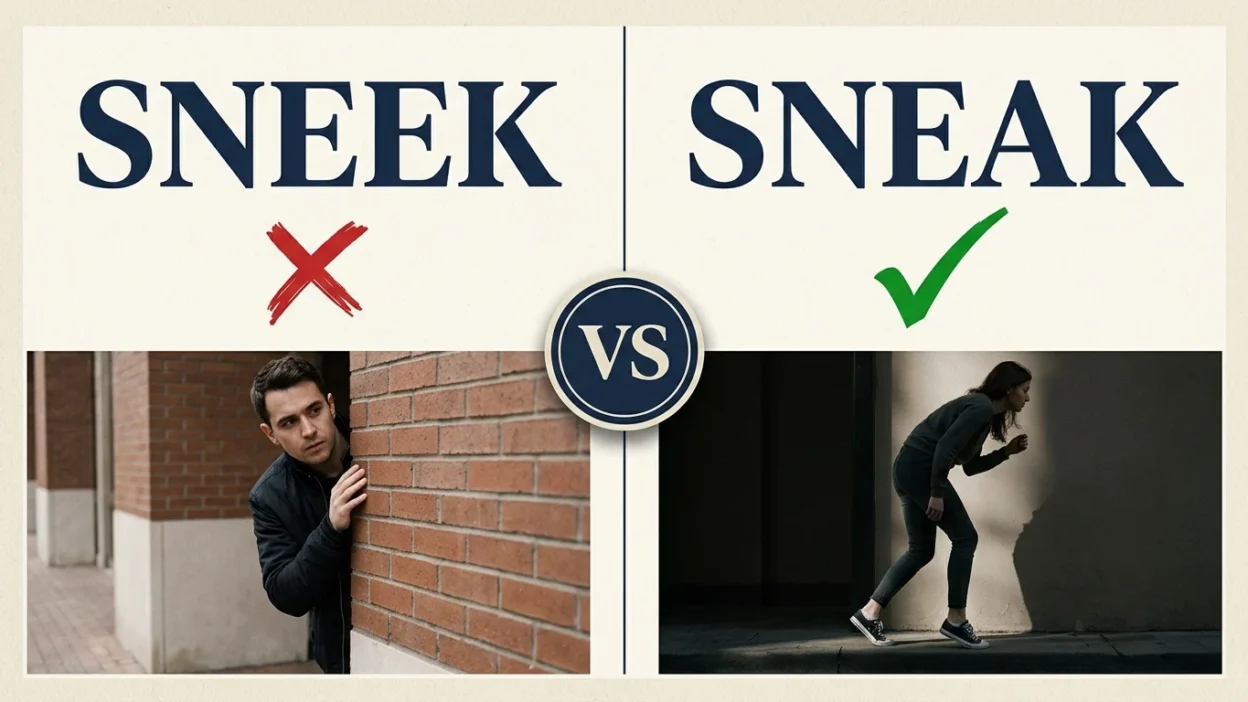
The correct spelling is sneak, not sneek. The word sneak means to move quietly, secretly, or carefully to avoid being noticed. It can also describe a person who behaves secretly or dishonestly.
Although sneek sometimes appears in usernames, brand names, and informal online writing, it is not a standard spelling of the English verb. Understanding this difference will also help you use related expressions correctly, including sneak peek, sneak out, sneak in, and the past-tense forms sneaked and snuck.
Quick Answer: Sneek or Sneak?
Sneak is the correct spelling in standard English. It means to move quietly or secretly to avoid being noticed or to do something without attracting attention. Sneek is a nonstandard spelling when used with this meaning. Always write sneak in schoolwork, professional documents, emails, and everyday communication.
Why Do People Confuse Sneek and Sneak?
People often confuse sneek and sneak because both spellings look similar and are intended to represent the same pronunciation.
The main difference is their vowel combination:
- Sneak: Uses the letters ea.
- Sneek: Uses the letters ee.
The word sneak is pronounced /sniːk/, with a long E sound. English spelling can be confusing because different letter combinations sometimes produce the same sound.
For example:
- EA: Eat, seat, speak, sneak.
- EE: See, tree, green, sleep.
Because ee commonly represents the long E sound, some people mistakenly write sneek. However, the accepted spelling is sneak.
Remember that pronunciation alone does not always tell you how to spell an English word. Learning the standard spelling is the best way to avoid this mistake.
Which Spelling Is Correct: Sneek or Sneak?
Sneak is the standard English spelling. It is used as both a verb and a noun and has several meanings connected with secrecy, quiet movement, and hidden actions.
Sneek is nonstandard when used as a replacement for sneak. It may appear in proper names, usernames, business names, or creative writing, but it should not be used as the ordinary spelling of the English word.
| Spelling | Status | Meaning or Usage | Example |
|---|---|---|---|
| Sneak | Correct | Move or act secretly | He tried to sneak outside. |
| Sneek | Nonstandard | Misspelling of sneak in this context | He tried to sneek outside. |
For school assignments, articles, emails, and professional writing, always choose sneak.
What Does Sneak Mean?
Sneak is an English word that describes moving quietly, acting secretly, or doing something without attracting attention. It can function as a verb or a noun.
The exact meaning depends on how it is used in a sentence.
Sneak as a Verb
As a verb, sneak means to move quietly or secretly to avoid being seen or heard. It can also mean doing something secretly, especially when someone wants to avoid attention or permission.
Examples:
- The children tried to sneak into the garden.
- She sneaked past the sleeping dog.
- He snuck out of the room during the meeting.
- The cat managed to sneak into the kitchen.
- I sneaked an extra cookie before dinner.
- They tried to sneak snacks into the cinema.
The word does not always describe something dishonest or harmful. For example, someone might sneak away from a noisy room simply to find a quiet place.
Sneak as a Noun
As a noun, sneak can describe a person who behaves secretly or dishonestly, especially someone who does something behind another person’s back.
Examples:
- He is such a sneak for reading my private messages.
- Nobody trusts that sneak.
- Don’t be a sneak and reveal my secret.
- She called him a sneak after he told everyone what happened.
This use of sneak often has a negative or disapproving tone.
Sneak as an Adjective or Part of an Expression
Although sneak is mainly used as a noun or verb, it also appears in familiar expressions.
For example, sneak preview describes an early showing or preview of something. Similarly, sneak peek means an early or brief look at something.
The adjective sneaky describes someone or something that behaves secretly, dishonestly, or in a way that avoids attention.
Example: He used a sneaky trick to win the game.
What Does Sneek Mean?
Sneek is not a standard English spelling of the verb meaning to move secretly or quietly. It is generally considered a spelling mistake when someone intends to write sneak.
People may write sneek because they hear the long E sound and assume that the word should contain ee rather than ea.
However, the standard spelling remains sneak.
Incorrect and correct examples:
- Incorrect: The boy tried to sneek outside.
- Correct: The boy tried to sneak outside.
- Incorrect: She wanted to sneek into the party.
- Correct: She wanted to sneak into the party.
- Incorrect: The cat will sneek into the bedroom.
- Correct: The cat will sneak into the bedroom.
Is Sneek Ever a Real Name?
Yes. Sneek is also the name of a city in the Netherlands and can appear as a proper name, username, or brand name. This does not make it an accepted alternative spelling of the English verb sneak.
Sneak Peek or Sneak Peak: Which Is Correct?
The correct expression is sneak peek, not sneak peak, when you mean an early look or preview of something.
This expression is common in entertainment, marketing, product announcements, social media, and everyday conversations.
The confusion happens because peek and peak sound alike but have different meanings.
- Peek: To take a quick or secret look at something.
- Peak: The highest point of a mountain, object, or level.
- The company shared a sneak peek of its new product.
- Here is a sneak peek at my upcoming blog post.
- We received a sneak peek of the new movie.
- The designer gave us a sneak peek at the collection.
| Expression | Correct? | Explanation |
|---|---|---|
| Sneak peek | Yes | An early look or preview. |
| Sneek peek | No | Sneek is nonstandard for this meaning. |
| Sneak peak | No, for this meaning | Peak means the highest point. |
| Sneek peak | No, for this meaning | Both words are incorrect for the intended expression. |
Memory Trick: You peek when you look. A peak is the top of a mountain. Therefore, an early look is always a sneak peek.
Common Phrases With Sneak and Their Meanings
The word sneak appears in several common English phrases. Adding a preposition or another word can change the meaning of the expression.
1. Sneak Out
Sneak out means to leave a place quietly or secretly, usually without telling anyone or attracting attention.
Examples:
- He tried to sneak out after midnight.
- She sneaked out of the party without saying goodbye.
- The children wanted to sneak out of the house.
- I had to sneak out of the meeting early.
2. Sneak In
Sneak in means to enter a place secretly or without being noticed. It can also describe adding something secretly or without openly announcing it.
Examples:
- The dog sneaked into the bedroom.
- He tried to sneak into the cinema without a ticket.
- She sneaked a joke into her speech.
- He sneaked an extra clause into the contract.
In the last two examples, sneak in describes secretly introducing something into a speech or document.
3. Sneak Up On
Sneak up on someone means to approach a person quietly so they do not notice you.
Examples:
- Don’t sneak up on me like that!
- The cat sneaked up on the bird.
- He quietly sneaked up on his brother.
This expression can also describe something that happens unexpectedly or sooner than someone expects.
Example: The deadline sneaked up on me.
This means the deadline arrived before the person felt prepared for it.
4. Sneak Around
Sneak around means to behave secretly, often because someone does not want others to discover what they are doing.
Examples:
- He was sneaking around the house at night.
- She doesn’t like people who sneak around.
- They were sneaking around without telling anyone.
5. Sneak Away
Sneak away means to leave quietly without attracting attention.
Examples:
- We decided to sneak away before the meeting ended.
- She sneaked away to enjoy some quiet time.
- The children sneaked away from the playground.
6. Sneak Past
Sneak past means to move by someone or something without being noticed.
Examples:
- The thief tried to sneak past the guard.
- The children sneaked past their parents.
- The cat managed to sneak past the sleeping dog.
Sneaked or Snuck: Which Is Correct?
Both sneaked and snuck are correct past-tense forms of the verb sneak. Neither is automatically wrong.
The difference is in how these forms developed and how they are commonly used.
Sneaked is the regular past-tense form. It follows the usual English pattern of adding -ed to a verb.
Snuck is an irregular past-tense form that is especially common in American English.
Examples:
- I sneaked out of the house last night.
- I snuck out of the house last night.
- She sneaked past the guard.
- She snuck past the guard.
Both forms are grammatically acceptable.
Is Snuck Grammatically Correct?
Yes. Snuck is an accepted past-tense and past-participle form of sneak. It is not simply a spelling mistake.
For example:
- He snuck into the room.
- She has snuck out before.
- They had snuck past the security guard.
The regular forms are also correct:
- He sneaked into the room.
- She has sneaked out before.
- They had sneaked past the security guard.
Sneaked vs. Snuck: Comparison Table
| Feature | Sneaked | Snuck |
|---|---|---|
| Correct form | Yes | Yes |
| Verb type | Regular form | Irregular form |
| Past tense | Yes | Yes |
| Past participle | Yes | Yes |
| American English | Common | Very common |
| British English | Often preferred | Also used |
In British English, sneaked has traditionally been more common, although snuck is also used. In American English, snuck is especially common.
For formal writing, either form is acceptable. Choose the one that suits your audience and maintain consistency.
Forms of the Verb Sneak
Understanding the different verb forms of sneak will help you use the word correctly in present, past, and future sentences.
| Verb Form | Word | Example |
|---|---|---|
| Base form | Sneak | I sneak out for a walk. |
| Third-person singular | Sneaks | She sneaks into the room. |
| Present participle | Sneaking | They are sneaking past the gate. |
| Simple past | Sneaked / Snuck | He sneaked away. / He snuck away. |
| Past participle | Sneaked / Snuck | She has sneaked away. / She has snuck away. |
Remember that both sneaked and snuck can be used after has, have, and had.
Examples:
- I have sneaked into the kitchen before.
- She has snuck out of the house.
- They had sneaked past the guards.
12 Examples of Sneak in Sentences
Here are practical sneak sentence examples to help you understand the word in everyday English.
- The little boy tried to sneak out of the bedroom.
- She wanted to sneak into the kitchen for some food.
- The cat managed to sneak through the open door.
- He tried to sneak past his teacher without being noticed.
- We decided to sneak away before the meeting ended.
- The children often sneak downstairs at night.
- I saw him sneak a cookie from the jar.
- The thief tried to sneak into the building.
- She gave me a sneak peek at her new project.
- Don’t sneak around when you can simply ask for permission.
- He tried to sneak out without waking anyone.
- The dog likes to sneak into the garden.
These examples show that sneak can describe entering, leaving, approaching, hiding, or doing something secretly.
Common Mistakes to Avoid When Using Sneak
Even experienced English writers sometimes confuse the spelling and grammatical forms of sneak. Here are some common mistakes and their corrections.
1. Writing Sneek Instead of Sneak
The most common mistake is using sneek instead of the correct spelling sneak.
- Incorrect: I will sneek into the room.
- Correct: I will sneak into the room.
2. Writing Sneak Peak Instead of Sneak Peek
These expressions sound similar, but only sneak peek is correct when referring to an early look.
- Incorrect: Here is a sneak peak of the movie.
- Correct: Here is a sneak peek of the movie.
3. Thinking Snuck Is Incorrect
Some people believe that snuck is grammatically wrong. However, both snuck and sneaked are accepted.
- Correct: He sneaked out last night.
- Correct: He snuck out last night.
4. Confusing Sneak With Sneaky
Sneak and sneaky are related but have different grammatical uses.
- Sneak (verb): He tried to sneak outside.
- Sneaky (adjective): That was a sneaky trick.
5. Using Sneak Instead of Sneaking
Use sneaking when describing an action that is happening or when the sentence requires the present participle.
- Incorrect: She is sneak into the room.
- Correct: She is sneaking into the room.
6. Using Synonyms Without Understanding Their Meanings
Words such as creep, tiptoe, slink, and prowl have related meanings, but they are not interchangeable in every situation.
Choose the word that accurately describes the action.
Memory Trick: How to Remember Sneak
A simple way to remember the correct spelling is to connect sneak with speak.
Both words contain the letters EA followed by K.
Remember this sentence:
Sneak and Speak both have EA.
Another useful reminder is:
- Sneak: Correct spelling.
- Sneek: Incorrect spelling for the intended meaning.
- Sneak peek: Correct expression for an early look.
Whenever you are unsure whether to write sneek or sneak, remember the word speak. This small spelling trick can help you choose the correct form every time.
American vs. British English: Is Sneak Spelled Differently?
There is no spelling difference between American and British English for the word sneak.
Both varieties use sneak as the standard spelling. The alternative sneek is not a recognized regional spelling.
| English Variety | Correct Spelling | Nonstandard Spelling |
|---|---|---|
| American English | Sneak | Sneek |
| British English | Sneak | Sneek |
| Canadian English | Sneak | Sneek |
| Australian English | Sneak | Sneek |
There is, however, a difference in the traditional preference for the past-tense forms.
- American English: Snuck is especially common, although sneaked is also correct.
- British English: Sneaked has traditionally been more common, although snuck is also used.
Therefore, regardless of your audience, always spell the main word sneak.
Synonyms for Sneak: Other Words With Similar Meanings
Learning synonyms for sneak can improve your vocabulary and help you describe different types of secret movement or behavior.
However, the best alternative depends on the situation.
| Synonym | Meaning | Example |
|---|---|---|
| Creep | Move slowly and quietly | The cat crept toward the door. |
| Tiptoe | Walk quietly on your toes | She tiptoed past the bedroom. |
| Slip | Move somewhere quietly or unnoticed | He slipped out of the meeting. |
| Slink | Move quietly, often to avoid attention | The boy slunk away after breaking the vase. |
| Prowl | Move around slowly, often searching | The fox prowled around the chicken coop. |
| Steal away | Leave quietly or secretly | They stole away in the night. |
| Skulk | Move secretly while hiding | He skulked around the building. |
| Stealth | Secret or careful movement without detection | The soldiers moved with stealth. |
These words have related meanings but different tones.
For example, tiptoe focuses on how someone walks, slink can suggest shame or embarrassment, and prowl often describes searching or hunting.
Choose the synonym that best describes the action instead of replacing sneak automatically.
Final Verdict: Sneek or Sneak?
The correct spelling is sneak, not sneek. It is a standard English word that can function as both a noun and a verb. Means to move quietly, secretly, or carefully to avoid being noticed. It can also describe a person who behaves secretly or dishonestly.
Remember the related expressions as well: sneak peek means an early look, sneak out means leaving secretly, and sneak in means entering without being noticed. Both sneaked and snuck are correct past-tense forms. Whether you are writing in American or British English, always use sneak as the standard spelling.
Frequently Asked Questions
1. How do you spell sneek or sneak?
The correct spelling is sneak. It means to move quietly or secretly to avoid being noticed. Sneek is a nonstandard spelling when used with this meaning.
2. What does sneak mean in simple English?
Sneak means to move quietly or do something secretly so that other people do not notice. For example, a child might sneak downstairs to get a snack without waking their parents.
3. Is sneek a real English word?
Sneek is not a standard spelling of the English verb sneak. However, it can appear as a proper name, such as the name of a city in the Netherlands, or as a brand or username.
4. Is sneak a noun or a verb?
Sneak can be both a noun and a verb. As a verb, it means to move or act secretly. As a noun, it can describe someone who behaves secretly or dishonestly.
5. Is snuck grammatically correct?
Yes. Snuck is an accepted irregular past-tense and past-participle form of sneak. Sneaked is also correct. Both forms can be used in standard English.
6. Which is correct: sneak peek or sneak peak?
Sneak peek is correct when you mean an early look or preview of something. Peek means a quick look, while peak means the highest point of something.
7. What does sneak out mean?
Sneak out means to leave a place quietly or secretly, often without telling anyone. For example, someone might sneak out of a party without saying goodbye.
8. What does sneak in mean?
Sneak in means to enter a place without being noticed. It can also mean secretly introducing something into a document, conversation, or plan.
9. What does sneak up on someone mean?
Sneak up on someone means to approach a person quietly so they do not notice you. It can also describe something unexpected, such as a deadline, arriving sooner than expected.
10. What is another word for sneak?
Depending on the context, synonyms include creep, tiptoe, slip, slink, skulk, and prowl. Each word has a slightly different meaning and tone.
Remember This
- Sneak is the correct standard English spelling.
- Sneek is nonstandard when used to mean moving secretly.
- Sneak can function as both a noun and a verb.
- Sneak peek is the correct expression for an early look.
- Sneak out means to leave secretly.
- Sneak in means to enter without being noticed.
- Sneaked and snuck are both correct past-tense forms.
- American and British English use the same spelling: sneak.
Conclusion
Choosing between sneek or sneak becomes simple once you understand the correct spelling and meaning. Sneak is the standard English word for moving quietly, acting secretly, or avoiding attention. Although sneek may look reasonable because of its pronunciation, it is not an accepted alternative spelling of the verb. Remember that sneak and speak both contain the letters EA.
You can also improve your English by learning common expressions such as sneak peek, sneak out, sneak in, and sneak up on. Remember that both sneaked and snuck are grammatically correct past-tense forms. With these spelling rules, examples, and memory tips, you can use sneak confidently in everyday conversations, school assignments, and professional writing