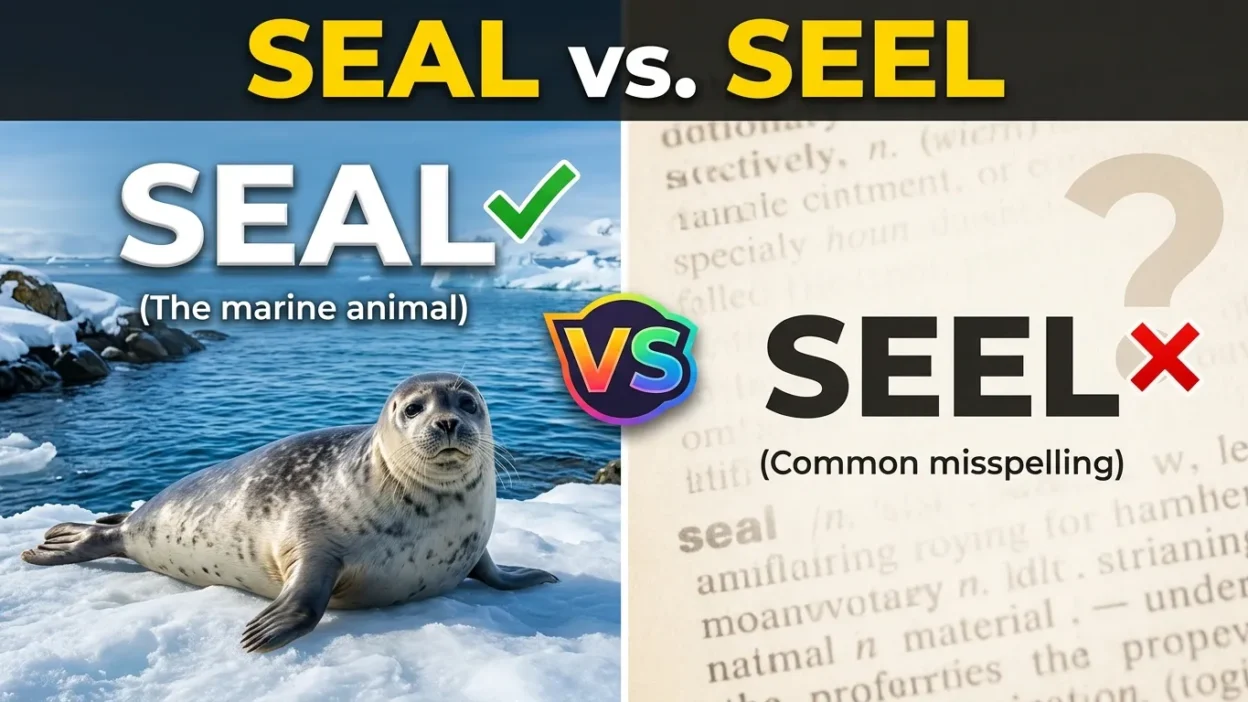
Are you confused about seal vs. seel and wondering which spelling is correct? The answer depends on the meaning, but seal is the correct word in almost all everyday English situations.
It can mean to close something securely, refer to a marine animal, describe an official mark, or indicate a device that prevents air or liquid from passing through an opening. The word also appears in common expressions such as seal the deal and seal an agreement.
Seel is also a real English word, but it is rare and archaic. It is mainly associated with historical falconry, where it refers to closing or sewing a bird’s eyelids. Because seal and seel are pronounced alike, people can easily confuse their spelling.
However, their meanings are different, and they cannot normally replace each other. This guide explains the difference between seal and seel, their definitions, pronunciation, correct usage, sentence examples, common spelling mistakes, and American and British English usage.
Quick Answer: Seal vs. Seel
Seal is the standard modern English word for closing something securely, referring to a marine mammal, or describing an official mark or closure. Seel is a rare, archaic verb associated with historical falconry and the closing of a bird’s eyelids. Both words are pronounced alike, but they have different meanings. For everyday writing, choose seal.
Why Do People Confuse Seal and Seel?
People often confuse seal and seel because the two words have the same pronunciation but different spellings and meanings. This type of spelling confusion can happen when someone knows a word by sound but is unsure how to write it.
The main reasons include:
- Similar pronunciation: Both words are pronounced /siːl/, like “seel.”
- Different vowel combinations: Seal contains “ea,” while seel contains “ee.”
- Unfamiliar vocabulary: Many English learners rarely encounter the word seel.
- Common spelling errors: Someone may accidentally type seel when they mean seal.
- Different word meanings: One is a common modern word, while the other belongs mainly to historical or specialized vocabulary.
For example, if you want to close an envelope, you should write, “Please seal the envelope.” Writing “Please seel the envelope” would be incorrect in ordinary modern English.
The key is to understand the meaning rather than relying only on pronunciation.
1. What Does Seal Mean?
Seal is a common English word that functions as both a noun and a verb. Its meaning depends on how it is used in a sentence.
Seal as a Verb
As a verb, seal means to close, fasten, or secure something so that it cannot easily be opened or so that air, water, or another substance cannot pass through an opening.
It can also mean to make an agreement official, confirm an outcome, or bring something to a successful conclusion.
Common uses of the verb seal include:
- Seal an envelope: Close it securely before mailing it.
- Seal a package: Close the package to protect its contents.
- Seal a container: Prevent air or liquid from entering or escaping.
- Seal a crack: Close a gap to prevent leakage.
- Seal a deal: Finalize an agreement.
- Seal a victory: Make a victory certain or secure.
- Seal something off: Block access to an area.
- Seal something in: Keep something enclosed inside.
Examples:
- Please seal the envelope before putting it in the mailbox.
- The workers sealed the cracks in the wall.
- The plumber used a special material to seal the leaking pipe.
- Remember to seal the jar after opening it.
- The two companies sealed the deal after several meetings.
- The final goal sealed the team’s victory.
These examples show how seal is used in everyday conversation, business communication, construction, packaging, and other practical situations.
Seal as a Noun
As a noun, seal has several meanings.
1. A Marine Animal
A seal is a marine mammal with flippers that spends much of its life in or around water. Seals are commonly found in coastal waters and other marine environments.
Examples:
- We saw a seal resting on the rocks.
- A gray seal swam close to the boat.
- The young seal followed its mother into the water.
In this context, seal refers to the animal, not an action.
2. An Official Mark or Symbol
A seal can be an official stamp, emblem, or mark used to show authority, authenticity, or approval.
Examples:
- The certificate carries the university’s official seal.
- The document bears the government seal.
- The envelope was marked with a royal seal.
An official seal can help identify the organization or authority associated with a document.
3. A Closure That Prevents Leakage
A seal can also be a material, ring, or device that prevents air, gas, water, or another substance from passing through a gap.
This meaning is common in mechanical equipment, household appliances, plumbing, vehicles, and packaging.
Examples:
- The bottle has a rubber seal.
- The window needs a new seal to keep rainwater out.
- The technician replaced the worn seal around the pipe.
- The jar’s lid forms an airtight seal.
In these sentences, seal is a noun describing the object or barrier that prevents leakage.
2. What Does Seel Mean?
Seel is a genuine but rare and archaic English verb. Its best-known historical meaning is associated with falconry, the traditional practice of training and handling falcons and other birds of prey.
In this specialized historical context, seel means to close or sew a bird’s eyelids, particularly those of a hawk or falcon. Historical dictionaries also record related archaic uses involving closing the eyes.
Unlike seal, the word seel is not commonly used in modern conversations, school assignments, emails, or ordinary business writing.
Seel as an Archaic Verb
The word may appear in historical books, older literature, or discussions of traditional falconry.
Examples:
- The historical account described how the falconer seeled the bird’s eyelids.
- The old text explained the meaning of seel in falconry.
- The student encountered the rare verb seel while studying historical vocabulary.
Notice that seeled is a form of the verb seel. It should not be confused with sealed, which comes from the common verb seal.
For most readers, recognizing this rare word is more useful than trying to use it in everyday writing.
Is Seel a Misspelling of Seal?
No. Seel is a real English word, so it is not always a spelling mistake.
However, it is incorrect to use seel as an alternative spelling of seal when you mean to close a package, stop a leak, refer to a marine animal, or describe an official mark.
For example:
- Incorrect for ordinary usage: Please seel the package.
- Correct: Please seal the package.
The spelling seel is appropriate only when its rare historical meaning is intended.
Seal vs. Seel: What Is the Difference?
The main difference between seal and seel is their meaning and how commonly they are used.
| Feature | Seal | Seel |
| Correct spelling | Seal | Seel |
| Pronunciation | /siːl/ | /siːl/ |
| Modern usage | Common | Rare and archaic |
| Part of speech | Noun and verb | Verb in its historical sense |
| Meaning: close securely | Yes | No, not in ordinary modern usage |
| Meaning: marine animal | Yes | No |
| Meaning: official mark | Yes | No |
| Historical falconry meaning | No | Yes |
| Example | Seal the envelope. | The falconer seeled the bird’s eyelids. |
The simple rule is that seal is the normal modern English word, while seel is a rare historical verb.
Although the words sound the same, their meanings are not interchangeable.
Is It Seal or Seel in Modern English?
For nearly all everyday writing, seal is the correct spelling.
Use seal when you mean to:
- Close an envelope or package.
- Secure a bottle, jar, or container.
- Make a pipe, window, or crack airtight or watertight.
- Prevent air, gas, or liquid from passing through a gap.
- Finalize a business agreement.
- Make an outcome certain.
- Refer to a marine mammal.
- Describe an official mark or emblem.
Correct examples:
- Please seal the box before shipping it.
- She sealed the letter with an adhesive strip.
- The company hopes to seal the agreement today.
- We saw three seals near the beach.
- The document carries the organization’s official seal.
The word seel should be reserved for its specific historical meaning.
If you are writing a text message, article, school assignment, email, or business document, seal is almost certainly the spelling you need.
Seal vs. Seel Pronunciation
Seal and seel are pronounced the same way in standard English. Both have the long “ee” vowel sound, represented by /siːl/ in the International Phonetic Alphabet.
The difference is in their spelling and meaning, not their ordinary pronunciation.
Compare these sentences:
- “Please seal the envelope.”
- “The historical text says the falcon was seeled.”
In the first sentence, seal means to close something securely. In the second, seeled is the past-tense form of the rare historical verb seel.
Because pronunciation alone cannot identify the intended word, readers and writers must use context to determine the correct spelling.
Seal vs. Seel Examples in Sentences
The following examples demonstrate the difference between the common word seal and the rare word seel.
Examples Using Seal
- Please seal the envelope before mailing it.
- Make sure you seal the package properly.
- The technician sealed the crack in the pipe.
- She placed a lid on the jar to create a tight seal.
- The two companies finally sealed the deal.
- We watched a seal swimming near the shore.
- The official document carries the organization’s seal.
- The workers sealed off the damaged area.
- The rubber seal around the window needs replacing.
- The team scored another goal to seal its victory.
- The factory uses special equipment to seal food packages.
- The bottle’s seal was broken before we purchased it.
Examples Using Seel
- The historical book explained the meaning of seel in falconry.
- The old account described how the falconer seeled the hawk’s eyelids.
These examples highlight the difference in practical usage. Seal appears in ordinary modern English, while seel is mainly encountered in specialized historical contexts.
Common Mistakes With Seal and Seel
Understanding common spelling mistakes can help you use these words correctly.
Mistake 1: Using Seel to Mean Close
Incorrect: Please seel the envelope before mailing it.
Correct: Please seal the envelope before mailing it.
Why? The verb meaning “to close securely” is seal. The spelling seel does not carry this ordinary modern meaning.
Mistake 2: Thinking Seel Is Never a Real Word
Incorrect: Seel is not a real English word.
Correct: Seel is a real but rare and archaic English word.
Why? The word appears in historical vocabulary, especially in discussions of falconry. Its rarity does not make it invalid.
Mistake 3: Spelling the Marine Animal as Seel
Incorrect: We watched a seel swimming in the ocean.
Correct: We watched a seal swimming in the ocean.
Why? The marine mammal is always spelled seal in standard modern English.
Mistake 4: Writing Seel the Deal
Incorrect: The partners finally seeled the deal.
Correct: The partners finally sealed the deal.
Why? The established expression is seal the deal, meaning to finalize an agreement or successfully complete a negotiation.
Mistake 5: Assuming Similar Sounds Mean Similar Meanings
The fact that two words sound alike does not mean they can replace each other.
Compare:
- Seal the container before storing it.
- The historical text described how the falconer seeled the bird’s eyelids.
The first sentence describes closing a container. The second uses a rare historical verb.
Remember: Spelling must match the intended meaning, even when two words sound identical.
How to Remember Seal vs. Seel
A simple memory trick can help you choose the correct spelling.
1. Connect Seal With the Sea
The word seal contains “sea” in its spelling. This can remind you of the marine animal called a seal.
2. Remember Everyday Expressions
Think of common phrases such as:
- Seal an envelope
- Seal a package
- Seal a container
- Seal a crack
- Seal a deal
- An official seal
These familiar expressions all use seal.
3. Save Seel for Historical Contexts
Think of seel as a rare word that you may encounter in a historical dictionary or a passage about falconry.
4. Practice One Sentence
“I will seal the box before sending it.”
Remembering this sentence can help you avoid using seel when you mean to close something.
American vs. British English: Seal or Seel?
There is no American and British spelling difference for the common word seal. Both varieties of English use the same spelling when referring to the marine animal, an official mark, a closure, or the act of closing something securely.
| Meaning | American English | British English |
| Marine mammal | Seal | Seal |
| Close a package | Seal | Seal |
| Official mark | Seal | Seal |
| Prevent a leak | Seal | Seal |
| Historical falconry verb | Seel | Seel |
The word seel is rare in both varieties of English. It is not a British alternative spelling or an American alternative spelling of seal.
Whether you are writing for an American or British audience, use seal for the ordinary modern meanings.
Similar Words and Related Vocabulary
Learning related vocabulary can help you understand the meaning of seal and recognize other types of English spelling confusion.
- Close: To shut an opening or prevent access.
- Secure: To fasten, protect, or make something safe.
- Enclose: To put something inside a space or surround it.
- Lock: To fasten something so it cannot easily be opened.
- Closure: Something that closes an opening or the act of closing.
- Sealing: The process of closing or securing something.
- Sealed: Closed securely or made final.
- Sealant: A substance used to close gaps and prevent air or liquid from passing through.
- Homophone: A word that sounds the same as another word but differs in meaning or spelling.
The words seal and seel illustrate how pronunciation and spelling can differ in English. Other commonly confused words, such as sale and sail, also sound alike but have different meanings.
Understanding these distinctions can improve your spelling, vocabulary, and confidence in written English.
Final Verdict: Seal or Seel?
Seal is the correct spelling for almost all everyday English situations. Use it when you mean to close a package, stop a leak, refer to a marine animal, describe an official mark, or finalize an agreement.
Seel is a genuine but rare and archaic verb associated mainly with historical falconry. It is not an alternative spelling of the common word seal.
The easiest way to remember the difference is:
- Seal = common modern English word.
- Seel = rare historical word.
If you are unsure which word to choose, consider the meaning of your sentence. For ordinary writing, conversations, emails, and school assignments, seal is almost always the right choice.
Frequently Asked Questions
1. Is it seal or seel?
Seal is correct for common modern English meanings, including closing something securely, referring to a marine mammal, or describing an official mark. Seel is a real but rare archaic verb associated with historical falconry.
2. Is seel a real word?
Yes, seel is a real English word, but it is rarely used today. Its best-known historical meaning is to close or sew a bird’s eyelids, particularly in falconry.
3. What does seel mean in English?
Seel is an archaic verb associated with closing a bird’s eyelids in historical falconry. It may also appear in older texts with related meanings involving the closing of the eyes.
4. What is the difference between seal and seel?
Seal is a common modern noun and verb. Seel is a rare historical verb. They are pronounced alike, but they have different meanings and cannot normally be used interchangeably.
5. Are seal and seel pronounced the same?
Yes. Both are pronounced /siːl/ in standard English. Because they sound the same, you must consider the meaning and context to choose the correct spelling.
6. Can I use seel instead of seal?
No, not when you mean to close something, prevent a leak, refer to the marine animal, or describe an official mark. Use seal for those meanings and reserve seel for its rare historical sense.
7. How do you spell seal as in “close”?
The correct spelling is seal. For example, “Please seal the package before sending it.” The spelling seel is incorrect for this everyday meaning.
8. What does seal mean as a verb?
As a verb, seal can mean to close something securely, prevent air or liquid from passing through a gap, block access to an area, or finalize an agreement. For example, “The two companies sealed the deal.”
9. Is seel an archaic English word?
Yes. Seel is considered an archaic or historical word, particularly associated with falconry. It is uncommon in ordinary modern English.
Remember This
- Seal means to close securely, an official mark, a closure, or a marine animal.
- Seel is a rare historical verb associated with falconry.
- Both words have the same standard pronunciation.
- American and British English use seal for everyday meanings.
- The correct expression is seal the deal, not seel the deal.
- When writing ordinary modern English, choose seal.
Conclusion
The difference between seal vs. seel comes down to spelling, meaning, and modern usage. Seal is the familiar English word used for closing envelopes and containers, preventing leaks, identifying official marks, referring to marine mammals, and finalizing agreements.
It appears in everyday conversations, business writing, educational materials, and common expressions such as seal the deal. If you are unsure which spelling to use in an ordinary sentence, seal is the safest and most accurate choice.
The word seel, on the other hand, is a legitimate but rare historical verb mainly associated with falconry. Although the two words sound alike, their meanings are different.
Remembering the connection between sea and seal, along with the rule that seel belongs to specialized historical vocabulary, will help you avoid this common spelling confusion and write more confidently in English.