
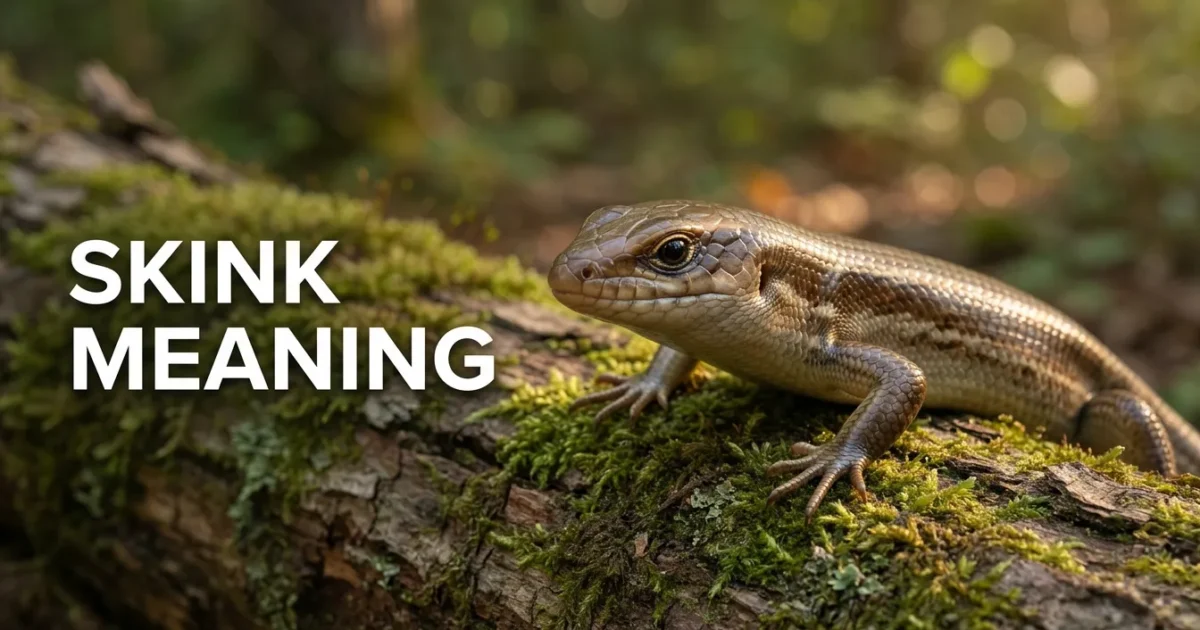
If you searched for skink meaning, the short answer is simple. A skink is a type of lizard with smooth, shiny scales, a slim body, and often short legs. The word comes from the Greek skinkos by way of Latin scincus, and English speakers have used it since the late 1500s.
The word has a few other uses, too. In older English, skink was a verb that meant “to pour a drink.” In Scotland, it also meant a cut of beef from the shin. That is why a famous Scottish fish soup is called Cullen skink. Some people also meet the word in novels, games, and spiritual or dream-meaning websites.
This guide explains every meaning in plain English. You will learn how to pronounce the word, where it comes from, how to use it in sentences, and how skinks differ from geckos, snakes, and salamanders. You will also find examples, related words, common mistakes, and answers to frequent questions.
Quick Answer: What Does Skink Mean?
A skink is a smooth-scaled lizard from the family Scincidae. Skinks live on nearly every continent, and many can drop their tails to escape predators. Less commonly, “skink” is an old word for pouring a drink and a Scots word for a beef shin. It is pronounced “skingk,” like “think” with an “s-k” at the start.
Skink Meaning at a Glance
| Meaning | Part of speech | Short definition | Where you see it |
| Lizard | Noun | A smooth-scaled lizard of the family Scincidae | Science, nature, pet care, everyday speech |
| Pour a drink | Verb (archaic) | To pour out or serve a drink | Old books and historical writing |
| Shin of beef | Noun (Scots) | A cut of meat from the leg | Scottish cooking history |
| Cullen skink | Noun (food) | A thick Scottish soup with smoked haddock | Menus, recipes, food writing |
| Character or race name | Proper noun | A fictional character or creature | Novels and fantasy games |
The lizard meaning is by far the most common today. The other meanings are mostly historical or limited to specific contexts.
What Is a Skink? The Main Dictionary Definition
In modern English, a skink is a lizard that belongs to the family Scincidae. Dictionaries usually describe it as a lizard with a long body, smooth and glossy scales, and short or sometimes very small legs.
Here are the key points that define a skink:
- Smooth, shiny scales: Many skinks look polished, almost like wet stones.
- Slim, tapered body: The body often flows into a long tail without a clear neck.
- Short legs: Some species have tiny limbs, and a few have none at all.
- Movable eyelids: Most skinks have eyelids they can close, and some have a clear “window” in the lower lid.
- Dry, scaly skin: Like all reptiles, they are not slimy.
Skinks are among the largest lizard families in the world. Scientists have described well over 1,500 species, and new ones are still being found. That means “skink” is a broad label that covers many different animals.
How Do You Pronounce Skink?
You say skink as one syllable: /skɪŋk/.
- It starts with “sk,” as in “skate.”
- The vowel is short, like the “i” in “sit.”
- It ends with “-nk,” like the end of “think” or “drink.”
Words that rhyme with skink: think, drink, pink, link, sink, wink, blink, and shrink.
The plural is simply skinks, which you say as “skingks.”
Where Does the Word Skink Come From? (Etymology)
The lizard meaning of skink has a long history. English borrowed the word in the late 1500s from Latin scincus. Latin took it from the Greek word skinkos. Ancient writers used these words for a lizard-like animal, often one from North Africa and the Near East. Some of them also wrote about it as a medicine or remedy.
Beyond Greek, the trail gets uncertain. Dictionaries do not agree on any earlier source, so it is best to say the deeper origin is unclear.
Is It Related to the Scientific Name?
Yes. The family name Scincidae comes from the same Latin root, scincus. Scientists use the related adjectives scincid and scincoid to describe skink-like traits. You will see these terms in biology books and research papers, but not in everyday talk.
The Older Verb “Skink” (to Pour a Drink)
The verb skink has a separate history. It is related to older Germanic words such as Middle Dutch schenken, which means “to pour.” In old English writing, to skink meant to pour or serve drink. A skinker was a person who served drinks, much like a bartender.
This use is archaic, so you will hardly ever hear it today. Two words that look and sound the same but have different origins are called homonyms. This is a good example.
The Scots Word “Skink” (Shin of Beef)
In Scots, skink also referred to the shin or knuckle of beef, and sometimes to a broth made from it. This meaning explains the name of Cullen skink, discussed below.
Types of Skinks: Examples of the Lizard Meaning
Because the family is so large, skinks differ a lot in size, color, and lifestyle. These examples show the range.
| Skink | Where it lives | What makes it notable |
| Blue-tongued skink | Australia, New Guinea, and nearby islands | Shows a bright blue tongue to scare predators; popular pet |
| Five-lined skink | Eastern North America | Young ones have stripes and a bright blue tail |
| Prehensile-tailed skink | Solomon Islands | Grows over 60 cm long, climbs trees, and eats mostly plants |
| Sandfish skink | North Africa and the Middle East | “Swims” through loose desert sand |
| Shingleback (bobtail) skink | Southern and western Australia | Has a short, stubby tail and rough, pinecone-like scales |
| Ground skinks | Many regions | Tiny, quick lizards often seen in gardens and leaf litter |
Skink sizes range from just a few centimeters to well over half a meter. They can be brown, gray, black, orange, or bright blue, so no single look defines the group.
Key Facts That Help Explain the Word
Knowing how skinks live makes the skink meaning easier to remember.
Skinks Can Drop Their Tails
Many skinks can detach their tails when grabbed. This is called tail autotomy. The loose tail wriggles for a while and distracts the predator, so the skink can escape. A new tail grows back, but it often looks different from the original one. This trick is one of the best-known skink traits.
Skinks Live in Many Habitats
Skinks have spread across most of the world. You can find them in forests, deserts, grasslands, mountains, and backyards. They are absent from Antarctica. They are most diverse in places such as Australia, Africa, and Southeast Asia.
Skinks Eat Different Foods
Most skinks eat insects, spiders, and snails. Some, like blue-tongued skinks, eat a mixed diet that includes plants. A few species, such as the prehensile-tailed skink, eat mostly leaves and fruit.
Skinks Reproduce in Different Ways
Some skinks lay eggs. Others give birth to live young. Both strategies occur within the same large family, which is unusual and interesting for a single group of lizards.
Are Skinks Dangerous?
No. Skinks are not venomous, and they pose no real threat to people. A large one may bite if it feels cornered, but this is rare and usually minor. As with any reptile, wash your hands after touching one.
Skink vs. Gecko vs. Lizard vs. Snake vs. Salamander
Many people confuse skinks with other animals. This table shows the main differences.
| Animal | Is it a skink? | How to tell the difference |
| Lizard | A skink is a type of lizard | “Lizard” is the broad group; skinks are one family inside it |
| Gecko | No | Many geckos have sticky toe pads, large eyes, and often lack movable eyelids |
| Snake | No | Snakes have no legs and no external ears; limbless skinks may look similar but still have eyelids and small ear openings in many cases |
| Salamander | No | Salamanders are amphibians with moist, soft skin; skinks are reptiles with dry scales |
| Anole | No | Anoles often have a throat fan (dewlap) and rougher scales |
Is a Skink a Snake?
No. A skink is a lizard. Some species have tiny legs or none, so they can look snake-like at first glance. Still, they are lizards, and most of them have eyelids and ear openings that snakes lack.
Is a Skink a Salamander?
No. This is a very common mix-up, especially with the blue-tailed young of some skinks. Salamanders are amphibians. They have thin, moist skin and usually live near water. Skinks are reptiles with dry, glossy scales.
What Is Cullen Skink?
Cullen skink is a traditional Scottish soup. It is made with smoked haddock, potatoes, onions, and milk or cream. It comes from the town of Cullen on the northeast coast of Scotland.
The word skink in the name does not refer to the lizard. It comes from the Scots meaning of “shin” or “broth,” because older versions of this kind of soup were based on beef shin. Over time, local cooks used smoked haddock instead. The name stayed.
If you see “skink” on a menu, check the context. A dish called Cullen skink is a soup, not lizard meat.
Skink as a Character or Name in Culture
The word also appears in stories and games.
- Novels: Author Carl Hiaasen created a famous character known as Skink, a wild former governor who lives off the land in Florida. He appears in several books, including Double Whammy and Sick Puppy.
- Fantasy games: In the Warhammer fantasy setting, Skinks are small, quick lizard-people in the Lizardmen army, which later became known as the Seraphon.
In these cases, the name borrows the lizard meaning, often to suggest something sly, tough, or wild.
Is There a Slang or Text Meaning for Skink?
There is no widely accepted slang meaning of skink in texting or social media. Dictionaries do not list one. If someone uses the word online, they almost always mean the lizard.
A few tips can help you read it correctly:
- Check the context for animals, pets, or nature.
- Look for typos. The person may have meant “skunk,” “skin,” “sink,” or “think.”
- Treat any unusual “slang meaning” you find on random websites with caution unless a reliable source confirms it.
Spiritual and Symbolic Meanings of a Skink
Some modern websites and spiritual writers discuss the skink spiritual meaning or skink symbolism. These ideas are not tied to one single tradition, so you should treat them as personal or modern interpretations rather than established facts.
Common themes people link to skinks include:
- Renewal and regrowth: This comes from the way skinks can regrow a lost tail.
- Adaptability: Skinks live in many places and adjust to different conditions.
- Caution and awareness: Their quick, watchful movements suggest alertness.
- Survival and escape: The tail-drop trick inspires ideas about letting go to stay safe.
Many cultures have their own beliefs about lizards in general. In some Pacific and Indigenous traditions, for example, lizards carry deep meaning. If you want to understand a specific culture’s view, look for sources written by or with people from that culture rather than general symbolism lists.
What Does It Mean to See a Skink?
In nature terms, seeing a skink usually means you are in a warm, sheltered place with insects. Skinks like sunny spots near logs, rocks, or leaf litter.
In dream interpretation, some people say a skink stands for hidden change or a need to let something go. There is no scientific proof behind dream meanings. Treat them as personal reflection, not fact.
How to Use Skink in a Sentence
These examples show the main meanings in action.
Lizard meaning:
- A small skink darted across the garden path.
- The blue-tongued skink opened its mouth and showed its bright tongue.
- Children watched the skinks sunbathing on the warm rock.
- She found a five-lined skink under a log.
Archaic verb meaning:
- In the old tale, the servant came to skink the wine.
- The innkeeper asked his helper to skink ale for the guests.
Food meaning:
- We ordered Cullen skink and brown bread at the café.
- The recipe uses smoked haddock, potatoes, and cream for a rich skink.
Character meaning:
- Readers love Skink for his wild, rule-breaking spirit.
Synonyms and Related Words for Skink
Skink does not have a perfect one-word synonym, because it names a specific group of animals. You can use broader or related terms instead.
Broader or close terms:
- Lizard: the general group that includes skinks
- Reptile: the larger class of animals
- Scincid: the technical adjective or noun for members of Scincidae
- Scincoid: a technical term for skink-like animals
Related animals people compare with skinks:
- Gecko
- Anole
- Iguana
- Monitor lizard
- Legless lizard
- Slow worm (a legless lizard of Europe)
Related terms in biology:
- Scincidae: the skink family
- Tail autotomy: the ability to drop the tail
- Ectotherm: an animal that relies on outside heat to warm its body
- Oviparous: egg-laying
- Viviparous: live-bearing
Common Misunderstandings About the Word Skink
“A skink is a baby snake. Skinks are lizards, and they are not young snakes. “ This is false.
“Skinks are poisonous.” Skinks are not venomous, and they are not toxic to touch. Some myths in different regions claim otherwise, but there is no good evidence.
“A skink and a skunk are the same.” They are not even close. A skunk is a mammal known for its spray. The two words look alike, which causes typos.
“All skinks look the same.” In reality, skinks vary in shape, color, size, and habitat. Some are tiny and fast, and others are heavy and slow.
“Cullen skink contains lizard.” It does not. The word comes from a Scots meaning related to beef shin or broth.
“A skink is an amphibian.” No. Amphibians have moist skin and usually lay eggs in water. Skinks are reptiles.
Tips for ESL Learners: Remembering the Meaning of Skink
Here are simple ways to remember the word:
- Link it with “think” and “drink.” They share the same ending sound.
- Picture a shiny, smooth lizard. The word “skink” can remind you of “skin,” and skinks have smooth, glossy skin-like scales.
- Remember the main meaning first. Learn the lizard meaning, then add the soup and old verb meanings later.
- Watch for context. If the text is about cooking in Scotland, think soup. If it is about nature or pets, think lizard.
Should You Keep a Skink as a Pet?
Some species, especially the blue-tongued skink, are popular pets. They tend to be calm and hardy. However, they need the right heat, light, space, and food. Rules about owning reptiles vary by country and region, so check local laws before buying one. Wild skinks should be left in nature unless local law and wildlife experts say otherwise. A reptile vet or a trusted breeder can give accurate care advice.
Frequently Asked Questions About Skink Meaning
1. What does skink mean in simple words?
A skink is a lizard with smooth, shiny scales and a slim body. Many skinks have short legs, and some can drop their tails to escape danger.
2. What is the origin of the word skink?
It comes from Latin scincus, which came from Greek skinkos. English began using it in the late 1500s. The deeper origin beyond Greek is unclear.
3. How do you pronounce skink?
Say it as “skingk,” with a short “i,” like in “think.” The plural, “skinks,” ends with an extra “s” sound.
4. Is a skink a lizard or a snake?
It is a lizard. Some skinks have tiny legs or none, so they can look like snakes. Still, they belong to the lizard group.
5. Are skinks poisonous or dangerous?
No. Skinks are not venomous and are not a danger to people. A large one may bite if handled roughly, so treat any wild animal with care.
6. What does Cullen skink mean?
It is a thick Scottish soup made from smoked haddock, potatoes, onions, and milk or cream. The word “skink” in the name refers to an old Scots meaning, not to a lizard.
7. What does it mean to skink a drink?
In older English, to skink a drink meant to pour or serve it. The meaning is archaic today, and you will mostly see it in old texts.
8. Is there a slang meaning for skink?
No widely accepted slang meaning exists. In modern use, people almost always mean the lizard. If the word seems odd in a message, check for a typo.
9. What is the difference between a skink and a gecko?
Skinks have smooth, glossy scales and usually movable eyelids. Many geckos have sticky toe pads and large eyes, and many lack movable eyelids.
10. Why do skinks lose their tails?
Dropping the tail distracts a predator, which gives the skink time to flee. The skink later regrows a new tail, although it often looks different.
11. What does a skink symbolize?
Modern symbolic readings link skinks to renewal, adaptability, and caution. These are personal or cultural interpretations, not scientific facts, and they vary between traditions.
12. Where do skinks live?
Skinks live on every continent except Antarctica. They thrive in forests, deserts, grasslands, and gardens, and they are especially varied in Australia, Africa, and Southeast Asia.
Conclusion
The skink meaning most people want is straightforward. A skink is a smooth-scaled lizard from the family Scincidae, found across much of the world. It is harmless to humans, often shy, and famous for its ability to drop and regrow its tail.
The word also has other uses that can confuse readers. It was once a verb for pouring drinks, and it was a Scots word for a beef shin, which explains the name Cullen skink. It also appears as a character name and a fantasy creature. There is no established slang meaning, and spiritual interpretations vary between sources.
Whenever you meet the word, look at the context. Nature, pets, and science point to the lizard. Food and Scotland point to the soup. Old literature may point to pouring a drink. With these clues, you can understand and use skink correctly in any situation.

Cole Jaxson is the administrator of SymbolPeak, overseeing site management and content integrity. He is dedicated to presenting Bible-based spiritual symbol meanings with accuracy, reverence, and clarity, ensuring the platform remains trustworthy, well-organized, and aligned with biblical teachings and faith-centered understanding for readers worldwide.