Time symbolism is one of the most profound and universal concepts, reflecting change, mortality, growth, and the passage of life itself.
From ancient cultures to modern society, time has been seen not just as a measurement but as a powerful symbol that shapes human understanding, emotions, and purpose.
Whether represented through clocks, seasons, or cycles, time symbolism helps us make sense of beginnings, endings, and everything in between.
Time Symbolism Meaning (Clear Definition)
Time symbolism refers to the deeper meaning and interpretation of time as a concept beyond its literal measurement. Symbolically, time represents:
- The passage of life
- Change and transformation
- Mortality and impermanence
- Cycles and continuity
In simple terms, time symbolizes both limitations and opportunities it reminds us that life is finite, yet constantly evolving.
What Does Time Symbolism Represent?
Time symbolism carries multiple layers of meaning depending on context. At its core, it represents:
- Change: Nothing stays the same forever
- Aging: The natural progression of life
- Cycles: Repeating patterns like day and night or seasons
- Opportunity: Every moment offers a new chance
- Mortality: A reminder that life has an end
Quick Summary Table
| Symbolic Aspect | Meaning |
| Clock | Urgency, awareness, deadlines |
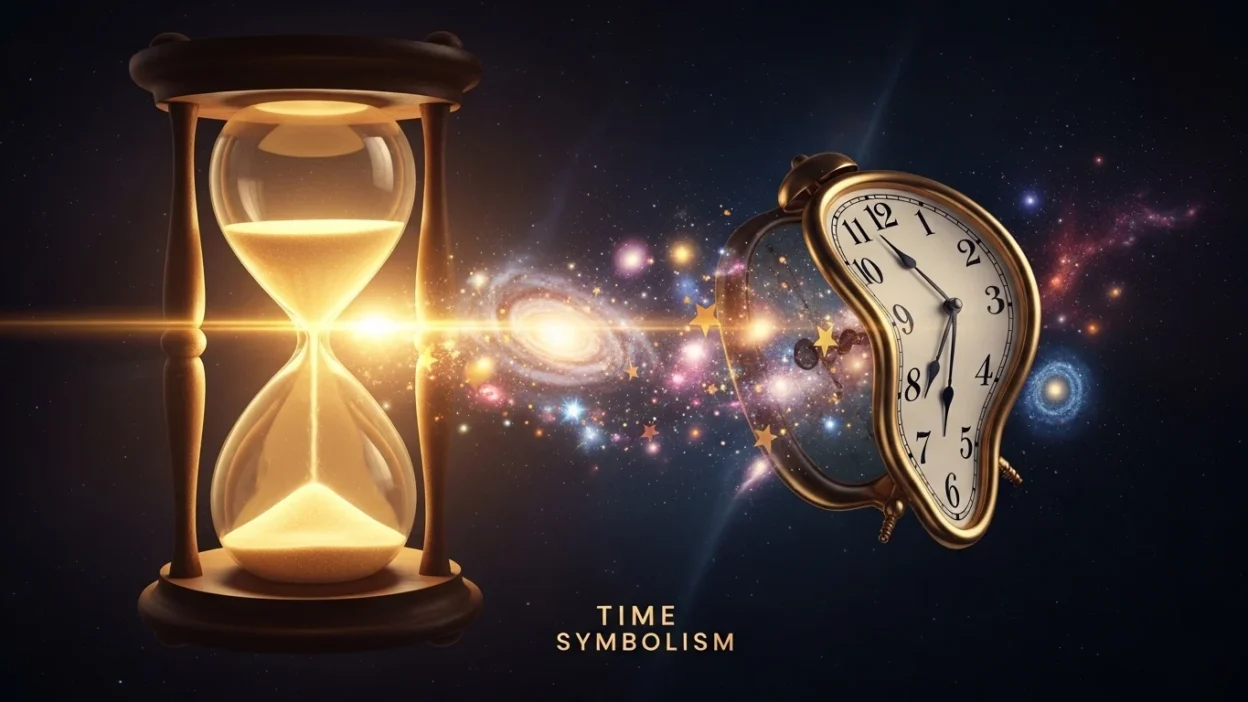
| Hourglass | Finite life, balance between past and future |
| Seasons | Life stages and natural cycles |
| Sunrise | New beginnings |
| Sunset | Closure, endings, reflection |
Spiritual Meaning of Time Symbolism
Spiritually, time symbolism often reflects the journey of the soul. It suggests that life unfolds in divine timing, where everything happens for a reason.
Key spiritual interpretations include:
- Divine Timing: Events occur when they are meant to
- Eternal Soul: Time is temporary, but the soul is timeless
- Growth and Lessons: Each phase brings spiritual learning
- Presence: The importance of living in the present moment
Many spiritual traditions emphasize that true peace comes from aligning with the natural flow of time rather than resisting it.
Biblical / Religious Meaning of Time Symbolism
In religious contexts, time symbolism is closely tied to divine order and purpose.
In the Bible, time is often seen as:
- God’s Plan: Everything happens according to divine will
- Seasonal Wisdom: “A time for everything” reflects life’s balance
- Judgment and Eternity: Time leads to spiritual accountability
Across religions, time is viewed as both sacred and purposeful, guiding human actions and moral decisions.
Time Symbolism in History and Culture
Throughout history, civilizations have used time symbolism to understand existence and organize life.
- Ancient Egyptians: Linked time with cycles of rebirth and the afterlife
- Greek Philosophy: Viewed time as both linear and eternal
- Eastern Cultures: Emphasized cyclical time, such as karma and rebirth
- Medieval Europe: Focused on time as a path toward salvation
Cultural interpretations vary, but they all recognize time as a force that shapes destiny and meaning.
Time Symbolism in Literature and Art
In literature and art, time symbolism is often used to explore deep human emotions and philosophical ideas.
Common themes include:
- Fleeting Moments: Capturing the beauty of temporary experiences
- Aging and Memory: Reflecting on the past
- Inevitability: The unstoppable passage of time
- Contrast: Youth vs. old age, past vs. future
Artists and writers frequently use clocks, shadows, and seasons to visually and emotionally represent time’s influence.
Dream Meaning of Time Symbolism
Dreaming about time often reflects your subconscious thoughts about control, urgency, or life direction.
Common interpretations:
- Running out of time: Anxiety or pressure in waking life
- Stopped clock: Feeling stuck or uncertain
- Rewinding time: Regret or desire to change the past
- Fast-moving time: Fear of missing opportunities
Such dreams encourage self-reflection and awareness of how you use your time.
Modern Meaning of Time Symbolism
In today’s fast-paced world, time symbolism has evolved to represent productivity, balance, and mindfulness.
Modern interpretations include:
- Time as Currency: “Time is money” mindset
- Work-Life Balance: Managing priorities effectively
- Mindfulness: Living fully in the present
- Self-Improvement: Using time wisely for growth
People increasingly see time as a valuable resource that must be protected and used intentionally.
FAQs
What does time symbolize in life?
Time symbolizes change, growth, and the limited nature of human existence, reminding us to value every moment.
Why is time considered powerful symbolism?
Time is powerful because it governs all aspects of life, from birth to death, and influences every experience.
What does an hourglass symbolize in time symbolism?
An hourglass represents the finite nature of life and the balance between past, present, and future.
Is time symbolism positive or negative?
It can be both time symbolizes opportunity and growth, but also mortality and endings.
What is the spiritual lesson of time symbolism?
The key lesson is to trust the process of life and focus on the present moment rather than fearing the future.
Conclusion
Time symbolism reminds us that life is constantly moving, changing, and evolving. It teaches patience, awareness, and appreciation for each moment we experience.
By understanding its deeper meaning, we can live more intentionally and embrace both beginnings and endings with wisdom.