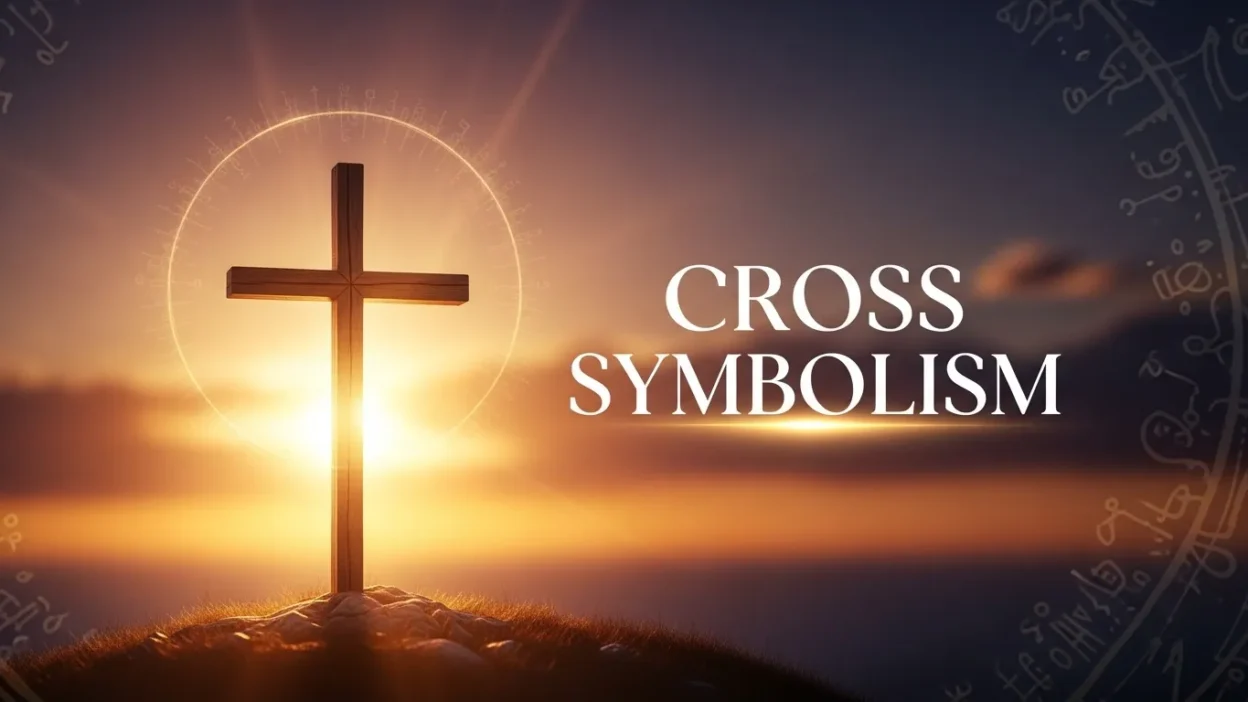
Cross symbolism is one of the most powerful and recognizable symbols in human history.
While many people immediately connect it with Christianity, the cross carries deeper meanings that extend far beyond religion.
Across cultures and centuries, it has represented faith, sacrifice, protection, balance, and the connection between heaven and earth.
Understanding cross symbolism helps us see how a simple geometric shape can carry profound spiritual, emotional, and cultural meaning.
Cross Symbolism Meaning (Clear Definition)
At its core, cross symbolism represents the intersection of two lines often understood as the meeting point between the physical and spiritual worlds.
In simple terms, the cross symbolizes:
- The union of opposites (heaven and earth, spirit and matter)
- Sacrifice and redemption
- Faith and devotion
- Protection and divine presence
- Balance and harmony
The vertical line is often seen as divine connection, while the horizontal line represents earthly existence. Together, they form a powerful symbol of unity.
What Does Cross Symbolism Represent?
Cross symbolism represents multiple layered meanings depending on cultural and spiritual context.
Here’s a quick summary:
| Symbolic Aspect | Meaning |
| Faith | Trust in divine power |
| Sacrifice | Selflessness and redemption |
| Protection | Spiritual safety |
| Balance | Harmony between forces |
| Hope | Renewal and salvation |
| Transformation | Growth through struggle |
Because of its simple shape, the cross also symbolizes direction (north, south, east, west) and the structure of the universe itself.
Spiritual Meaning of Cross Symbolism
Spiritually, cross symbolism reflects the journey of the soul.
The vertical axis represents spiritual growth reaching upward toward higher consciousness. The horizontal axis symbolizes human relationships and earthly experience. Where they meet is the heart the center of awareness.
Many spiritual traditions view the cross as:
- A symbol of inner awakening
- A reminder of divine guidance
- A sign of spiritual protection
- A pathway to transformation
In meditation and sacred geometry, the cross can represent alignment mind, body, and spirit in balance.
Biblical / Religious Meaning of Cross Symbolism
In Christianity, cross symbolism is deeply connected to the crucifixion of Jesus Christ. It represents sacrifice, forgiveness, redemption, and eternal life.
The Christian cross stands for:
- The sacrifice made for humanity’s salvation
- Victory over sin and death
- Unconditional love
- Resurrection and hope
However, the cross predates Christianity. Ancient cultures used cross-like symbols long before biblical times, often representing the sun, life force, and cosmic order.
One well-known ancient example is the Ankh, an Egyptian cross symbolizing life and immortality.
Cross Symbolism in History and Culture
Throughout history, cross symbolism has appeared in many civilizations:
- Ancient Egypt (life and eternity)
- Celtic cultures (nature and eternity)
- Greek symbolism (balance and structure)
- Native traditions (four sacred directions)
The Celtic Cross combines a cross with a circle, representing eternal life and unity. It merges spiritual belief with ancient sun symbolism.
In medieval Europe, the cross became a sign of identity, protection, and faith during wars and pilgrimages.
Cross Symbolism in Literature and Art
In literature and visual art, cross symbolism often represents suffering, sacrifice, or moral struggle.
Writers use the cross as a metaphor for:
- Bearing burdens
- Personal sacrifice
- Redemption arcs
- Inner conflict
In classical paintings and Renaissance art, the cross symbolizes spiritual devotion and divine presence. Artists have used it not only as a religious symbol but also as a visual representation of hope rising from suffering.
Dream Meaning of Cross Symbolism
Seeing a cross in a dream can carry several meanings depending on the context.
Common interpretations include:
- A need for spiritual guidance
- A period of sacrifice or challenge
- Protection during difficult times
- A call to restore balance in life
If the cross appears glowing or peaceful, it may symbolize reassurance and faith. If it appears heavy or broken, it could reflect emotional burdens.
Dream interpretation depends heavily on personal beliefs and emotional experiences.
Modern Meaning of Cross Symbolism
Today, cross symbolism goes beyond religion.
Many people wear cross necklaces not only as a sign of faith but also as a symbol of:
- Identity
- Strength
- Protection
- Hope
- Personal transformation
In modern spirituality, the cross is sometimes seen as a symbol of alignment grounding yourself while reaching for higher awareness.
It also appears in fashion, tattoos, jewelry, and art, where it can represent both spiritual devotion and personal resilience.
Frequently Asked Questions
What is the basic meaning of cross symbolism?
Cross symbolism represents faith, sacrifice, balance, and the connection between heaven and earth.
Is cross symbolism only Christian?
No. While strongly associated with Christianity, cross symbolism existed in ancient cultures long before Christian traditions.
What does a cross symbolize spiritually?
Spiritually, it represents growth, protection, divine connection, and harmony between physical and spiritual worlds.
What does dreaming of a cross mean?
Dreaming of a cross often suggests guidance, protection, sacrifice, or a need for inner balance.
Why do people wear cross jewelry?
People wear cross jewelry as a sign of faith, protection, identity, hope, or personal strength.
Conclusion
Cross symbolism is far more than a religious emblem. It is a timeless symbol of sacrifice, balance, protection, and transformation.
If viewed through a spiritual, historical, or personal lens, the cross continues to remind us that growth often comes through struggle and that hope can rise even in the darkest moments.